Listen on Spotify
 Apple Podcasts
 Audible

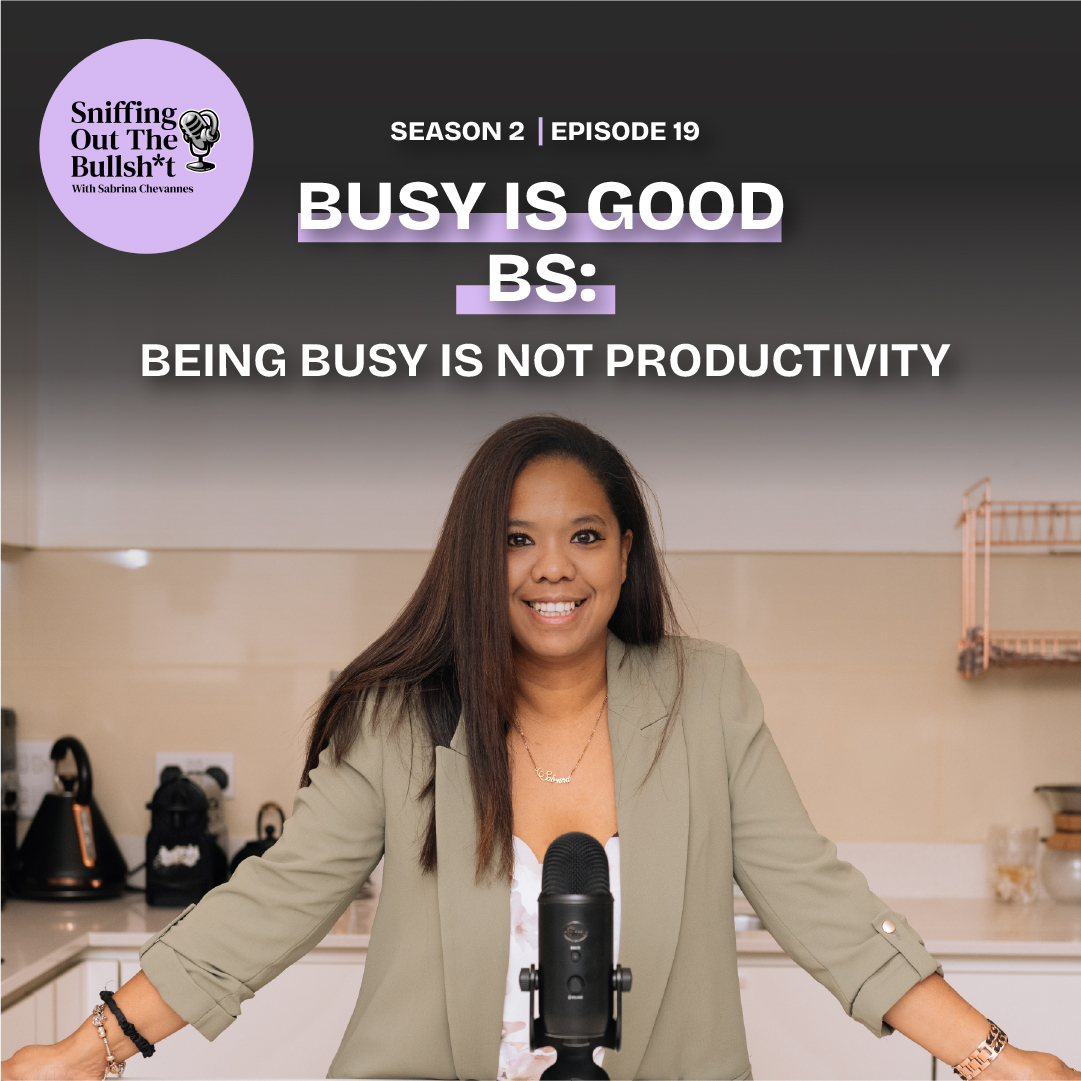
“Being constantly busy is proof of productivity and importance.”
Sniffing Out the Bullsh*t · Season 2 · Episode 19
Being Busy Is NOT Productivity
This episode examines “Being Busy Is NOT Productivity”, showing why busyness measures activity; productivity measures progress on outcomes that matter. The two can diverge dramatically.
Myth vs reality.
Busyness measures activity; productivity measures progress on outcomes that matter. The two can diverge dramatically.
Episode summary
Measure productivity by meaningful progress, not activity
You worked all week. Your calendar was full. Your to-do list was endless. You were busy from morning to night. So why does your business feel exactly the same? In this episode of Sniffing Out the Bullsht*, we’re unpacking the biggest lie entrepreneurs tell themselves about productivity – and why being busy might be the very thing keeping you stuck.
If you’ve ever ended a week exhausted but unsure what actually helped drive the business forward… this one’s for you. Because busyness isn’t business.
Key takeaway
Measure productivity by meaningful progress, not activity; remove work that keeps you occupied without moving an important outcome.
Short clips.
One useful idea.
Watch the argument in context and continue on the original platform.
Listen, skim or read every word.
This is the maintainable version: the summary, chapters and transcript all originate from the same approved transcript.
The Entrepreneur's Busy Trap: Why We Confuse Activity with Results +
Have you ever had one of those weeks where you’re just completely shattered?
Where you’ve had a completely full calendar, like an endless To Do List?
You’re still answering emails at like 10:00 PM, You’ve played musical chairs with meetings, you’ve recorded content, you’ve spent time engaging on social media, and you ticked a turn of things off your list.
Busy.
But at the same time, you then do a view of your week and you’re like, OK, what progress was actually made this week to move the business forward?
And you realize you don’t actually know because you didn’t bring in any revenue or increase your pipeline.
You didn’t book any speaking gigs for yourself, your margins haven’t improved and your processes don’t even feel any better.
But you’re shattered and you were insanely busy like all week.
So how have you not made any progress?
I’ve definitely had many of those weeks until I realized what I was doing.
And I know that you have had those weeks too.
So today we’re sniffing out the bullshit around productivity and busyness because I think we’ve just been sold a version of productivity that rewards activity and not results.
Hello and welcome to Sniffing Out the Bullshit, a podcast for ambitious entrepreneurs who want help raiding their way through the bullshit jungle of entrepreneurship and then the tools, skills, and mindset that actually required for success.
I’m your host, Sabrina Chevannes-Denman, the no bullshit entrepreneur.
The Pitfalls of Performative Productivity and Aesthetic Tools +
So I think the main problem with all of this is that people confuse busyness with productivity.
Like if you’re constantly doing things like talking to people, creating content, checking things off your To Do List, then you feel productive, right?
But we’re forgetting what we’re actually trying to achieve our main goals.
Instead we’re focusing on the outputs, like how many emails we’re sending, how many posts we’re writing, and how many meetings we’re doing.
However, we’re not analyzing how much closer we are getting to our goals, whether even any of the work that we did was in relation to any of them, or were they for something that we thought we should be doing but doesn’t actually contribute to our bottom line because this happens all the time.
So if we look at the contents of our new productivity, it’s all so inspirational.
You’ve got your 5:00 AM morning routines and people bragging about how they’ve smashed all their goals before 8:00 AM when people are just waking up.
Those lazy people just waking up at 8:00 AM.
And then you’ve got the crazy notion boards, which track pretty much every piece of data.
It plans out everything in detail, and accounts are pretty much every scenario that could ever possibly be.
And then you have your Google calendars, which are now all about being aesthetic, the themed colours and, you know, schedules where every minute of the day is just accounted for, for ultimate productivity.
Plus they look pretty.
Honestly, wherever you look, someone’s got a new tool and a hack to save you 10 hours per week.
I mean, hell, I’ve even got some of those tools on my own website.
But hasten to add, the difference is I don’t do performative productivity.
Like I’m genuinely constantly optimizing my business to find the best ways to get more done with a lot less stress.
So I’ve then developed techniques to be as efficient and focused as possible.
And a lot of the time I’m not even using half these tools that people are promoting.
Like I absolutely trying all of these products when I was still working out my processes, I bought all the cool templates, the apps, etcetera, all the things that promised me ultimate to productivity.
And some were beautiful.
Like I absolutely loved them.
Like I I’m all for a beautiful design.
I mean, obviously, I literally run a design agency, so I love that stuff.
But what I quickly realize is that somehow I managed to spend more time organizing things in the app than doing the actual work.
I mean, it would take ages to set up these pretty to do lists, to design the calendars and to plan my fancy schedule.
And so instead I just thought I’m just going to write them down.
Because literally just writing all this stuff in my notebook was way quicker and way easier.
So when it came to me doing my time audit that I do regularly, I saw how many hours I hope a week I was spending on organizing myself and I realized just how counterproductive it was.
The thing is, I felt busy, like I had these really cool tools and I was checking things off.
Like I was getting so much done, but I was somehow not achieving any of my goals because I realized I wasn’t actually being productive.
I was just really busy.
How Meetings, Emails, and Comms Become 'Work About Work' +
And I also had so many meetings on my calendar that were pretty much unnecessary.
Like there’d be 30 minutes or even at an hour calls that could easily have been 5-7 minutes.
But you know, the usual chit chats and all the faffing.
And because we like allocated that time in the calendar, then we used up that time because they were allocated that way.
It’s classic Parkinson’s law, right?
And plus, right, they could have often achieved the same goal from these meetings with one e-mail.
But so many people think meetings feel productive, like they’re doing something.
So they often schedule them in to look busy.
And now like networking meetings are very different.
I mean, because they are all about building relationships, right?
So you want to spend more time with these people naturally, like connecting and building up the trust.
However, it wasn’t until so many of these business owners I was networking with would be like, Oh my God, I’m so busy.
And they all just seemed proud of it.
Like, I mean, it was this really cool thing to say.
I’m busy almost was equated with success.
And that’s when I realized something was seriously wrong.
Like so many people said to me, because busy is good, right?
I started to think, is it me?
Like because we’ve done business into a badge of honour and especially as entrepreneurs, I feel smart, virtuous to say I’ve been so busy, but I’m like, we’re busy doing what?
Because there’s a huge difference between movement and momentum.
I just think most founders don’t realize they’re completely confusing the 2.
Now, according to Sauna’s Anatomy of Work report, right, employees apparently spend 60% of their time on what they call work about work.
And just because it’s this, this is they’ve included this like as emails, meetings, status updates, chasing approvals and admin.
So more than half of the work they do is not even work, which is nuts.
And then there’s Microsoft’s work trend index.
And in that report, they found that employees spend 57% of their time just communicating and that’s with emails, chats and meetings.
So that original 60% from Asana probably actually higher because they’ve not included all the chats, right?
So think about your daily comms, you’ve got Slack, you’ve got WhatsApp, Discord, text messages, you’ve got messages within the project management software like Asana, for example.
Like you’ve got a tonne of different ways of communicating and you’re constantly having to update people.
And then most of the day is wasted on this.
And then there’s very little time to actually do any real work.
And if these employees are not actually set up with the right systems and are not prepared for deep work sessions, then they’re not even going to get their work done properly because they’re going to get distracted by all these comms channels and then their work won’t be as good when they actually get around to doing it.
It’s crazy.
So right, yes, right.
These these reports are about employees rather than business owners.
But just think about your own schedule for a moment.
Do you know what percentage you spend on all this stuff compared to the real work?
Because I think for some business owners, that number is going to be way higher than 60%, especially if you’re not at the stage where you have like a strong team around you and you’ve got people to help you with all these things.
So let me ask you something.
Are you also spending most of your week like these people, coordinating, replying, tweaking, maintaining all that sort of stuff?
Are you spending more time reacting rather than advancing?
Because this is very common now.
Busyness as a Status Symbol: Why We Avoid Truly Impactful Work +
And so much so that Harvard Business of you has written about how busyness has somewhat become a status symbol in Western business culture because somehow being busy signals importance.
But I don’t know, I just think we’re looking at this all wrong because importance.
It’s just not the same thing as impact.
I know which I’d rather have, but I don’t know.
The problem with us founders, I think, is that we don’t have bosses, so we don’t have anyone grading our output.
So how do we measure productivity?
Is it things like number of tasks completed, the number of hours you’ve worked, how many emails you’ve cleared or how much content has been posted or how many meetings have been books?
Like is it as these sort of things?
Because I know some founders who definitely use these as KPIs or markers for their productivity.
But the problem is none of these things guarantee things that are actually important to the business.
Things like revenue growth, like better margins or stronger positioning or clearer strategy.
These are the things that really matter because you know, you can post every single day and still be invisible.
You could attend millions of networking events and still have no pipeline and you could launch like 3 new offers every week and still have weak demand.
Like honestly, I see this all the time.
People are doing so much work but nothing actually shifts.
It’s more motion and just less traction.
And now I get it right.
There’s clear psychology that explains why being busy feels so good.
Because you know when you tick off those tasks, that gives you dopamine and your brain loves this.
It loves a quick win because that’s what it is.
You know when you achieve inbox zero, that feels productive.
When you decide to reformat your website, that feels productive.
Even if you like a researching tools for three hours for your business, that also feels productive.
But what about things like reviewing your pricing strategy and trying to raise them to be more profitable?
What about making a difficult sales call that could be a bit awkward, or killing a product that isn’t working and making that decision when changing your positioning so that you were clearer to your audience?
What about those things?
Because they’re the things that really make a difference to your business, but those are also the things that leave you feeling maybe risky and uncertain, maybe even a little exposed.
And so your nervous system would rather spend hours tidying your CRM or something than having an uncomfortable conversation about money.
So you convince yourself I’m being productive with this stuff.
But sometimes what you’re really doing is just avoiding the thing that would actually move the business.
So this is where you need to realize that a lot of this being busy stuff is just bullshit.
The really uncomfortable reality that you to face is that you can do things like post daily, send newsletters, build your funnels, attend events, rewrite your pitch deck or optimize your landing pages.
You can do all of those things and still not work because unfortunately no amount of activity is going to, you know, for the sake of activity.
There is like the just doing things for the sake of it.
None of that’s going to fix like a weak value prop or you’re poor targeting and somewhat confused positioning, or if you’ve got no clear sales process and terrible margins, you’re not going to solve that because you need a deep analysis of your business and real strategy to solve those things.
Now I see all the time there are fundamental issues within a business, but instead of taking the time to deal with those issues, founders are busy looking for hacks and tools that make them feel good at the moment.
And you know, there’s business influences that everywhere.
They’ve all apparently found success in their businesses using these tools and hacks apparently.
So naturally it’s going to wave a magic wand that yours too.
That’s what they think.
So you know, it’s it’s it’s painful to see.
I see all the time.
But the problem is, is that Productivity Tools aren’t going to solve a clarity problem and time blocking isn’t going to solve a strategy problem.
And just working long hours is not going to fix going in the wrong direction with your business.
And so just like any doctor will tell you if you come in sick, you can’t just treat the symptoms.
You need to deal with the underlying course.
And This is why I always come back to, which is why people know me as a small business diagnostician, because I like to diagnose in a business rather than just throw like temporary solutions at the symptoms.
Because in medicine, we know that we could happily just take some drugs to feel better temporarily, but we need to have a difficult conversation or investigate much deeper and deal with the real issues if we really want to get truly better.
But that’s the hard part and it’s definitely not fun.
It’s much easier to just pop a pill and pretend everything’s OK.
But the problem is, you know things will come back to bite you in the arse if you just do that.
So please stop popping pills in your business and deal with the underlying cause to your problems so that you can fix them and move on with a better future.
Defining Real Productivity, a Weekly Test, and Final Actions +
And so I guess the question is, is what is real productivity then?
Because if it’s not being busy and checking things off our to do lists and meeting other people and stuff like that, what is it?
Well, real productivity isn’t about doing more.
It’s about doing fewer things that truly matter.
So while busyness looks like the things I mentioned earlier, the content creation, the meetings, the emails, the To Do List, all that sort of stuff, productivity actually looks more like having just one strong sales conversation.
It’s making a bold positioning decision, It’s creating a strategic shift, and it’s making a difficult but necessary change in the business.
It’s the things that truly help you get closer to your goal.
Do you know what?
It might not even require you to talk to a single person or even type one letter on your keyboard.
It could just be really serious thinking time.
Because the most productive find founders that I know are often working offline.
They don’t go anywhere without a notebook and pen.
They get away from the distractions of the digital world and instead they just brainstorm on paper.
So they get clarity without the noise from others.
And then they map out all the information they have in a visual way so they can make a strategic decision to move the business forward.
Obviously, the truly productive founders don’t actually look busy from the outside, they look calm.
That’s because they’re not reacting all day.
Instead, they’re protecting their thinking time to make big decisions.
They’re prioritizing leverage and they’re measuring the outcomes rather than the effort.
So if you’re listening to this now, try and decide, trying to decide like if you’ve been busy or you’ve been productive.
I’m going to give you a simple test you can do at the end of each week.
I want you to ask yourself, what did I do that directly increased revenue and what did I do that strengthened my long term position?
And what uncomfortable action did I avoid?
And then I want you to go and ask yourself, if you deleted half your tasks on your To Do List for the next week, would your revenue actually change?
Because if the honest answer is probably not, then I think you know what I’m going to say.
Because it seems to be you’re essentially just maintaining your business and not moving it forward.
And now maintenance is definitely important, but it’s certainly not growth.
So if you feel busy right now, but you also feel stuck, like you’re not making any progress, then you’re not alone.
It’s exactly why I’ve done this episode, because most of the founders who come to me for help are busy but not productive.
And it doesn’t mean you’re lazy or incapable, and it certainly doesn’t mean you’re behind.
It might just be that you’re measuring the wrong thing.
But I will tell you something.
The answer is not another productivity app.
And it isn’t waking up earlier either, or developing a killer morning routine like the influencers do.
And it certainly isn’t working longer hours like the hustle Bros say to do.
It’s about working on the right things in the business.
It’s about staying focused on what really matters, staying on track for your goals and not doing what others say to do just because it looks aesthetic and just because it feels good, it doesn’t mean it’s productive.
Because if you’re constantly working but not making progress, then something is up.
And it might be a fundamental issue in your business operations.
It may be a positioning issue within your market, or it may just be as simple as you’re keeping yourself busy with the wrong things.
So this episode is your sign to get really self critical with your business.
And sometimes remember, the most productive thing that you can do is to just stop and ask yourself, is this actually moving me forward?
Because remember, don’t confuse busyness with business.
So I think it’s a good place to end there.
And I hope you enjoyed this week’s episode.
And you know, maybe it was a bit of a wake up call if you’ve been feeling productive, but nothing seems to be getting done.
But if you know others who are suffering with the same issues, then please do share this episode with them.
But until next week, please keep sniffing out the bullshit.