

Do you know what’s funny?
It feels like every brand woke up 1 morning, looked around and went right team, let’s go save the planet.
Because suddenly every company is like eco conscious and every coffee cup is compostable and every corporate website has a nice leafy green banner with the words sustainable, carbon neutral and ethical sourcing written all over them.
And do you know what?
I’d be all up for this as I believe in doing your bit for the planet.
But The thing is, it’s become less about helping the planet and more about helping their own PR.
Everyone jumped on this sustainability train during COVID when I feel like they thought the world was about to end.
But now they’ve shifted to being obsessed about money.
I mean, even more so than they were before.
So now wild world, world burns.
Quite literally.
Some of these brands are using climate change as a marketing strategy.
Annoyingly, many are benefiting from it.
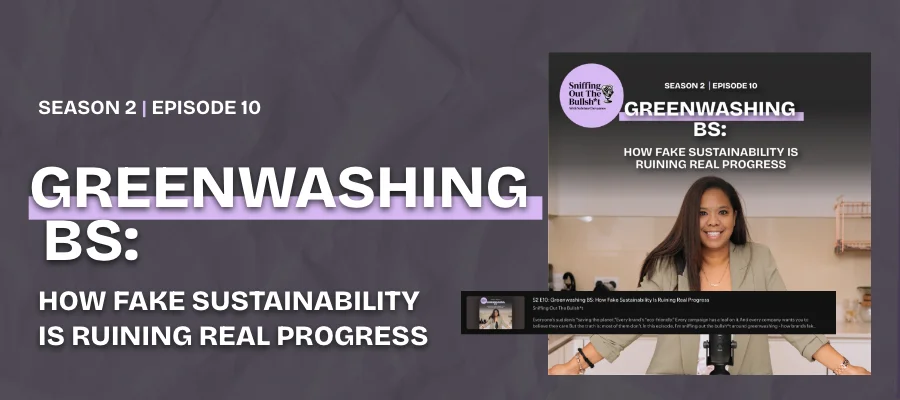
So in today’s episode, we’re sniffing out the bullshit behind greenwashing, which is basically how businesses bake sustainability for clout and how you can spot the signs and how real change makers can rise above the noise.
Hello and welcome to Sniffing Out the Bullshit, a podcast for ambitious entrepreneurs who want help wading their way through the bullshit jungle of entrepreneurship and then the tools, skills, and mindsets that are actually required for success.
I’m your host, Sabrina Chevannes, the no bullshit entrepreneur.
So the myth is simple.
If a company says it’s sustainable, it probably is.
We want to believe that, don’t we?
Because honestly, it just makes life easier.
We want to think that buying that eco detergent or the green T-shirt somehow cancels out the guilt of existing on a melting planet.
And brands know this.
They’ve realized that sustainability isn’t just good ethics, it’s good business.
Because in 2023, PwC did this like Global Consumer Insights survey and they found that 78% of customers are more likely to buy from companies that they perceive as environmentally responsible.
So obviously now every boardroom has a sustainable strategy and every like boardroom then employs this PR firm, which is Uber expensive to try and make it sound inspirational and you know, legit basically.
Basically suddenly every company has a conscience.
Like banks are talking about their carbon footprints, oil companies are posting pictures of wind farm to God sakes, and fast fashion brands are releasing conscious collections that somehow still include polyester.
So when you dig deeper, it’s rarely about the impact, It’s about image.
So take that airline that plants trees for every flight while still adding new routes every month, or the tech giant promising to be net 0 by 2030, yet relying on cobalt mined under horrific conditions.
It’s kind of ridiculous, but he’s the genius of the myth.
They’re not lying outright, they’re just saying things that sound true enough, such as eco friendly, ethically sourced, 100% natural.
These words are unregulated.
They mean absolutely nothing without context.
And according to the European Commission’s 2021 study, 53% of green claims online were vague, misleading or entirely substantiated, IE made-up, and another 40% had no supporting evidence at all.
So let’s think about that for a second.
More than half of what we read about green products could be complete fiction.
And sometimes it’s not just clever wording, it’s deliberate deception.
Do you remember Volkswagen’s clean diesel scandal?
They literally built an entire global campaign around the idea that their cars were environmentally friendly.
Except they weren’t.
They’d literally installed software in their engines to cheat emission tests.
So the cars appeared clean in the lab while emitting up to 40 times the legal limit of nitrogen oxides on the road.
And the result of this?
Well, thank goodness they got caught and they received billions in fines.
Their executives were charged and the trust completely shattered.
It’s a perfect example of what happens when sustainability becomes basically a sales pitch instead of a principle.
As I said, I’m all for people doing good stuff for the environment, but there’s a danger attached when people are manipulative with it all.
When everyone claims to be sustainable, the word basically stops meaning anything.
It’s a lot like how I complain about the word authentic losing all meaning with all the personal brand guru is claimed to be authentic while manufacturing everything about themselves.
It’s very similar.
So with sustainability, when consumers can’t tell the difference between marketing and meaningful action, they start to switch off.
And that’s the real damage of the myth.
It doesn’t just trick buyers, it cheapens the work of companies who are actually are doing the right thing.
Which sucks.
It’s like the business version of virtue signaling.
And disgustingly, it works because people want to feel like they’re making good choices without giving up convenience, comfort or cost.
So brands aren’t selling products anymore, they’re selling absolution.
And I see this all the time in the entrepreneurship space too.
I’ve had clients proudly tell me we’re a sustainable business.
And when I ask how, they say something like, oh, well, we use like, digital business cards instead of paper.
I mean, great, every little helps and all that, but that’s not exactly saving the planet, is it?
So this myth allows people to pat themselves on the back for doing the bare minimum and call it purpose.
So when a company says they’re saving the planet, what they really mean is we found a way to sound progressive without changing a damn thing.
And that, my friends, is where the real bullshit begins.