

All right.
So we’re a couple of weeks into the year now and I wanted to check in on you.
How are your New Year’s resolutions going?
Because most people have already failed them by now.
So if you’re still going, then get on you.
And when I say most, I mean over 90% of people have already failed the resolutions.
And we’ll get into the science of why that is a bit later on, but I want to talk about a similar topic, one that’s totally connected to it, of course, but it’s the whole new year, new you bullshit.
It’s not necessarily resolutions, it’s just this particular phrase and movement.
Let’s say, like how many times have you seen this already whilst scrolling through Instagram or LinkedIn?
Like coaches, founders, fitness brands, productivity apps, etcetera.
They’re all pushing this message and, and just so we’re clear, I’m not criticizing people who want to change, right?
I believe that wanting change is human and wanting growth is a good thing.
I totally believe in setting goals.
However, what I don’t believe is the idea that you’re supposed to radically invent yourself overnight because the calendar just flipped from December the 31st to January the 1st.
That idea isn’t just unrealistic, it can actually be harmful.
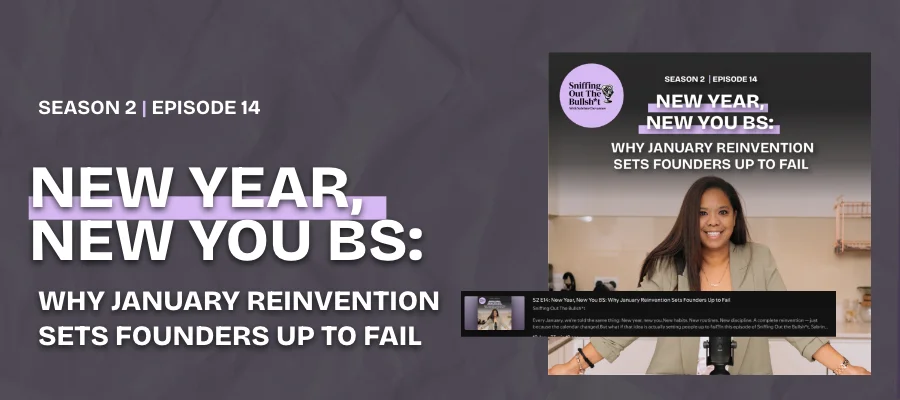
So today we’re sniffing out the bullshit behind the whole New Year, New U mantra, why it keeps failing people, and why founders feel it especially hard, and what actually works instead.
If you want real progress this year, hello and welcome to Sniffing Out the Bullshit, a podcast for ambitious entrepreneurs who want help wading their way through the bullshit jungle of entrepreneurship and then the tools, skills, and mindset that actually required for success.
I’m your host, Sabrina Chevannes, the no bullshit entrepreneur.
OK, so let’s look at why I think New Year, New Year is kind of bullshit.
Well, it promises this clean slate, a reset, as the kids are calling it these days.
Some sort of like chance to become a totally different version of yourself.
You set new habits, you embark on new routines, you have new discipline, new energy, new power, and basically a new personality, apparently.
Now, look, I get it.
December is usually utter chaos, right?
You’ve eaten and drank far too much.
You’re feeling guilty about that gluttony and the extra weight you’ve put on.
You’ve then like spent far too much money on presents but also on yourself and going out for the million Christmas parties that you invited to.
And you’ve got no routines as you’ve taken that much deserved rest.
And those people shut up shop for the holidays anyway, right?
So your brain is then probably fried from watching too many Christmas movies, being around the kids all the time, and catching up with basically every single friend you haven’t seen since the summer.
So I haven’t been here.
So yeah, I mean, after that kind of December, the idea of a complete reset sounds so appealing and hopeful and even somewhat empowering.
And it’s why gym memberships do so well in January and those juice detoxes always seem to have an offer on and alcohol free drinks have a big boom, right?
January 1st comes and we’re like, OK, let’s just start again.
But the problem is, it’s not like you’ve got some new iOS update and you just shut yourself down on September 31st and boot up version 2 point O on January 1st, or version 25 point O depending on how long you’ve been making these news resolutions for Now, I’m afraid that you actually wake up on January the 1st with the same old nervous system as you normally have.
You have the same habits, the same responsibilities, the same capacity, and the same context you always had.
Nothing magical happened overnight apart from a date change.
But this myth of the New Year, New me thing tells you otherwise, right?
It tells you that this is your moment and this time will be different.
So that’s where things start going wrong.
Because New Year, New you doesn’t just suggest improvement, it implies replacement.
It quietly suggests that the version of you that existed before January wasn’t actually good enough.
It wasn’t disciplined enough or focus enough, and it wasn’t doing life properly.
So instead of building on who you already are, you’re like, encouraged to abandon that version completely.
And that’s a really important distinction, because growth isn’t about becoming someone else.
It should be about adjusting how you operate within the reality of your life.
But the myth somehow skips that part.
It jumps straight to the extremes, the extreme routines and extreme discipline and extreme expectations.
And you know, whenever it happens, I see suddenly it’s I’ve got to get up at 5:00 AM everyday.
I’m working out seven days a week and I’m eating perfectly and I’m consistent on my content now.
And plus I’m scaling the business.
But I’m also present with my family and I’m calm and focused and motivated all the time.
And if you’re a founder, you probably laughed at the last bit, right?
Or felt slightly sick, Or probably both.
Because we know the truth.
This isn’t ambition.
It’s actually overload.
And it’s damn unhealthy because this myth doesn’t just sell you the destination rather than the journey.
It basically sells you the idea that if you don’t make it there, then the problem is you.
Not the plan or the expectations or the fact that your life is probably pretty complex, non linear, and hella unpredictable.
Instead the problem is just you.
So This is why I think this narrative is bullshit, because it makes people feel pretty hopeful in January and then kind of shitty by February.
So before we even get into the science of why resolutions fail, or why motivation collapses, or why discipline isn’t the answer, we need to recognize the core problem.
New Year.
New Year is built on the idea that change requires reinvention, and that is fundamentally not how real, sustainable change actually works.
So what do people think is actually happening when we have this new year, new year thing, or most people go into January thinking something like this year will be different.
I just need to be more disciplined.
I’ve learnt from last year and I’m finally ready now.
And I think like founders add extra layers to this, right?
They say things like this is the year the business scales or this is the year I’m going to be consistent with my content.
I know I definitely said that one or even this is the year that I stop burning out because this is the year I do everything properly and there’s so much optimism, there’s so much motivation, but there’s also genuine intent.
So when people buy into this whole new year, new you thing, here’s what they usually think is happening.
They see January as some kind of turning point that they’ve finally reached the moment where they’re ready, they’ve learned enough, they’ve suffered enough, and they’ve had their wake up call.
So this time, they’ll stick.
And there’s this belief that something has clicked, that motivation has arrived, and they’re finally in the right headspace to get shit done.
And because that feeling is real, right?
The hope is also real.
People assume that the change will be too.
So January becomes this month where everything magically gets fixed.
The business, the routines, the energy, the balance, the discipline, all at once.
And on paper, it sounds logical, right?
You’ve had your time off, you’ve had your space to think, you’re starting fresh.
But what people don’t realize, and what the myth completely ignores, is that feeling ready isn’t not the same as being set up properly to enjoy everything that you’re going to face.
And feeling motivated isn’t the same as having the crassity.
And feeling clear isn’t the same as having the systems in place.
Or feeling hopeful isn’t the same as I know having removed the things that caused the problem in the 1st place.
So people mistake this emotional shift for a structural one.
They assume that because they feel different, they’re going to behave differently.
I think that’s the real trap of the new Year, new you bullshit.
Because when the behaviour doesn’t magically change, they don’t then question the idea.
They start to question themselves.
And that’s where this whole thing starts to unravel.
Because if people genuinely want change and they genuinely feel motivated in January, why does this fall apart oh so reliably every year?
Why do we see the same pattern over and over again?
So let me hit you with some signs of this bit.
Because it’s like written so clearly and so obviously that is going to happen, but yet somehow we just keep falling for it.
But the first thing I want you to understand is that motivation is not a resource that you can rely on.
I keep having to tell my founders this because they constantly beat themselves up when they’re not feeling motivated.
And The thing is, motivation is a fleeting feeling.
It spikes when something feels new, when there’s, like, novelty and there’s hope, right?
So January is basically this motivation sugar rush is the start of a new week, a month, a year, like, and everything’s reset.
We’ve had a big break.
And it’s just, it’s emotional, not structural, right?
And unfortunately, motivation doesn’t survive bad sleep and stress and interruptions and boring repetition and decision fatigue.
But yeah, most New year plans rely almost entirely on motivation to carry them through.
So the moment that life interferes, which it always does, the behaviour then collapses.
And there’s another issue.
The second issue I’ll say is something psychologists called optimism bias.
Because at the start of the year, we all massively overestimate ourselves in so many ways.
We overestimate how much energy we’ll have, how consistent we’ll be, and how much time we realistically have.
And we plan every single day as if it’s going to be a good day.
But the problem is habits aren’t built on good days.
They’re built when you can endure the very average days and when you can get through those really rough days.
And most January plans don’t survive contact with an average Tuesday.
So when miss people miss like a day or break the streak, it’s this all or nothing mentality.
Instead of thinking this plan is adjusting, they think I failed.
And that behaviour and thinking is catastrophic because you add in what’s also known as the fresh start effect, the idea that these temporal landmarks, like I said, like a Monday or birthday or New Year’s Day, these big landmarks make people think and feel more capable of change.
And just to be clear, this effect is real, right?
People do feel more motivated after perceived research.
The problem is though, is that the effect is short lived.
It creates intention but not the follow through.
So people then mistake that emotional clarity for actual behavioural change, and then they feel confused when it disappears a few weeks later.
So nothing actually went wrong or broke during that process, but the brain just did what brains do, we just didn’t actually account for it.
And another massive issue is cognitive load.
Most new year plans involve changing too many things at once, right?
We have new routines, new habits, new goals, and new expectations and standards while we’re at it.
So every single change requires decisions, and these decisions cost energy.
So by trying to overhaul everything, people then exhaust themselves before the habits even have a chance to stick.
And this is especially breathable fan as right, who already operate with high decision load every single day.
There’s just simply no spare capacity of this kind of self-imposed intensity.
And I’d say finally, there’s also the discipline myth, right?
Because when plans like fall apart, people assume the issue is willpower.
But the problem is willpower is finite.
It’s affected by sleep, but stress, nutrition and workload, emotions, all the things that fluctuate constantly.
And sustainable change doesn’t come from forcing discipline, it comes from reducing the number of moments where discipline is actually required.
But yet most New year plans do the opposite.
They create more pressure and more friction.
Plus they create more decisions and essentially more chances to fail.
So really the failure shouldn’t be mysterious.
It’s basically baked in to the desire from day one.
And This is why New Year the EU doesn’t just fail occasionally.
It pales down predictably.
And it’s not because people are lazy or because they don’t want it enough, but it’s because the way we’re taught to change is fundamentally misaligned with how humans and especially founders actually function.
So at this point might be thinking, right, OK, fine, new year, new doesn’t really work, but is it actually harmful?
Like, don’t we just love a bit of harmless motivation?
And on the surface, it probably does look harmless because, you know, we listen to a motivational fluff from time to time because whatever gets us going, right?
Well, the problem is, to me, it’s not the intention, it’s the pattern.
Because when you repeat the cycle every single year, the big reset, the big promises and the big expectations, and then it inevitably collapses, something subtle but extremely important happens here.
So you don’t just drop the goal that you set for yourself, you actually start losing trust in yourself.
Like each time it doesn’t work, the internal story shifts a little bit more towards things like I’m bad at consistency or I never stick to anything and I always fall off.
And the more that story repeats, the harder change becomes not easier, right?
And that’s where new year.
New year becomes dangerous because it turns what’s normal human behaviour into a personal flaw.
So instead of saying that plan didn’t work, people actually start saying there’s something wrong with me.
And that’s a very different thing.
I’ve seen plenty of founders have their confidence completely erode away over the years because of big goals are set up for failure.
They inevitably fail all these goals and then they actually decide they’re not cut out for business and often end up back in employment.
And it’s just really sad to see.
I think it’s because of this all or nothing thinking, right?
It creates this mindset, which is unhealthy because think about it, January plans are rarely gentle.
They’re not, oh, I’ll slowly improve this one thing.
They’re actually more like, I’m going to do everything all at once right now.
And the moment you miss a workout or skip a routine or have a messy day, the whole thing feels ruined.
So people don’t adapt to the situation, they end up just abandoning it forever.
And it’s not because they’re incapable, but it’s actually because the plan in the 1st place had no room for just being human.
So you either live up to the new version of yourself or you failed.
There’s literally no middle ground.
And it really doesn’t help that so much social media content right now is geared around this, too.
Like, how many people have you seen doing hard 7575 hard?
I can’t remember which one it is because there are people constantly documenting their journey because that’s actually a requirement.
You’re supposed to take a photo every day, but then like, if you miss a day, you have to start all over again.
And I know so many people who have tried it and they abandoned it.
And then they get really angry at themselves because all these influencers are out there claiming it’s actually not that hard.
And The thing is we don’t even know if they’re doing it like so we’re comparing ourselves to strangers on the Internet and deciding where failure compared to them, even though we don’t even know if what we compare ourselves is actually true.
So it’s all kind of ridiculous and we’re putting all this pressure on ourselves.
And so far all of this is true for everyone, but I, I think that founders feel it also on a completely different level because of founders goals aren’t even just about habits or routines.
They’re often tied to identity and to their income and essentially to survival, right?
So when a founder says this year, I’m going to be more disciplined, what they often mean is this year the business has to succeed.
So when a January reset starts to fall apart, it doesn’t just feel disappointing, it feels threatening, right?
Like for example, if you work in a normal job, then a bad week is pretty annoying and you probably feel a little bit down.
But if you run a business, a bad week can spiral into panic and you could feel on the verge of losing everything.
And yes, I may sound a bit dramatic here, but that is definitely how many founders react.
Because lots of people do put everything all in their business basket.
And that pressure changes how people approach change.
Founders often don’t give themselves the permission to be average or inconsistent or even human a lot of the time, right?
Everything always somehow feels such high stakes.
Now, most founders I know have pretty random days.
No day is the same, even if you try to structure your week pretty routinely.
And this is the thing about the new year advice.
Because most new year advice assumes a fairly stable day.
One with predictable hours, few interruptions, very clear boundaries and energy that roughly is the same every single day.
Now, founders don’t live like that.
One day we’re super calm and focused, everything’s great, and the next is water, wall, coals, fires, decisions, stress.
So when founders set these kind of linear goals, their daily routines, which is, which is schedules and perfect consistency, they’re designing for a life that they don’t actually have.
And then they beat themselves up when they can’t live up to it.
And so This is why it’s dangerous.
And I know so many people swear by a routine, right?
But if you’re going to be successful and be able to handle reality, you also need to have great adaptability for whether that routine gets straight out the window.
Because unfortunately, real life does not look like an influence’s perfect home, a 5:00 AM ice bath won by a matcher, and perfect clarity for the day ahead.
And I think this is the real issue for founders.
We are surrounded by comparison everywhere we look.
And January is when everyone’s posting their wins, everyone’s announcing their plans, and everyone looks so confident and certain.
So if then your own year doesn’t start with fireworks, it’s pretty easy to assume that you’re already behind, even if logically you know that’s nonsense.
So that combination, the pressure, the identity comparison, unpredictability, all that makes founders especially vulnerable to the new year new you trap.
So if this new year, new you does stuff doesn’t work and pushing harder, faster and more intensely just burn people out, what actually does work?
So looking at the issues we’ve spoken about, the problems all come from the fact that we’re trying to reinvent ourselves, which is totally unhealthy.
We really don’t need more willpower or to become some hyper discipline version of ourselves, right?
We certainly don’t need a new personality.
Well, most people don’t.
I mean, if you’re listening to this podcast, I’m guessing you’re pretty good.
I mean, instead we just need to be making fewer decisions, designing better systems and plans that respect reality.
So I think that one of the biggest shifts that people need to make is moving from the old, I need to be more disciplined narrative to how can I make this easier to do on my worst days?
So therefore, instead of relying on motivation, you actually reduce friction instead.
And instead of designing for perfection, you design for inconsistency.
Because remember, it’s not about the big transformative goals that look good on social media.
It’s iteration over intensity.
And real change doesn’t come from doing everything at once, it comes from small adjustments made consistently over time.
You try something, see where it breaks, adjust it, and repeat.
That’s how products get better and that’s how businesses grow.
And it’s also how humans change too.
Yes, somehow January encourages the opposite.
It pushes people into these rigid, all nothing plans that leave no room for learning.
But I’m telling you, if a system can’t survive a bad week, then it ain’t a good system.
And so we need to massively shift our mindset here around identity.
So I think that instead of asking who do I want to become this year, I think a much more useful question is what kind of environment do I need to support the version of me that I already am?
I think it’s so powerful to ask yourself that question.
You do not need to change.
And I know Every Man and his Dog recommends James Clear’s book on Atomic habits, but it really is a great, good book.
And this whole podcast episode really has been about building habit and not making massive changes, even though I haven’t explicitly said so.
I don’t know why I haven’t specifically said about habit making or habit formation.
I guess it’s just because I don’t want to be cliche about it.
But I genuinely read James’s book every January, and not because of the year’s resolution or because it’s a new me.
And in fact, I’ve read it multiple times, so it’s certainly not new, right?
But it’s actually really to remind me not to make these big bold changes.
And instead it really is about making small, tiny changes to really impact my life.
And this year I’ve also bought his workbook, which is completely new, and I kind of like it.
It’s kind of black and gold and sexy.
I’ve not done it yet though, because I’m still working through the book and making notes about what I want to do this year.
So when I do get to it, I’ll tell you what it’s like, and I’m sure it’s going to be amazing, but I want to use that to help me work through habits.
And so, yeah, it’s always all about habits, not to the big power moves.
And James really talks about the environment a lot, and I think people really underestimate it.
A lot of the time we’re failing because our environment constantly works against us.
So what we actually need to do is change the defaults and the triggers first and then let the behaviour follow afterwards.
Because The thing is, what actually works isn’t dramatic.
It doesn’t come from a catchy slogan, and it sadly doesn’t look impressive on Instagram.
It’s actually much quieter and slower, more deliberate in fact.
But the difference is it’s much more sustainable.
And that’s how, yeah, it will be the difference between another year false starts and a year where things genuinely move forward.
So I’ve been thinking about this a lot because so many of my clients are in utter chaos mode in January.
Many sadly get incredibly low as they set these major expectations for themselves.
And I’ve done this in the past and it started making me design my year a little differently because I actually think that January, it’s a bit of a terrible month for execution.
I know you probably think I’m crazy saying that because everyone around you is launching a new offer and all the brands are telling you to push harder in January and make this year great and all that.
But I really think that actually it’s a great month to recalibrate.
Because let me ask you, did you really do a proper end of year review in December?
Like during those holidays when you’re stuffed with chocolates and your brain is fuzzy from all that mulled wine, like most people are generally doing it at the start of January.
And so this year, I’ve taken extra time to do my review.
I’ve gone into massive detail about what has worked and what hasn’t.
I’ve also taken the time to map out a proper strategy for the year.
And I mean proper.
Like, I love a strategy and I always do strategies, but I mean, the whole year, I’ve been planning so much recently for myself and my clients that they basically now have a guide throughout the whole year that they have so much less thinking to do so that they know exactly what routes to take to achieve their goals.
And in this strategy, I’ve accounted for bad days, bad weeks, or even bad months because I know from this year in 2025 that I’ve had gone, that could happen.
You can have bad months.
So I’ve got Plan B’s in place and even Plan C’s in there.
And I really think that this is what January should be for you.
Tuck yourself away from all the noise of the go getters tell you to smash this year and all the others who are bragging about the amazing starts they’ve already had.
But instead, I want you to try a new exercise.
I want you to go deep, as deep as you could go about what you really want from this year and your life.
I want you to identify constraints, not just your aspirations.
Things like, where are you genuinely limited right now?
Is it time, energy, cash flow, decision fatigue?
Too many offers?
Too many clients?
Because for me, good strategy starts with reality.
I think so many founders actually try to avoid reality.
And unfortunately, many founders then fail because they’re ignoring those constraints and planning as if they don’t exist.
So I really think this is where you’d start.
I also think January is a great time to find the real bottleneck.
Not the 10 things you’d like to improve, but the one thing that if fixed, would make everything else easier.
Now this might be unclear positioning.
You’re doing too much yourself.
Maybe it’s inconsistent leads or lack of systems, or maybe it’s just constant context switching.
Because The thing is, if you try to fix everything at once, then nothing actually moves.
But if you fix that bottleneck, then progress will actually compound, which then totally connects me to the next thing that I want to recommend to do in January.
I want you to work out what not to do this year.
Yeah, that’s why I want you to do a not To Do List.
But you haven’t think it has to create one of those very much, have you?
But tell me these things, which offers are you sun setting?
What platforms are you stepping back from?
What commitments are you not renewing?
Because most founders spend every year adding and adding and adding all these things, but almost no time subtracting.
And I think subtraction is actually where the breathing room comes from.
So I think this is a great exercise to do.
And I’d say finally use January to design all the systems that will carry you through the year.
You will determine how work flows, how decisions get made, how your energy is protected, and how your week actually looks.
Because when systems are doing the heavy lifting, you don’t need to constantly rely on motivation.
So you get January right, then the rest of the year gets a hell of a lot easier.
So if there’s one thing I want you to take away from this episode, it’s this.
You do not need a new you.
You’re not behind everyone else or you’re late to the party and you’re not failing because you didn’t magically transform yourself on January the 1st.
The idea that change has to be dramatic or immediate and just totally formed is one of the biggest bits of bullshit that were sold, especially as founders, because real progress is much quieter than that.
It’s less exciting and less Instagram friendly, sure, but it actually lasts.
So you do not need to overhaul your entire life, you don’t even need to become more disciplined, and you certainly don’t need to prove anything to anyone.
You just need plans that fit the reality of your life.
You need systems that support you on your bad days and the patience to let change compound instead of forcing it.
So if your year hasn’t started the way you imagined, then that’s fine.
And if you’ve already slipped on a goal, that’s normal.
And if you’re feeling a little bit of disillusioned with all this, this is your year noise, then you’re definitely not alone.
You’re not breaking.
You’re just human.
And honestly, that’s a much better place to build from because the whole new year, new me thing never really sat right with me.
I don’t feel it used to be like you, me my Nah, I I’m just might say maybe it’s say me, but just a little bit better.
I think that’s OK.
I’m going to keep getting that 1% better each day and then see that compounding return on December the 31st.
So that’s it for me for this episode of note, the sniffing out the bullshit.
And if this resonated with you, then please do share it with someone who’s putting unnecessary pressure on themselves right now.
Or maybe save it for the next time January makes you feel like you’re already behind.
So until next week, please do keep sniffing at the bullshit.