Listen on Spotify
 Apple Podcasts
 Audible

“Success has one recognisable definition that every entrepreneur should pursue.”
Sniffing Out the Bullsh*t · Season 1 · Episode 20
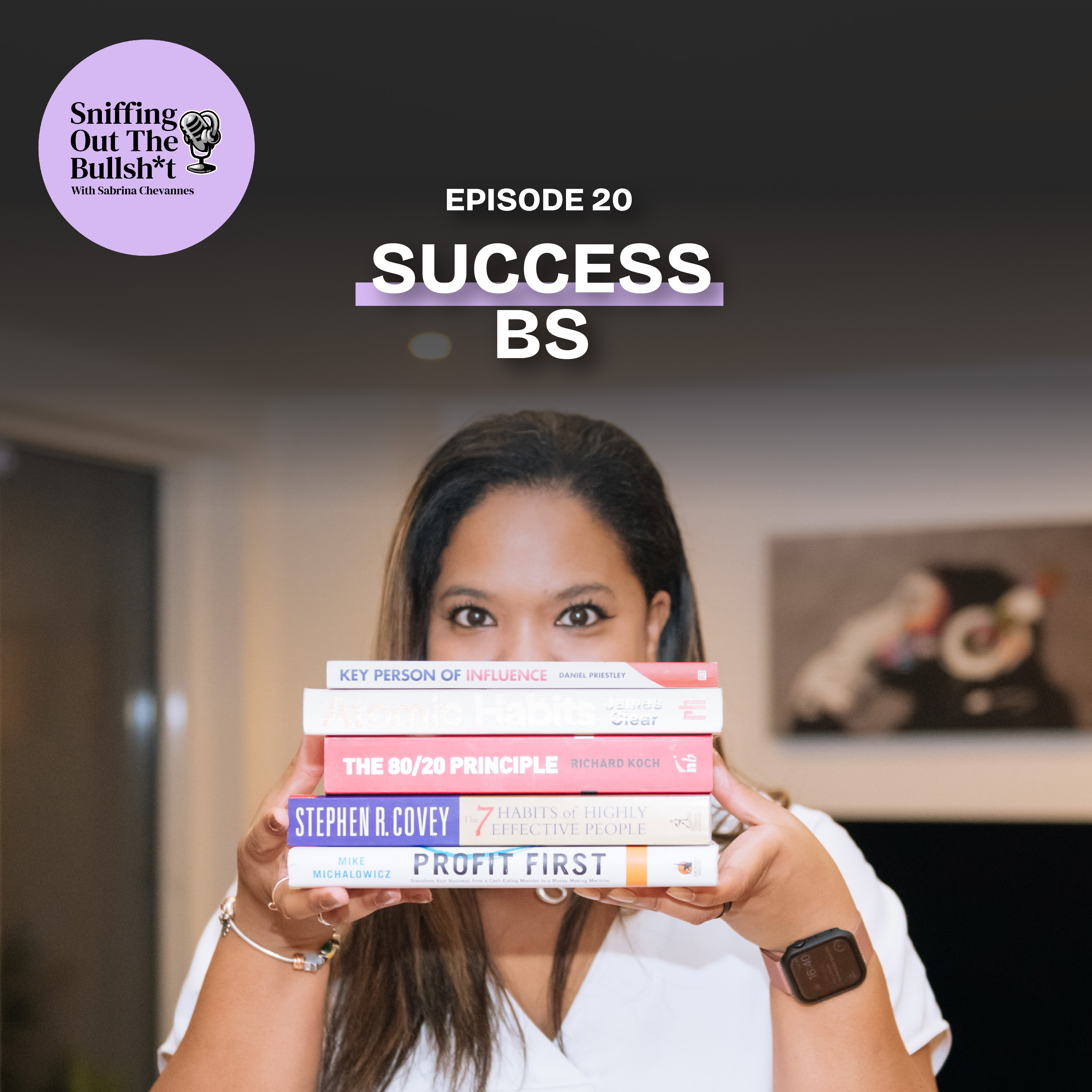
Success BS
This episode examines “Success BS”, showing why success is contextual and should be defined by the founder’s own values, responsibilities and desired life.
Myth vs reality.
Success is contextual and should be defined by the founder’s own values, responsibilities and desired life.
Episode summary
Success is contextual and should be defined by the founder’s
In this episode of ‘Sniffing Out the Bullsh*t,’ host Sabrina Chevannes-Denman, the No Bullshit Entrepreneur, delves into the complex and personal nature of success. Despite a thriving business and a fulfilling personal life, Sabrina discusses why she considers herself ‘unsuccessful’ based on her own evolving definitions of success. She examines dictionary definitions, contrasts them with societal views, and shares stories of high-profile entrepreneurs like Justin Kan and Arianna Huffington who reached financial success but faced personal struggles.
Sabrina advocates for a holistic view of success that includes personal happiness, health, relationships, and continuous learning. The episode encourages listeners to redefine success according to their values, rather than societal norms.
Key takeaway
Success is contextual and should be defined by the founder’s own values, responsibilities and desired life.
Short clips.
One useful idea.
Watch the argument in context and continue on the original platform.
Listen, skim or read every word.
This is the maintainable version: the summary, chapters and transcript all originate from the same approved transcript.
Introduction to Sniffing Out the Bullshit +
Hello and welcome to Sniffing Out the Bullshit , a podcast for ambitious entrepreneurs who want help wading their way through the bullshit jungle of entrepreneurship, and the tools, skills, and mindsets that are actually required for success.
I’m your host, Sabrina, the No Bullshit Entrepreneur.
So, I consider myself incredibly unsuccessful.
Now, I’m not even being hard on myself or being self-deprecating, but I genuinely do think that I’m an unsuccessful person right now.
From the outside, it may look like I have tons of great things going for me.
I run my own business, I have a gorgeous home, I’m travelling the world frequently, I have a really supportive partner and an extremely cute dog, if I say so myself.
My parents are still alive, and they’re amazing people. I get to see them, and it’s incredible.
So, to many people, they’d be like, “Well, OK, that’s a successful life.”
You’re probably listening to me now thinking I’m being incredibly ungrateful.
So let me tell you this, just to confuse matters even more.
I love my life.
I am insanely grateful for all of the above.
Every day, I think I’m incredibly lucky that I have all of this laid before me.
So why on earth do I think I’m unsuccessful?
Redefining Personal Success +
I guess that’s because of how I define success.
Now, don’t get me wrong. On some level, I’m successful.
At one stage, I probably did consider myself very successful, but not now because my goalposts have moved.
So let me explain this by looking first at the dictionary’s definition of success.
The dictionary defines success as “the favourable or prosperous termination of attempts or endeavours; the accomplishment of one’s goals.”
That’s very dictionary terminology and probably doesn’t help a lot of people.
But really, the key part here of this definition is where it says “one’s goals.”
So that means success is defined based on your own goals for you.
And therefore, every person’s definition of success is technically different.
So my life goal is to have the ultimate freedom to not have to work and to just spend my day however I like.
I sometimes define success to people as never having to set an alarm because then I can choose when I want to wake up and don’t have to go to any obligations.
But right now, my alarm goes off every single morning, and I have to work if I want to be able to pay my bills and eat.
So this is why I believe I’m unsuccessful right now.
But at some point, my only goal in life was to own my own home.
So when I moved into my apartment, where I’m recording this from, I considered myself the most successful person in the world.
And I still love this home so much.
I actually have no ambition of trying to get a bigger home.
My only goal at the moment is to have more time for myself so I can spend it on the things I really, really want to do.
So whilst the goalposts have moved, I still love this home.
I’m still super happy.
I’m super grateful to be here.
So you see, there’s a difference between gratitude and your ambitions and your goals.
The High Performance Coach Dilemma +
It’s only because I was on a call the other day, and I found myself really disagreeing with someone on the call.
They introduced themselves as a high-performance coach.
They had this huge tendency to encourage people to do more, to constantly look for more, and to say that what they were doing was not enough.
The “more” always seemed to relate to money.
It was always about how to get people to make more money, look more successful, and become more accomplished because, to many people, success equals money.
So that was their whole thing.
It was just encouraging people to do more, make more money, and therefore be more successful.
So I literally just read one definition of success from Dictionary.com.
But there’s more than one definition on there.
The first one I read was literally the first one listed, so it made sense to talk about that one, and it was the most generic one.
But this is the second one on the list.
It says, “The attainment of wealth, position, honours, or the like.”
This is what most people’s definition of success is.
It’s usually to do with fame and fortune.
Now, in the definition’s defence, it does say “or the like” at the end of it.
So I guess that keeps it broad enough that it could refer to different things.
But you’re probably thinking now, “Why on earth does she care about how people define success, and whether people want more money or to be famous or whatever?”
And I guess I don’t need to care.
But, as I said, I run an entrepreneur members’ club, and I’m surrounded by other founders who are consistently looking to do better.
A lot of the entrepreneurial coaching I do is with people who want to become more successful, whatever that means to them.
When I see people going by society’s definition of success, I see that this is what leads to more stress, more dissatisfaction, and inevitably burnout.
There have been so many cases of entrepreneurs constantly chasing the goal of insane growth or money and, in the process, actually causing themselves harm.
It was last week’s episode that I did on the speed and growth wars that led me to create this episode.
If you want to give that a listen as well, flick back to last week’s episode and let me know what you think.
They’re connected for sure.
It’s what made me want to do this episode after talking about it and discussing it with others.
But I will also give you examples because, like I said, if you go to the reintroduction episode, I changed the structure of this podcast.
It’s less about me ranting into the mic.
I actually want to back it up with data, examples, and science to make it a bit less ranty and a bit more substantial.
So I’m going to give you some examples because I feel like then you can understand what I mean.
Success Stories and Their Hidden Struggles +
And so I’m going to start off with someone who worked their butt off to become incredibly successful, but actually became super depressed as a result.
Good. Oh, I needed that drink.
So who was I going to talk about?
I was going to talk about Justin Kan, the co-founder of Twitch.
He started his brand as Justin.tv back in 2007, and the whole model was basically him broadcasting his life 24/7.
It actually became really popular, and they grew and grew.
They faced several technical difficulties on the platform, and this is when Kan observed the rise in popularity in gaming and decided to pivot the business.
So he focused on the gaming industry, thereby launching Twitch in 2011.
By 2014, he had sold Twitch to Amazon for a whopping $970 million.
So this sounds like the biggest success story ever.
However, during what should have been the happiest time, celebrating his success and everything that goes with earning $970 million, he actually experienced depression.
He was struggling with finding fulfilment and purpose despite his huge financial success.
He spoke about how empty he felt despite all the accolades and financial security, and decided that he wanted to bring more awareness to mental health and wellness.
So Justin now has a YouTube channel and a podcast where he regularly opens up about these difficult topics.
He’s such a great advocate for men’s mental health issues and has realised there’s a lot more to life than just money and fame.
So yeah, his was a really interesting story.
He’s not the only famous entrepreneurial story like this.
Take Ariana Huffington, for example.
Back in 2005, Ariana co-founded The Huffington Post , an online news site posting blogs and articles on various different topics.
It quickly grew into one of the biggest and most influential news sites in the entire world.
It even won a Pulitzer Prize for National Reporting at some point.
However, in 2007, Ariana collapsed at her desk from exhaustion.
She broke her cheekbone and needed stitches, all because she was so freaking tired from working too much.
This was a real wake-up call for her in how she was running her life and putting too much into the business.
She completely re-evaluated her definition of success at that point and recognised that despite her professional achievement, she was neglecting her health and well-being.
That’s why, in 2016, she founded Thrive Global, which started off as a platform to combat stress and burnout by providing science-based solutions to improve well-being.
It was similar to The Huffington Post in that it offered tons of digital content, but it also offered workshops and seminars.
Now it’s become an all-in-one productivity and health platform that integrates with different tools like Teams and Slack and helps support employee well-being.
It’s just gone crazy.
She’s now a massive advocate for better work-life balance, mental health awareness, and the importance of sleep and self-care because of what happened.
This incident caused her to shift her whole life toward promoting these values, both personally and professionally.
There are plenty of other people like Huffington and Kan who have had similar experiences, but they may not necessarily be in the limelight as much as these two.
If you listen to or watch my other podcast, No Bullsh*t Talks , you’ll know that plenty of my guests have faced burnout.
They talk about the fact that they regret being so obsessed with money and growth, and they wish they’d focused on something more meaningful.
Holistic View on Success +
So I guess the question is, how can you redefine success so it means something different to you?
Well, perhaps a good start would be to have a more holistic view of what success is—one that includes personal happiness, health, relationships, and personal growth.
You also probably want to make sure that you align your definition of success with your personal values and your passions.
If you take my definition of success from the beginning of this episode, I only really talked about what I imagined my life would be like when I became supposedly successful.
But I guess that situation would come about because of a few things.
I would have made a difference in the world already.
I would hopefully have helped thousands of people along the way.
I would have made enough money doing something fulfilling.
I wouldn’t feel like something was missing in my life, and I’d feel free to just learn whatever I wanted each day.
So I guess the way I look at it is that there are different categories of personal success.
I would be looking at all the different areas of them in order to define what I think success is in my personal life.
I’d say the categories are:
Personal fulfilment—finding joy and satisfaction in what you do.
Being genuinely fulfilled within yourself.
Health and well-being, obviously.
Making sure you’re prioritising both physical and mental health.
Relationships also play a part in it.
You need to value and nurture your relationships with family, friends, and colleagues too.
That’s very important.
It has a big impact on your mental health.
Then you’ve got your impact and legacy, which I mentioned earlier.
I’d want to make a difference in the world and help loads of people.
So, making a positive impact on others and leaving a meaningful legacy behind.
And yeah, continuous learning is always a big one for me.
Valuing personal growth and lifelong learning.
That’s why I was saying that I’d love to just wake up whenever I want and feel free to learn whatever I wanted each day.
There are plenty of people out there who’ve defined success in a different way.
It doesn’t make them any less wealthy either.
So it doesn’t have to be about money.
Examples of Purpose Over Profit +
I mean, take, for example, the founder of Patagonia, right?
I don’t want to butcher his name, but Yvon Chouinard, I think is his name because, you know, it’s French, and my name’s French, and people butcher it, and we just pronounce it the English way.
But I’m pretty sure it’s Yvon Chouinard, right?
The founder of Patagonia has always been someone who’s put purpose over profit.
They’ve been giving away a portion of their profits to environmental causes for ages.
They’re part of 1% for the Planet, like we are.
They do things on a much bigger scale, and 1% of their profits is larger than ours.
They use sustainable materials for their clothes.
They’ve always been about purpose over profit.
They even have those marketing campaigns—you must have seen them—where it’s like, “Don’t Buy This Jacket,” and it’s a picture of their clothes because they’re trying to say that you should only buy what you actually need.
They’re saying there’s too much unnecessary shopping, which is bad for the environment.
So that’s their marketing campaign, and they’ve always been like that.
Shouldn’t we also measure the success of the company by its positive impact on the environment?
This has always been the case.
In fact, a couple of years ago, you must have seen the news where he signed away his entire company to a trust.
The Patagonia Purpose Trust now holds 100% of the voting stock of Patagonia, which ensures that the company’s mission remains intact.
Then there’s the nonprofit, the Holdfast Collective, which receives all of the company’s profits that are not reinvested in the business.
Those profits are then used to address climate change and protect the environment.
That attitude is unbelievable.
I know he’s one of a kind, and there aren’t many people like Yvon Chouinard.
But there are people out there who do believe there’s more to life than just money.
Steps to Define Your Own Success +
So I guess I want to ask you, what steps will you be taking to define what success really means to you?
Because I think consuming a lot of social media content really clouds your judgement.
You kind of become chained to society’s definition of success, which may not actually align with your values.
So I think some serious self-reflection is going to be required.
There are plenty of ways of doing this, so you can pick whatever feels right for you.
But self-reflection is one of the most powerful things you can do.
You can journal, mind map, or even just write out what your ideal life would look like.
This will help you define what success is to you.
You see, because I started off at the beginning talking about what my ideal life looks like.
It wasn’t about the house I was in, the car I was driving, or even the material things that I owned.
It was about the quality of my life.
I still have some work to do on my definition.
Don’t get me wrong.
I know the destination, but I’d also like to have a few stops along the way where I can feel successful again.
So I’m probably going to have to go and re-listen to my own episode on goal-setting bullshit because, yeah, I have issues with SMART goals and the way they’re set.
I talk about it in that episode—how to set proper goals.
So I might have to listen to it, take my own advice on goal setting, and try to have some stops along the way to my destination.
However you choose to self-reflect, find out what a balanced life looks like to you and see if you can work out what success looks like before mapping your journey towards it.
Conclusion and Invitation for Feedback +
So, you know what?
I chose to do today’s episode because I really think it complements last week’s episode on speed and growth bullshit.
But actually, it also really complements the Happiness Bullshit episode too.
I chose this topic because of the discussions that were sparked by last week’s episode.
So I would love to invite you to get in touch with any questions or comments because I’d love to create more content around what you guys want to listen to.
I’d be so happy to do an episode on a topic that you’d personally like to hear about.
But that’s it from me today.
Until next time, keep sniffing out the bullshit.