

Personal Interlude: Dealing with Burnout
Personal Interlude: Dealing With Burnout
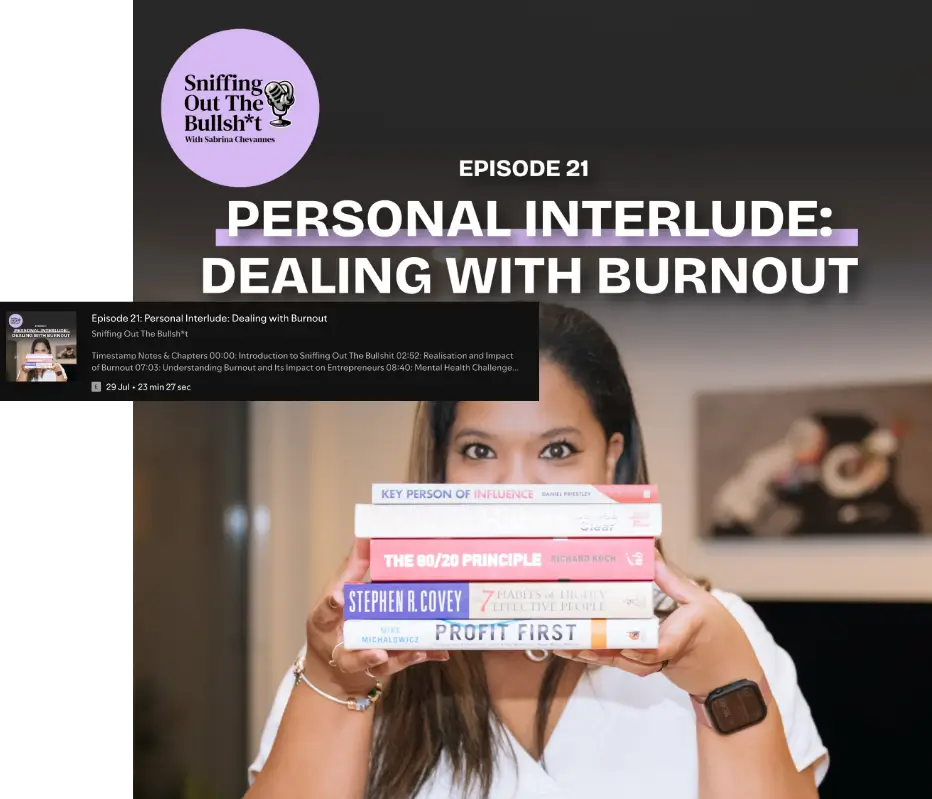
In This Episode...
0.00: Introduction to the Podcast
1.27: Realisation and Impact of Burnout
3.36: Understanding Burnout and Its Impact on Entrepreneurs
6.27: Mental Health Challenges and Stress Factors
10.46: Reassessing Workload and Managing Stress
13.03: Managing Time and Overcoming Burnout
So I don’t know if this is a good or a bad thing, but I’m recording this podcast while on holiday. I guess it’s good that I’m finally getting away, but it’s bad that I’m sitting here working.
You will get people on both ends of the spectrum – those who say that this is utterly shocking behaviour and the whole point of going on holiday is to take a break, and there will be those who say that this is just the reality of entrepreneurship, and you can never really switch off.
I think it’s somewhere in the middle.
I think that everyone deserves to fully switch off and take a break. The problem is, if you’re a true entrepreneur, your brain never switches off. You’re coming up with new business ideas in your sleep.
So you just have to learn how to handle it so that it is manageable.
I’m only recording this on holiday because I actually enjoy making this content. Plus, I picked the opportunity to do a personal interlude, as it’s essentially like writing in your diary, or a voice note version of your diary!
I am really trying to keep consistent with my content and it’s very easy to say “Oh well I’m on holiday and that’s a very valid reason not to put out content”, but then I will slip behind and just be OK with making excuses.
Recording this podcast isn’t stressful, nor is it taking me away from quality time with my partner. I’m recording this as he’s in the gym! So, I think it’s all about context.
What is NOT OK, however, is the fact that I’ve been pretty ill on this trip – in fact I lost my voice at some point. It’s not even fully back as I’m recording this, but hopefully I’ve done a cracking job at the editing that you can’t tell that much!
But despite being at an all-inclusive resort with all your booze included, I’ve been drinking hot water with honey in it!
I’ve been ill for quite some time now, and in true entrepreneurial fashion, I thought “Oh I’m going on holiday soon; I will just rest then.”
But now I’m here, I’m struggling and not able to enjoy the trip properly. So, it’s put some things into perspective a little bit.
I’ve been in a bit of denial lately. I’m burnt out but don’t want to admit it. This is because I really hate the way the term “burnout” is really overused now.
Even when we’re just a little bit tired or demotivated, people claim to be burnt out and use it as an excuse not to get stuff done. As a result, we’re all becoming so much less resilient.
There have been some wonderful things that have come out of the pandemic that have helped us be more aware of mental health issues and more understanding around these problems, but it’s also made us more prone to act like victims.
There’s now a term for everything – a diagnosis for every little symptom, so we feel like we’re burdened with all these diseases. When more often than not, we’re just dealing with normal life stuff – we’re tired, we’re fed up, we’re a bit down when things are tough.
This is all very normal and it’s just life. But by naming these feelings, we end up feeling sorry for ourselves and all just become a lot more fragile.
But I have to finally admit it. I’m burnt out.
Why have I finally come to this conclusion?
Well, the World Health Organisation have actually classified burnout as a syndrome, rather than a disease, but they’ve documented it as the following:
“Burn-out is a syndrome conceptualized as resulting from chronic workplace stress that has not been successfully managed. It is characterized by three dimensions:
• feelings of energy depletion or exhaustion;
• increased mental distance from one’s job, or feelings of negativism or cynicism related to one’s job; and
• reduced professional efficacy.
Now, my job is my business – I don’t have a boss; that’s just me. So, I don’t have the luxury of blaming a poor work culture or a toxic boss, like many people have been seen to do on social media.
Instead, I need to reflect on how I’m running my own business.
Now, looking at these three dimensions – they’re quite vague again. But, I think the key bit of me is about the mental distance away from my work.
I’ve been absolutely shattered and definitely had reduced efficacy, but this can happen in various circumstances. But it’s the fact that I often feel like I don’t want to work on some of these projects anymore, which is so sad.
Because I genuinely LOVE what I do. I always talk about how I feel like I’ve genuinely found my IKIGAI since I started N0BS – the entrepreneur members’ club. However, there have been some other projects which have been seriously stressing me out.
This constant stress has been going on now for the last couple of months and I’ve really struggled to find good staff to help me through it.
The attitudes of people post-COVID have really changed and this has really negatively impacted my business – but that’s a different episode in itself.
So, I wanted to talk through what burnout is, why it’s so prevalent in entrepreneurs and what we can do to help prevent it and deal with it if we do end up with it.
I already mentioned the WHO’s definition of burnout, but what does this translate to in everyday symptoms?
Well, the usual ones are:
• Feeling tired or drained most of the time
• Feeling helpless, trapped and/or defeated
• Feeling detached/alone in the world
• Having a cynical/negative outlook
• Self-doubt
• Procrastinating and taking longer to get things done
• Feeling overwhelmed
So, again, quite general and could easily be mistaken for anxiety, depression or perhaps even just low mood during a tough time.
But the culmination of all of the above, is what can be defined as burnout.
And also, with a low mood, you usually snap out of it eventually and you start feeling like your normal self. With burnout, it isn’t something that goes away on its own. Instead, it can get worse and really impact both your physical and mental health.
In fact, according to the Burnout Report 2024 by Mental Health UK, 91% of adults in the UK have experienced high or extreme pressure or stress in the last year.
Those are some crazy stats.
They found that almost a quarter of UK adults feel unable to manage the stress properly too, with 34% of 18–24-year-olds having to take time off work in the last year due to mental health issues.
When you see those stats alone like that, you probably think this justifies the shtick that Gen Z-ers get about being entitled and lazy. But it’s not so simple. Let’s explore some of the other things the report brought up so we can see why this particular generation may be struggling.
The report discusses both workplace and lifestyle stresses. They mention that the typical workplace stressors include high workloads, job insecurity and bullying. Now, it makes total sense that Gen Z-ers would face job insecurity more, as their jobs are probably the first on the line when cuts are made. Naturally, they’d face more bullying from their more senior or superior colleagues and also be given most of the brunt work.
Likewise, the lifestyle stressors they discuss include poor sleep, the cost-of-living crisis and poor physical health. Since Gen Z-ers are likely to earn less money than the older generations, they’d be concerned about the cost-of-living crisis and trying to maintain a social life while working.
Now, I’m definitely not making excuses for this generation, or advocating taking so much time off work. But I do see that this generation may need a fair bit of support that they’re not really getting.
I mentioned earlier that there’s definitely a lack of resilience amongst us now and it’s causing us to handle stress poorly, but let’s park that for a moment and look at what is causing these mental health issues and an increase in cases of burnout, especially among entrepreneurs.
We entrepreneurs don’t take care of ourselves properly. We believe time is money and when we’re not working, we’re not earning.
As an employee, you can take a nice break every so often and it doesn’t impact your bank balance. As an entrepreneur, each minute you take off from working is money you’re not potentially earning.
But I think there’s an issue with this type of thinking in the first place. It’s a dangerous way of looking at it. We need to realise that these breaks are essential to help us function at the highest level so that we can earn more money when we’re working.
What I realised is that I have been powering through the last few months, doing all-nighters to complete projects, doing work myself because freelancers we’ve hired have let us down etc. etc. I’ve just taken it all on because I’ve gone back to bootstrapping a startup and that has a whole different kinda vibe compared to running an established business.
I’ve really really struggled to find trustworthy people and that’s also largely because of people taking on too much.
With the cost-of-living crisis, freelancers have been taking on so much work in order to make ends meet, that they then cannot fulfil a lot of the work that they take on. Or they rush it and it’s really poor quality. Neither of these options are good and we’ve been on the receiving end of a lot of this lately, which has made it all incredibly frustrating, so I went back to doing it all myself.
I thought I could handle this hustle – after all, I started my other businesses this way and they went on to do well, so why can’t I do it again?
Well, first of all, I’m ten years older! So my body doesn’t react in the same way.
But also, I think there’s a lot more work these days and it wasn’t healthy in the first place, so why would it be healthy now? I definitely took a lot more holidays back then too!
So the thing is, I’m now burnt out, but what am I going to do about it? Am I going to just rest for a bit and continue doing the same thing? Absolutely not.
I’ve been reassessing what I need to change to make my life a bit easier to manage.
The thing is, I do a lot of things and I love doing a lot of things. I don’t actually think that’s the problem. To many people, I do too much and I should cut back on those things. But I know that if I cut back, I will just fill my time doing other things as that’s who I am.
It’s not the number of things I’m taking on but it’s the stress that goes with them. This is largely because I do not have the support network I need.
So, here’s what I’ve been working on and I think some of these tips could be very useful if you feel that you’re taking on too much at the moment and want to re-evaluate.
I’ve been keeping a “stress diary”. I used to do this when I was really stressed and I noticed that all my stress was coming from a couple of bad employees I had, so I realised I had to get rid of them.
This time, it’s from certain tasks that I’ve given out to freelancers and they don’t get done. And I’ve planned out everything around these tasks and then that throws things off course. But it keeps happening EVERY SINGLE WEEK.
I’ve had to sit back and think whether it’s even worth continuing with some of these activities unless I finally find someone I can trust to help me.
Constantly feeling let down and dealing with stress week after week is what causes the problem. Therefore, I’ve decided to park one of my projects (even though it means a lot to me) until I’ve found someone really reliable.
Next, I’ve done a bit of a time audit of where I’m spending my time. If anyone needs to know how to do that, I’ve popped a link to my time audit guide in the show notes. I’ve noticed which have been energy drainers and taken up way more time than anticipated.
Again, this is because the support network is not there.
I am also eliminating those from my workload until I find someone to help.
It’s really tricky because when you’re bootstrapping a startup, you don’t always have the funds to be able to invest in good people. But if you don’t, then you will overstretch yourself and then you will lose your best team member – yourself! So, it has to be worth the investment, to ensure that you’re not overwhelmed.
I am also now changing how I structure my week. I am no longer going to do 16-hour workdays and leave no time for things I want to do.
I am going to schedule non-negotiable times where I can go to the gym and relax, as I think this is actually important for my work. If my physical health is not in good shape, then neither will my mental health.
Having time away from the computer and to stop thinking about work will help provide some clarity to what I am doing.
I am also scheduling one day off each month. A day where I don’t do anything to do with work – a day just for me and spend it however I like. Again, this should be non-negotiable.
If you’re anything like me, you’ve put this great stuff in your calendar and then when a client asks you if you’re free during that time, you bump them in instead. However, that doesn’t work either – you need to make this time like any other meeting in your calendar and stick to it.
Would you cancel a client meeting for another one because you consider it more important? Not likely. Would you cancel a client meeting because you want to finish a project? Not likely either. If you do either of these things, then you’re definitely not managing your time properly!
And on that note, I will be managing my week slightly differently by batching my work on different days, helping to boost productivity as I’m not jumping between different tasks all the time.
This is something Cal Newport always talks about through his work. If you haven’t read Deep Work, then you absolutely need to. But his latest book is what has got me thinking about all this – Slow Productivity.
He talks about doing fewer things and concentrating on doing them well. He believes that the reason we feel overwhelmed is because of society’s need to just do more all the time. This alone causes anxiety and puts us under pressure to constantly be busy.
Between this book at Oliver Berkman’s Four Thousand Hours, I’ve been really thinking about how I’m spending my time.
I wanted to create this episode because I know there are so many people in the same boat as me lately – feeling a bit overwhelmed with everything and not sure how to handle things.
It’s forced me to do a bit of a reset and think about how I want to spend my time and which projects are most important for me to focus on and where I need help.
I’ve brought a pen and notebook on this holiday and I’m about to head off to the pool to just go brainstorm a few things in analogue mode.
Staying away from my computer and the internet has also been doing wonders for my mental health. I’ve not spent time on social media while I’m away and therefore not absorbed any toxic content that’s been annoying me.
We all need breaks like these, whether they’re abroad and somewhere sunny, or even just in our own home but just free of distractions.
I’m now not afraid to admit that I’m burnt out but I’m actually doing something about it.
It’s not pleasant and I feel completely shattered and disheartened with a lot of things, but I know that I’m ready to bounce back after a good rest and prepare for a much better life.
I want to help other entrepreneurs with burnout too as I’m seeing it more and more. This constant strive for success and to hit the big numbers that everyone else seems to be doing around them.
It’s not healthy and we’re all getting very ill as a result.
I hope that if you’re feeling a bit overwhelmed, then this podcast has helped you reflect a bit and realise that you’re not alone. And that perhaps you can also start making a few small changes before it’s too late.
I’m off to the pool now and I will be relaxing for the remainder of this trip.
I will come back to England nice and refreshed and ready for a new, and less stressful calendar.
Until next time, keep sniffing out the bullsh*t!
Related Episodes


