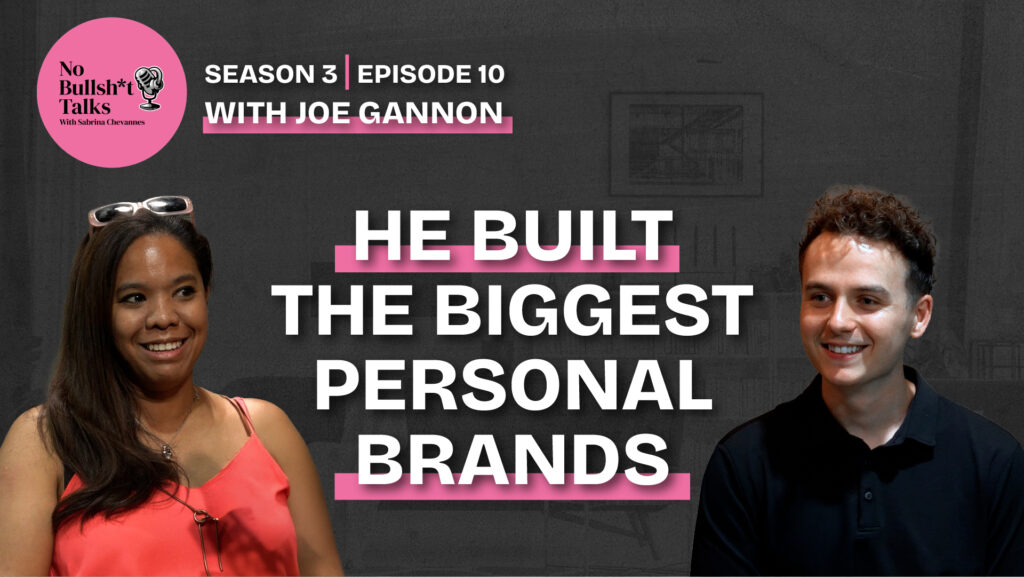
No Bullsh*t Talks · Season 2 · Episode 2
Understanding the Power of Storytelling
With Amanda Baker.
 Watch on YouTube
 Listen on Spotify
 Apple Podcasts
About this conversation
On Branding and Content
Join us on this emotional and insightful episode of Ricky Chick’s Podcast with special guest Amanda Baker, founder of 5 Stories and a TEDx speaker. Amanda shares her deeply personal and tumultuous journey through the highs and lows of entrepreneurship, including losing her company, battling emotional abuse in co-founder relationships, and finding meaning through storytelling.
Learn about Amanda’s 5 Stories methodology, the importance of owning your narrative, and the future of intentional and meaningful entrepreneurship. Plus, get a sneak peek into Amanda’s candid thoughts on personal branding, authenticity, and the ever-evolving world of social media.
Watch
See the full video conversation.
Listen
Take the conversation with you.
 Audible
Watch the moments
that travelled.
Watch, share and continue on the original platform.
Read the full conversation.
The transcript is organised by timestamp so it can be generated from the master transcript, edited once, and published here without designing a new section every week.
A Heartbreaking Business Journey+
It wasn’t fair. It wasn’t a fair journey, and it wasn’t fair from the get-go.
I didn’t go with my gut feeling. I was desperate. I took the money. I gave away too much equity. I lost my company. It broke my heart. It broke my life.
I was a… dot dot dot… who the f*ck am I after pouring four years of my life and every single penny I had into this business?
Introducing the Podcast and Guest+
No BullSh*t Talks is a podcast for entrepreneurs by entrepreneurs.
There’s too much BullSh*t there, especially when it comes to business.
This podcast aims to highlight what’s true and what’s not in the world of entrepreneurship, bringing you honest and raw conversations about the roller coaster that is entrepreneurship.
Each week, my guest will be a high-performing entrepreneur sharing the ups and downs of their journey and helping you prepare for the road ahead while providing you with actionable insights and absolute gems of knowledge.
Stay tuned as I introduce this week’s guest.
Amanda Baker’s Story Begins+
Amanda Baker is the founder of Five Stories and the creator of the Five Stories Methodology. She inspires leaders all over the world on how to tell their story and use it to promote their businesses. And yes, everyone has a story, even if you don’t think you do.
She is also a TEDx speaker and a new mom to the beautiful Lyra.
I present to you Amanda Baker.
The Confusing Name Change+
Welcome, Amanda Baker, to the podcast. I hesitated, though, because the last time I spoke to you, you were Amanda Harrison. Usually that means you got married, but I’ve got divorced very quickly. But did you divorce?
No, I know what his name starts with.
So, Amanda Baker. Yeah, you married Ryan Harrison, became Amanda Harrison, and now you’re back to Amanda Baker.
Yeah, I think I should start there because it’s confusing.
Yeah, it is. It is. For people who are sort of watching, yeah, I mean, I would be just not feeling it. Not feeling it. That’s it, not feeling it.
I think in life we do try things on, whether it’s clothes or whether it’s names or men.
Men?
Yes. I mean, gosh, we could go there.
In fact, my husband’s going to be very hyped that you mentioned his name in this podcast.
Oh, then in the video.
Oh my gosh, I’m not going to hear the end of it.
I always mention your podcast.
All right, babe. All right, babe, you’re right.
But yes, it just didn’t work for me, and I went back to Baker.
Well, welcome, Baker, to the podcast.
Thank you for having me.
I’m so excited to have you here, but this is actually attempt number three.
Yeah, I mean, but we’re here.
I might have to do a separate episode on how many times I failed setting up this podcast. So I’m so glad we’re actually here having this conversation.
Actually, I’m going to start the conversation before the battery runs out on the camera or some sort of ridiculous failure that happened first.
Fingers crossed that doesn’t happen today.
I feel like I’ve got a good feeling. I’ve got a good feeling.
Yeah.
The Rollercoaster of Entrepreneurship+
You’ve been on a ahead of a journey, and I feel like there were so many highs and lows. That’s what entrepreneurship is like, right? There are always highs and lows.
I don’t know what you see on social media. Even if they just show the highs, there are always some lows.
You are at a really cool point in your career, but I want to hear about your journey and how you got here. What do you think are the most pivotal moments of your journey? What do you think are the moments that brought you to where you are today?
Oh my goodness, that is a big question. That is a really big question. Thank you. Thank you for asking it.
I feel like I’m always the one asking the questions and my clients to unpack their story, so it’s very rare that I get a chance to do this. So thank you.
Wow. Yes, I have been on a big journey. I guess my journey as an entrepreneur started when I was really, really young, just trying to figure out ways to make a little bit of money, but also to have fun and get people together.
So I guess we could start there, but I won’t start there. I’ll go back to where I was at uni and getting into this whole creative world of advertising. That’s kind of what I was really curious about, and what really got me into this work that I do now around storytelling and helping people to connect with their story and tell it in Five Stories.
But ultimately, I’ve always been a creative person. I’ve always been a person that, hey, I just want to do something meaningful. I want to do something that I feel personally connected to, that really matters to me, but something that’s going to make a positive difference in the world, or at least in people’s lives in some way, big or small.
Pivotal Moments and Personal Struggles+
And I guess pivotal moments in my life, I’ve got the personal moments. I got stabbed in a nightclub and nearly lost my life, which was kind of a realization of, “Oh my God, we’re not here for very long. We’re so lucky to be here anyway.”
Of course, I survived that craziness, and that was a moment that made me think, “Wow, our lives are so precious and so important. What we choose to do with our life is the most important thing, and it’s up to us to choose.”
My uncle committed suicide, and that was really close to me in my life. That was something that was really pivotal for me, and a moment where I really realized the meaning. We’re all here to find meaning, and when we don’t have meaning in our life, we’re disconnected from each other and ourselves.
That has also led me to this work that I do with storytelling because, ultimately, what is a story? A story is how we connect with the meaning in our lives and in the world.
So I feel very fortunate to be doing this work. That’s the real deep stuff that changed me and moved me toward where I am now.
I really do deeply believe that my granddad inspired me massively when I was growing up. My dad divorced when I was pretty young. I was about six or seven. I can’t really remember now because that was a very long time ago and another life when you were that young, right?
I was literally going through photo albums that my nan had.
I love doing that. I find that’s a really amazing way to connect back to our roots, connect back to our origins. If you’re lucky and fortunate enough to have your grandparents who are still here, I have three nans actually that are still alive.
I tell you what, the women in my family, they’re going strong. One of my grandmas is like 93 years old. I’m just like, “What?”
That’s amazing.
Yeah, absolutely love them. We were around our house the other day and I was just looking through pictures. It’s just like, how? How did that happen? It’s like looking through a film of your life at a time when you were younger.
It’s madness.
But I think that’s a really great way to connect with your roots and connect back to who you were and how you’ve become this version of yourself.
I guess how I got here is many events, many choices, many decisions, many fuckups, many highs and lows, and wiggly lines and wobbly bits.
I’ve just always wanted to do work that really, really makes a difference. That was once working in the advertising industry to actually work on certain campaigns.
How would that have made a difference?
I guess because advertising is just getting people to buy things. It’s adding to the whole commercial side of stuff. But I wanted to do things a little bit differently and work with businesses and brands that are purpose-driven and impact-driven.
That’s what I ended up going into. I’ve been very fortunate to have a couple of agencies in London, branding agencies, where the birth story of my methodology, Five Stories, came about.
That came about when I was creating stories for brands who just had no idea who they were or what they stood for. They would work with me and my company to help figure that out.
Fast forward to now, I’m sort of banging the drum for storytelling, not just for branding or marketing. It’s actually for belonging and connection because I really do believe that we need more of that in the world.
It sounds like a ridiculously difficult but powerful journey..
The Challenges of Co-Founding+
That you’ve been on. Actually, I want to talk about one of those agencies. I feel like these days everyone seems to run their own agency, whatever that definition of agency is. That’s another topic for another day.
But I want to talk about running an agency because you’re a co-founder, right?
Yeah.
I’ve had a few.
Yeah, yeah.
There’s always a discussion about whether it’s better to have a co-founder or be a solo founder. Obviously, there are pros and cons for both of them. I know you’ve had some interesting moments on your way, so I want to hear from you. Co-founder or no co-founder? What’s your thoughts on it, and what were your experiences?
Yeah, I think co-founder or no co-founder, there’s pros and cons for everything. I think it’s just about knowing what you want and what you need. I think it’s really as simple as that.
My first agency had four co-founders, me included. I was one of them. It was all gravy, it was all good for a little while, but what happened was normal.
Our first business was an app that would let people borrow and swap clothes called Pink Wardrobe. I was a sole founder then, but I had investors and people who were part of my team. That was great, and that was my first experience of entrepreneurship as a sole founder.
But for me, it was lonely. It was lonely, man. I ended up getting my fingers burned by taking a chunk of money off VCs too soon and giving away ownership of my business. Then it all came crashing down. I had a lawsuit over my head, and I had to deal with all of that at the age of 26 or 27.
If I had a co-founder at that point, that would have been great just to have someone help me navigate through that mess with someone. I just had friends who didn’t really understand and my mom, who was scared because she thought her house was going to be taken away because I was in so much debt with the company and it was registered to her house.
Yeah, it was just a mess.
But even not a co-founder, just anyone who understands business, any fellow entrepreneur who could warn you that VC funding is not the be-all and end-all.
I think so many people just think, “Oh my God, I need a backer. I need funding.” They don’t realize how much equity they give away, and actually they give away control as well. That’s what they don’t understand.
You have to go back to why you became an entrepreneur. Yes, money is great. When I got that investment, there’s a few things that I thought was, “Oh my gosh, someone believes in me. Someone believes in my idea. They care about it as much as I do and they want to see this succeed.”
Sometimes that can be true. A lot of the time it’s not. Everyone has their own agenda, and often that agenda is with themselves and putting money in their own pocket, not making your dream become a reality and you fulfilling it.
Honestly, check your investors. Do your research. Meet people. Have conversations. More than one. Trust your gut feelings. I didn’t go with my gut feeling. I was desperate. I took the money. I gave away too much equity. I lost my company. It broke my heart. It broke my life.
I went through a massive identity crisis. I was like, “Who the fuck am I?” after pouring four years of my life and every single penny I had into this business, which was about twenty-odd grand of savings.
I was back at my mom’s, very lucky to have my mom there and be able to go back into the room I grew up in, where I came up with the fucking idea. But it was a really hard, heavy, sad, and lonely.
Then I started my second business, an agency here in London, where I was one of four co-founders. That was different. I was buzzing. I was excited because I had people to be on the journey with you.
But it wasn’t fair. It wasn’t fair from the get-go.
I am the kind of person that if I have an idea, very similar to you, I’m going to make it happen. I’m going to give it my absolute all, especially if I care about it and want it to exist in the world. I’m gonna do it.
I’m a fucking hustler. I’ll work my absolute ass off to make it happen if I really want it to exist.
I feel like that energy and my tendency to show up and make things happen has been abused by people in the past. I’ve let that happen, so that’s definitely on me. But it’s on them too. It’s a two-way thing.
At the beginning of that relationship, I only had 7.5% of the company.
What? Seven and a half percent of the company? There were four of you.
Yeah. Two of them had the majority share because their other company bankrolled it. They had the name and brought me and another member of the team into a meeting and basically said, “Do you want to be a co-founder? We’re giving you an opportunity.”
It was that whole, “This is a great opportunity for you.” If you hit a certain amount of profit, I think it was £100,000 or £150,000 revenue in the first year, then we’ll give you more shares.
We smashed that. I brought in a massive client, a quarter-of-a-million-pound client. It was a company I had met while working at a previous company, and I’d been nurturing that relationship for years.
Then suddenly they were ready to buy, and at that point I had an agency.
Fast forward a little bit, and I just felt like my co-founders women—two white middle-aged men and another guy who this was his first business I’d obviously been in a business before I did feel there was times where I actually didn’t feel seen there were times where I really didn’t feel heard there was times where i didn’t feel respected at all by this people.
I felt emotionally abused. I felt like they took the piss out of my talent and my energy.
I got that company off the ground and brought money into it. By the end of it, I was burnt out. COVID hit. I had to make my team redundant, and I was on a Zoom call crying my eyes out literally just like this is an absolute mess.
Clients had stopped spending. There was no money coming in. I couldn’t pay my team. I’m very emotional on a zoom call.
One of my co-founders said, “Amanda, now isn’t the time to get emotional.”
I saw red.
That was all I needed to hear to think, “You know what? Fuck this. I’m out.”
I literally closed the laptop. I was shaking so much. I cried. I sobbed and bogy coming out of my like literally honestly like bogy’s just everywhere it was not sexy.
I mean Ryan was like, “Babe, what’s happened? Someone’s literally died.” Honestly that someone had literally died.
He’s like hugging me while I was crying so hard I couldn’t breathe.
That’s how it felt. It was madness. It was intense.
That’s the buildup of all that disrespect.
Consistently coming to the table with ideas and bringing your best, and then not being appreciated.
Years of buildup.
To have this moment, it sounds like one little moment. People think, “You’re just being emotional,” or “You just snapped” at the moment how like you know fragile are you.
But actually, that’s years of buildup. You just took that emotional abuse and disrespect in the business scene.
People don’t get what that’s like. Of course you’re going to feel that way.
You know what? It happens all too often. I speak to so many women who experience this. Obviously, it happens to men too, but from what I’ve seen, it happens more prevalently to women in terms of how they are respected.
Now that you’ve been through all that, what advice would you give to other women listening or watching this podcast who feel mistreated by co-workers, co-founders, or anyone else? How would you recommend they deal with that?
Call them out.
If you’re feeling like someone’s taking the piss, someone talking over you, someone you know you present some you’ve done all this work and they are dismissing it, and or yeah like talking saying oh I actually know that I did actually what about the like.
You can tell by the tone. I think it’s a lot of it is if you’re feeling like there’s like that it’s a competing or they’re just not support you with emotional support that you need like
“How’s it going? like “just checking in” “how are you feeling?” like “Is there anything I can do to support you or help you?”
Like I mean co-founders, founders, leadership—whatever it is—it’s a team, right?.
If at any point you don’t feel like you’re in a team, there’s a problem. A big big problem.
You cannot move a business or a dream forward without a team. Like literally you cannot.
If I could go back to that Amanda, I would have said something earlier.
I let it build up to a point where I completely exploded.
It happened the way it was meant to happen, but I still haven’t had those conversations with my ex-co-founders. I’ve never spoken to them, “Do you know how you made me feel? Do you know what you did?”
Yeah, it’s really hard.
That’s why it took you so long. People listening will hear you say “call them out” so confidently, but they’re probably thinking, “I wish I could.”
It’s hard, man. It’s hard.
The problem is I think that like you said you blew up because even though it’s the right thing to do, you didn’t do it and because it is difficult but somehow you have to get to that point; otherwise, it’s just going to continue and get worse, right?.
Yeah, it’s going to get worse. The only person you’re hurting is yourself. The only person you’re hurting I mean is yourself you know like that’s the only person.
It’s like you know if you’re dating someone it’s like a or you know you’re in literally in an abusive relationship but on emotional level. It does happens in business all the time.
I do think the more we talk about it, and I haven’t really spoken about this very much especially not publicly I don’t speak about this publicly one because
I’m still you know connected to my ex-co-founders. I’m a big believer in don’t burn bridges.
We’ve all done stupid shit. I’ve done lots of stupid shit in business and in just in personal life and just in life it doesn’t matter like business life whatever it’s just we’re humans. We’re all going to stupid shits we’re all gonna learn from that stupid shit, hopefully, some of us and yeah it is what it is.
I also believe that sometimes we have to go through different versions of ourselves to to get a version of ourself who is obviously stronger, wiser, braver all that kind of stuff.
I believe that I had to go through all of that.
Then I started another company with one of my co-founders. We grew that got to a year and then I was like you know what “this isn’t working for me” it was like I just woke up one day and I was like this isn’t working for me it’s not feeling good for me anymore.
I dug a little bit deeper and said to him let’s do a day like get together strategy—a strategy day.
I came with all this preparations all these questions I completely like designed the whole workshop that we are going to do I was like I got this I’ve got this and I was as literally went I was like right I just want to about getting on the same page about where we want to go with this business, like what we’re feeling what we’re enjoying what’s bringing us joy, what problems are we seeing here and feeling and how can we address those and also where we want to go with this business what’s the vision that we both have, what’s our shared vision what’s our shared values, what’s our shared experiences, what’s our shared beliefs.
I came out of the whole session one feeling exhausted because the whole time I was the person asking the questions.
I never got asked a question once.
That was a massive alarm for me.
Literally I was like, “Whoa. I’m in a 50/50 business relationship with someone.”
No, I’m not. And even previously, no I’m not.
It was toxic because that was one of the you know it just followed me.
I had to get out.
It was you know the guy was he’s a nice guy nice enough guy. But it just it didn’t feel fair.
Again this word Fair it didn’t feel Fair.
A business relationship has to feel fair.
If it doesn’t, if someone’s doing more like if you’ve got a 50/50 split inequity, you both need to be doing 50/50 like sometimes it’s not going to be possible.
Because sometimes you’re going to feel like a 20 I’m going to bring 20% of my energy in time and stuff today, and actually so but that’s okay you communicate that right but I’m just meaning in terms of like the whole of the experience of being a founder and entrepreneur you’ve got to ring it the the work you got to bring it in equal measures.
Otherwise, it just gonna feel one-sided, lopsided, and it’s going to fall apart it’s going to fall apart because you’re not aligned.
Overall, I feel like this is a common theme with co-founders. Usually, there are different personalities usually one person is a go get out there doing all this stuff, exactly and then there’s others who don’t but they can bring things in other ways and that’s the thing you could have complimentary personalities and skills and they can be doing something else for example that’s why I’m a so because obviously like I said I just I’m all in it all the time all the energy was out there but I’d love to have a co-founder even if they weren’t doing that obvious stuff.
But they were doing operational stuff and maybe they were like maybe doing the finances adding and making stuff you know keep a flow behind closed doors and the things that I’m not necessarily good at.
I think there are those complementary things and
unfortunately, it seemed like you know they were the right people for you. But as you said, all those things happened for a reason. They brought you to where you are today personally you are today.
Now you’re showing up as the Amanda founder of Five Stories, bringing your methodology to the world and inspiring leaders to do this.
I want to talk more about that today.
The Importance of Telling Your Story+
You’re a storyteller, and you want to help other people tell stories.
I want to talk about the state of storytelling at the moment. I feel like it’s becoming a bit of a buzzword maybe. People are talking about storytelling for the first time. Personal branding is a thing on everyone’s mind now.
It’s like, “I’m going to tell my story. I’m going to build a personal brand.”
So I want to talk to you now, what does that look like to you? Do you think it’s important for people to tell their stories? And how is that different from having a personal brand?
Oh, big question. Thank you for asking it.
I’ve been thinking about this a lot.
It’s absolutely vital that we tell our stories. It’s not just important. I think it’s a matter of to make sure that we are all able to sharp as our most authentic self.
Even that word, authentic, I don’t even hesitate when I say it because that word authentic.
It’s been ruined. It’s been so ruined.
People are trying so hard to be authentic so much that it’s so fake.
I call myself an “authentic authentic.” I’m like an authentic authentic mean it’s bigger authentic that the word has lost all meaning.
I mean I feel like we’re just over I feel like what’s some of these fucking buzzwords. It’s just like it’s driving me crazy I’m just like “Oh my gosh”
That’s why I have my Bullshit buzzword series.
I love it. I’m here for it. I’m here for it.
We are having this conversation it’s about being real right that’s it’s just not be around the bush it’s just like about being real but I don’t thing you can’t be authentic until you know your story.
That’s the truth. You cannot be authentic until you know your story until you’re connected to your story.
If you show up without being connected to your story, then who are you showing up as?
You’re probably repurposing content you’ve already shared, or you’ve been influenced by someone else’s post or content, and then you’re like “Oh, I need to do that too.” because oh that’s the thing.
“I need to position myself.”
“I need to do a fucking carousel.”
“I need to do a reel with this bloody track.”
Whatever it is it’s just stop it. Just stop.
Focus on you.
Focus on who you are, what stories make you who you are, and show up as who you fucking are.
It’s not hard, but it is hard.
Yeah. Society has completely infiltrated our brains.
Like seeing all this stuff all those things that you said like
people are looking at other people, determining that they’re successful, and also all the people who are sending courses, templates, and all this sort of stuff so it is regurgitating the same content.
So people see this and they’re blinded by vanity metrics.
So they’re seeing oh well this type of post that got x amount of likes and comments therefore “That must be what I should be doing.”
And therefore it then is hard like you saying it’s not hard to share to it you, you shouldn’t be hard to be yourself, that’s the easiest person..
The Difference Between Personal Branding and Storytelling+
But we’re seeing all this other stuff, and then people are like, “Okay, well, am I not good enough as myself?”
Yeah, and I think that’s where the difference between personal branding and storytelling is, right?
But I want to dive more into the storytelling thing. We’re going to come back to personal branding because I do think there is an issue with personal branding.
A big, big problem with it.
Understanding Your Own Story+
But I want to go back to the story first so people understand, because I don’t think you can do any form of personal branding until you really, truly know who you are.
I think the people who are following that sort of stuff don’t truly know who they are. They don’t know how they should be showing up because they don’t know what that is, if that makes some sense.
When people hear “story,” they think, “I don’t have a story.”
They think they need some kind of origin story, which is one of the pillars. They think they need an origin story like a superhero origin, right?
They think they need some kind of backstory, some story where they’ve lost a key person in their life, and that’s what makes them who they are.
People think that’s what we mean by a story.
So I wonder, you say that everyone should have a story and everyone should be able to tell their story. How do regular folks who feel like they don’t have anything to say, people who go, “Oh, look at me, I’m not interesting,” find what their story is? And how do they tell it?
Incredible question, and thank you again for asking it.
The Power of Personal Stories+
I think one thing I want to say is that everyone, if you’re a human being and you’re breathing, you have a story. You do have a story.
You were born. Or what was the date you were born? Where were you born? What was your mom’s name, dad’s name, siblings?
I mean, even just going back to the basics, this is what I meant earlier by it’s not actually that hard to show up and tell your story. But it’s about knowing what parts of your story.
That’s the hard bit because our stories are so big. Our stories are massive. And I think that’s what makes us scared because they’re so big.
And everyone’s showing up online and you’re right, everyone’s banging on about stuff and it’s just so fucking noisy. Personal branding is so noisy. So, so noisy.
Because it’s like, “Look at me, buy from me. Look at me, buy from me. Hello.” It’s just like, Jesus Christ, can we just calm down?
Maybe just take a bit of a pause and just reconnect with ourselves…
Challenges in Telling Your Story+
By connecting to our story.
And that’s the work that I do with people. It’s taken a step back from the social media.
And I do actually say to my clients now, I would encourage you, they don’t have to, it’s their choice, but I encourage you to come off social media for a bit while we do this work on this program.
Because I don’t want you to get distracted and start getting confused about what your story is because you’re comparing yourself to someone.
If you start comparing yourself to someone, you start feeling like you’re not good enough. You start feeling like your story isn’t good enough.
No, your story is good enough. Your story is the most important thing and the most powerful thing that you own because it’s the only story that you can fucking tell.
That’s the power of it.
But you’re right, people don’t know. I don’t think it’s that people don’t have a story. I’m here to tell you, you do. Every single person, every single human being has a story.
As human beings, it’s something that we all share. It’s an incredible, incredible gift that we all have.
If you’re born and you’re living and you’re breathing and you’ve got a heartbeat and you’re walking this planet or moving through this planet in some way, shape or form and you’re existing here, you have a story to tell.
So the word that I do, Five Stories, it’s a methodology that ultimately gives you a map back to your story, a map back to your meaning.
I’m working with people of all different walks of life at all different points in their life where they’re just like, “You know what, I’m feeling lost, I’m feeling confused, I’m feeling really disconnected to myself because something’s happened that’s changed in my life.”
Or they feel burned out from doing all this content creation on social media and they don’t even know who they are anymore. They have so much to say and they don’t even know what to fucking say. I hear that a lot.
I also hear a lot of, “My story feels so big and I just don’t know where to start.”
A lot of it is just knowing where to start with all of that.
And yes, origin is the first story that I’ll help my clients connect with because the origin story is taking it back to your roots.
Taking it back to, okay, what is the journey? Where did you begin and what’s the journey you’ve been on so far up to this point?
What are the moments that changed you? What are the moments that inspired you? Who inspired you?
Just trying to understand how have you become this version of yourself and why you believe what you believe, why you care about what you care about, and why you do what you do.
I work with creative entrepreneurs who are impact-driven.
Every single one that comes to me, they either have a business idea, or they’re working on a company, or they maybe have a book in the making, or they’ve already got a couple of books out, TED speakers who are coming to me who are really wanting to own their story more, really wanting to stand in their story more and stand for something.
And they go through my method with me to get clearer, to get more concise with how they show up with their words.
Because they want to have those moments of hand slamming on the table. They want to have those moments of fist up to the sky like, “Follow me, this is what we stand for. This is the movement. This is the change that I want to fight for. Come with me.”
Origin is the first story in the Five Stories.
I feel like I’m not going to interrupt you and tell you the Five Stories because I want people to watch your TED Talk.
Oh yes, watch the TED Talk.
Mate, I’m like, don’t do it. Come on, stop. They get a taster. Go watch the TED Talk.
Where was I? Yeah, go watch the TED Talk. Exactly.
You always help me.
No, I’m glad you interrupted that because I was about to go in and start revealing the goods.
But yeah, I need to get better at my little hooks and shits. I’m not good at that.
That’s it though. We’re never good enough at our own PR stuff like that.
And I guess that’s because we’re trying to help other people..
Critique of Personal Branding+
And that nicely feeds into personal branding.
Yeah, yeah, because I think that personal branding is a big, big buzzword at the moment, two words, but everyone has a different version of what it means now.
I get told all the time I have an amazing personal brand. I don’t even have a personal brand. I just show up as me. I’m just me.
And I think it’s because there’s so much…
I’m getting thinking about all that stuff online right now.
And I want to hear your thoughts currently on personal branding because I think I’ve ranted enough already. So yeah, thanks, thanks, pass the baton on personal branding. Let’s bash it. I’m kidding.
Yeah, I think personal branding for me… yeah, I mean, I’m over it.
That’s it. I can’t even be bothered to talk about it. I’m done. Just move on, please. I’m exhausted, mate.
Honestly, I’m just so tired of this personal branding bullshit personal branding hype. I’m just like, stop telling people to build personal brands.
Let’s just… why are we doing that? Why are we talking about branding people?
People are constantly changing and evolving. I’m a different person right now, in this moment, having this conversation with you about personal branding than I was when I walked through that door to do this podcast.
Brands—the whole point of building a brand—and I know this because I spent very many years, a decade of my life, building fucking brands for lots of big, world-changing businesses—is about a promise that stays consistent, consistently showing up, standing for something.
Yes, which is important, but being consistent with that… humans are not consistent.
We’re unpredictable, we’re messy. We are not static. We’re not statues.
Brands are… it just doesn’t make sense. I’m just like, why are we doing this? Why are we all falling for this hype and hustling to be seen as these perfect performing statues?
Who the fuck are we connecting with?
Do you know what really drives me crazy? I’m not on LinkedIn or social media at the moment because I’m being present in my story and reconnecting with it.
I’m doing the work because I believe in it. I do it pretty much every time I go through a massive change, and I’ve just become a mom, so, you know, good timing.
It pisses me off when I see people commenting on my posts. It’s just… and just really… oh yeah, really…
And they just… it’s not even a human line anymore. Now it’s AI. That’s the thing.
It’s all automated. I see them turn up on my posts every day and I’m like, you clearly didn’t write this. You didn’t even read it. It’s automated.
Or they’re doing it as a perfunctory thing because they just want to beat the algorithm.
It’s no longer about humans. It’s about beating the algorithm because all they care about is vanity metrics.
It’s twisted. I’m seriously sad for us. Sabrina, it’s really quite sad. It is actually quite sad. I’m sad for us. Like, what have we become online?
You just mentioned being present, right? And people are recommending these perfect posts go viral because they recommend the algorithm.
So they will say we need to post 200 times.
So I thought, okay, let me just think about it. Two comments a day. Even if I took like a minute to read the post, which obviously I’m undershooting it, and then you take like a minute to think about what you’re doing, and then another minute to actually craft the post—obviously I want to spend more than a minute on those.
That’s three minutes per comment. That’s 200 comments. That’s 600 minutes. That’s 10 hours. Do the math.
As I say, I’m bad at math, but the math is the math, right?
These people are self-proclaimed saying you’re supposed to spend six hours a day on LinkedIn and ten hours…
But what are you doing with your life, honestly?
And they’re saying they’ve got clients and they’re making money and they…
I’m like, what on earth? This is bullshit.
Because you cannot have clients and spend six hours a day on LinkedIn.
You just said, “I went… I brought all these new clients coming up now and you’re really excited.”
You’re being present. You’re doing all these things.
That’s not someone who spends all day on social media.
It just is bullshit.
But it’s easy and nice to believe that people are saying these posts and sharing them because they think, “Oh, this is a great way to be.”
And that’s how the personal branding hype gets pumped up.
And I’m kind of hoping it dies down at some stage. I kind of… I don’t know what you feel.
I think it… I think for our health it needs to die down.
The Crisis of Connection and Authenticity+
I think we’re in a crisis of connection. I think we’re in a crisis of meaning. I think we’re in a crisis of creativity.
I think I’m actually really sad for us. I’m sad if this is how it is. It can’t continue like this.
I’m sad for the next generation of humans, my daughter included. She’s only four months old now.
And more than anything, the thing that makes me so, so sad is we don’t know how to be ourselves anymore. We don’t know how to be ourselves online. We don’t know how to be ourselves offline.
That is the sad truth of where we are as a culture. That is where we are in society. That is where we are as a species.
We don’t know who we are anymore. We’re so lost. We’re so confused. We’re so disconnected because of the algorithm, because of the digital world, because of all these demands and pings and distractions.
Every time I go on the train, I literally purposely don’t go on my phone because I just like to look around at how many people are on their phones.
I sat behind someone on the train, so before my baby girl came last year, and there was just me and this other person.
The gap between us, and they were on their phone, and I was just like, let me just see.
My journey from Waterloo to where I was going is about an hour and 20 minutes. This person was on their phone the whole time.
I was watching their activity. ASOS, TikTok, ASOS, scroll scroll scroll, TikTok, back to ASOS, Twitter, scroll scroll scroll.
I was so fucking exhausted just watching it.
And I had to write it down like every action they did just to see how long it was.
People do it as a tick. It’s like a default kind of response now. They don’t even realize they’re doing it.
I even started doing it. I tap my phone just to see.
And I’m like, oh my God. I had to turn off notifications because I see people doing it and they’re just scrolling and I don’t think they’re even processing the information.
They’re just flicking between apps. Watching videos of people dancing, checking a dress, back to ASOS, back to TikTok, WhatsApp, Instagram.
I was like, I’m exhausted just watching it.
But that’s where we are. That’s the reality of where we are as humans.
And it’s fucked. It’s fucked. But there’s no real connection at all.
And that’s what we’re talking about, real connection.
If we are looking at that, that’s what we’re living in.
And also, 90% of that content you’re consuming is fake. It’s not real. It’s not real.
And how damaging is this to our brains? It’s unbelievable.
And I just wish more people would see it because everyone’s like, “I have to be on my phone. I have to do this.”
And most people say, “I need my phone, it’s compulsory,” until the battery dies and nothing bad happens.
It’s like, you realize, “Oh, I never needed it that much.”
And I started slowly weaning myself off things—taking myself off social media, taking myself off email.
And I’m like, no one died. Nothing bad happened.
So actually I could do this more. I can do this more.
And you start to realize you just enjoy life way more and be present.
Oh my God, that word—be present.
It’s really hard.
And I guess the same with story. It sounds like being yourself should be easy. It should be easy to just show up as you are.
But the truth is, it is hard because we don’t have a map. We don’t have a blueprint. We don’t have something guiding us back.
We don’t have people helping us get back to who we truly are before we start showing up again, so we can show up as the truest version of ourselves.
I’m going to stop using that other word. I’m bored of it. I’m bored of it.
And that’s what I’m trying to create here. I’m trying to create that map. In fact, I have created that map.
Five Stories is the map back to who you are it’s a map back to your meaning.
And I’m just getting started. And I’m excited because I finally, finally feel like people are listening.
Gosh, I think I was saying to you before we got on this podcast, I have nearly walked away from this so many times.
Because I’m sharing all this stuff. I’m talking about belonging starts with the story that we tell, starts with telling our story.
And I’m thinking, why is no one hearing me? Why is no one listening?
Last year was the worst year I’ve ever had in business. I’ve had four businesses.
I built up to maybe 20 grand, maybe not even there. I had no savings, I had debt.
Then my baby came along and I felt like I didn’t deserve to be a mother because I didn’t feel successful or where I wanted to be before becoming a mother.
Why is your success dependent on how much money you earn?
And that is because of what I’m seeing. It’s all fuck. Nothing to do with that.
But you’re an absolutely incredible mom.
I know I am. I am.
And you deserve every bit of that. And you are successful.
But we just accidentally, unknowingly, subconsciously, because society has done it to us, tied your success to the level of monetary income you received that year.
And thought that made you not successful.
But you’re forgetting everything else you’ve got in your life and everything else you’ve done.
Just because you had one bad year does not make you not successful.
And that is society’s fault. And that is what we absorb all that bullshit content on social media.
That’s the problem. That’s the issue.
And that’s why I’m going to share my stuff in real conversations like this, on no bullshit talks.
Because we need less bullshit. We need more meaning. We need more truth.
That is the truth I believe in.
The Future of Entrepreneurship+
And I believe that, and I hope that is the direction people want to move in this year.
And I want to get people’s predictions there. So for the next 12 months in the world of entrepreneurship, yeah, what do you see the predictions looking like? What do you see the nature of entrepreneurship looking like this year?
I think we need to slow the fuck down. I honestly do.
Every person, I’ve got a lot of friends who are entrepreneurs, and I adore them, you’re one of those friends.
Everyone I speak to is so busy. So busy.
And I’m just like, can we just stop being busy for a bit? Can we just stop being busy for a bit and take a bit of a step back and just be here, feel here?
Do we ever feel here enough?
You saying to me, look at what I’ve achieved, look at what you’ve achieved, there’s so many times where I hear you and you’re like, you’re going to be on a billboard and all this kind of stuff.
You’re so incredible, you’ve achieved so much.
But why don’t we big ourselves up in love? Why don’t we do that?
I’ve gone off on one a little bit, but I think the future of entrepreneurship needs to be slower.
Scale slow, intentional. More intention, more meaning.
I think we’re going to be building a lot more from our stories as the foundation.
I think we’re going to be building a lot more and building businesses that are based on our beliefs, our values, and our experiences.
And we’re going to grow businesses that are more intentional, more meaningful, and that are for our audience and the people.
It’s to create communities that are ultimately going to bring people together, foster more belonging, and help us all truly connect.
Because we really, really, really—we’re dying for it. We literally are dying for it.
Well, I feel like you’ve just described Nobs in the community there.
There we go. You’re welcome. And that was my vision too, so I do hope the future of entrepreneurship is like that because that’s exactly my vision for Nobs and what I want to create, that sort of community.
Exactly. I actually think intentional collaboration—people who align with your values and your beliefs and your experiences and your stories—that’s what it’s about.
It’s lonely up in here.
Intentional. Love it. Intention. Let’s do it. Love it.
Yes, babe.
Yes.
Final Thoughts and Tools for Success+
Just want to say thank you so much for coming on today’s podcast. It’s been amazing having you.
Thank you so much for having me. I’ve enjoyed it so much.
I will Ask quickly, I’m going to try to ask everyone, what do you think your biggest tools are for success as an entrepreneur?
Oh, community. Wow. Community. Community, people, people who you can… community, people you can trust, people who will hold a brave space for you to share how it’s going and how you’re feeling and what you need.
Amazing. Yeah, well thank you so much. It’s been amazing and a pleasure having you. Thank you. Love it.
Thank you so much.

Meet the guest
Amanda Baker
Natalie is the founder of Elevate – a wellness retreat business. She is an exited FinTech business owner, a venture scout and a neuro-linguistic programming coach (as well as a proud member of N0BS ).