Apple Podcasts
 Audible
 Listen on Spotify

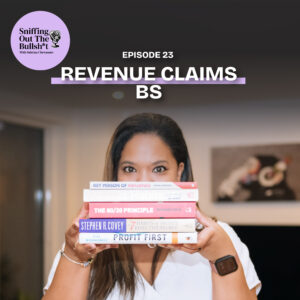
“Revenue claims tell you how successful or healthy a business is.”
Sniffing Out the Bullsh*t · Season 1 · Episode 23
Revenue Claims BS
This episode examines “Revenue Claims BS”, showing why revenue without context says little; profit, cash, costs, time period and business model change the meaning.
Myth vs reality.
Revenue without context says little; profit, cash, costs, time period and business model change the meaning.
Episode summary
Revenue without context says little
Why is it now fashionable to brag about how much money you earn online? Is this actually cool or is it as cringe as you think it is?
Sabrina explores the psychology of money, why we’re influenced by these claims and how much of it is actually true.
Key takeaway
Revenue without context says little; profit, cash, costs, time period and business model change the meaning.
Short clips.
One useful idea.
Watch the argument in context and continue on the original platform.
Listen, skim or read every word.
Introduction to the Podcast +
Hello and welcome to Sniffing Out the Bullshit, a podcast for ambitious entrepreneurs who want help wading their way through the bullshit jungle of entrepreneurship and then the tools, skills, and mindsets that are actually required for success.
The Taboo of Discussing Money +
OK, so I’m going to ask you a question straight off the bat.
Income Bragging in Entrepreneurship +
but they’re now getting a free shout out, so hey, Zoopla.
But the point is, is that it’s a little rude when you ask about someone’s finances.
And I think that most people do think it’s rude.
The Evolutionary Psychology of Status and Wealth +
But you know, This is why entrepreneurs don’t put it on there.
Instead, they just, you know, when during tough times, they just live off the old results, they put all their old wins and things like clients on social media instead, or they Photoshop new ones, which is what’s happening now.
So I guess this brings me on to the latest trend, right?
Social Media’s Role in Perpetuating False Success +
And like, so when someone claims to have made a lot of money, you think, OK, they must be successful and you automatically assume that this person has done something right, whether in business or in life.
And so somehow these people with money become more attractive, not necessarily sexually more attractive, obviously to a lot of people that is also the case, but just in a way where you want to try and get to know that person more.
People hit that follow button on social media, right?
Consequences for New Entrepreneurs +
So it’s just a waste.
The Ethics of Misleading Marketing +
and Stripe come up on on your phone with all this supposed money coming in.
So the fact that people have dedicated time to create websites with this functionality shows you just how many people are looking to create this.
They’re not real, they’re fake.
Real-Life Examples of Faked Success +
or their fake comments to make it look like lots of people are clear with them.
Trust me, this actually happens.
Coping Strategies: Building Self-Awareness and Redefining Success +
First of all, it creates this massively unrealistic expectation for other entrepreneurs.
The Importance of Authenticity and Verification +
I was actually fuming because like, if I’m in the middle of my day and you know, it’s my fault and leaving e-mail notifications on, so you know, I’ll take some accountability for this, but I’m in the middle of my day and I see the e-mail going urgent.
I’m like, Oh my God, I’m going to respond to this.
The Psychological Impact on Entrepreneurs +
You’re, you know, like, and that’s what these fake revenue claims are too.
Practical Steps to Avoid the Pitfalls of Comparison +
and the feelings of inadequacy, you likely end up with depression and burnout.
All because some idiots are choosing to lie about how much they earn on social media.
And this is what the effect does, which is why it really irritates me.
I wish that other entrepreneurs would have some respects for their, you know, the colleagues or you know, compatriots will have you want to describe it.
You know who are also in this boat because from perhaps that you’re lying about your, your social media or your forever new claims because you feel insecure too.
But it doesn’t mean that you should make other people feel insecure as well.
So what can we do to stop ourselves getting offended by all this?
Well, you know, I’ve, I’ve been there too.
So I’m, I’m telling you from experience, we all need to cultivate some self-awareness and recognize the triggers first of all.
So when you are spending time on social media from now on, start paying attention to what triggers those feelings of inadequacy or the urge to compare yourself to others.
Because once you’re aware, you can start to do something about it.
For example, you can start to curate your environment by cleaning out your feed on whatever platform you’re using.
Limit yourself to that toxic content, unfollow those accounts or constantly talking about wealth and also, you know, spreading bullshit.
Instead, seek out content that actually inspires you, aligns with your values.
I know I’ve had to do this a lot lately as even top creators who I once admired have recently, I would say, sold out because I don’t even know if they think they have to create content like this now to succeed.
And I again, inverted commas, but it’s just not right.
For example, one creator I used to really admire, I used to listen to all his podcasts, consume his YouTube content.
And I thought he was really quite down to earth.
The Downside of Following the Wrong Influencers +
to get to £100 million in revenue.
Key Takeaways & Final Thoughts +
And if they were, they wouldn’t be spending so much time on social media, right?
So if you’ve realised that you’ve been following some people lately because they claim to be earning a certain amount of money, have a think and see if that’s actually true and see if their content is actually healthy to digest or if it’s warping your brain.
And actually do some research and ask for genuine testimonials.
Because when I’ve questioned the results of these guys or big claims, they get very defensive and claim that they don’t need to prove their worth.
A lot of the creators actually just block you.
They can’t deal with any comment that isn’t in their favour.
Like if you look at their their profiles, it’s just got a bunch of those people who are in pods or agreeing with what they’re saying.
And then a bunch of other people just agree because they want to get in with them.
And anyone who disagrees is blocked.
And that’s not healthy.
That’s not what successful entrepreneurs do.
They can handle debate.
They can handle a respectful conversation that doesn’t always agree with them.
So the problem is, you know, this whole buzzword again with the buzz term of I don’t need to prove my word has gotten very out of hand because it, it started off as the right thing were people who are being disrespected in, in, you know, corporate setting.
And you know, they are like being overworked and you know, but it’s now translated into people who don’t have an experience, who don’t know what they’re doing.
And I’m just making all these bullshit claims.
And I’m saying I don’t need to prove my worth.
The problem is, you really do.
Like if you’re sending me services and I’m really paying good money for them, that’s exactly what you need to do.
Again, it’s just another classic social media buzz term that’s causing people to be obnoxious pricks, right?
To be honest though, that’s been done for this episode before.
I get really ranty again so I’m going to have to catch you all next week, but until then, keep sniffing out the bullshit.