Listen on Spotify
 Apple Podcasts
 Audible

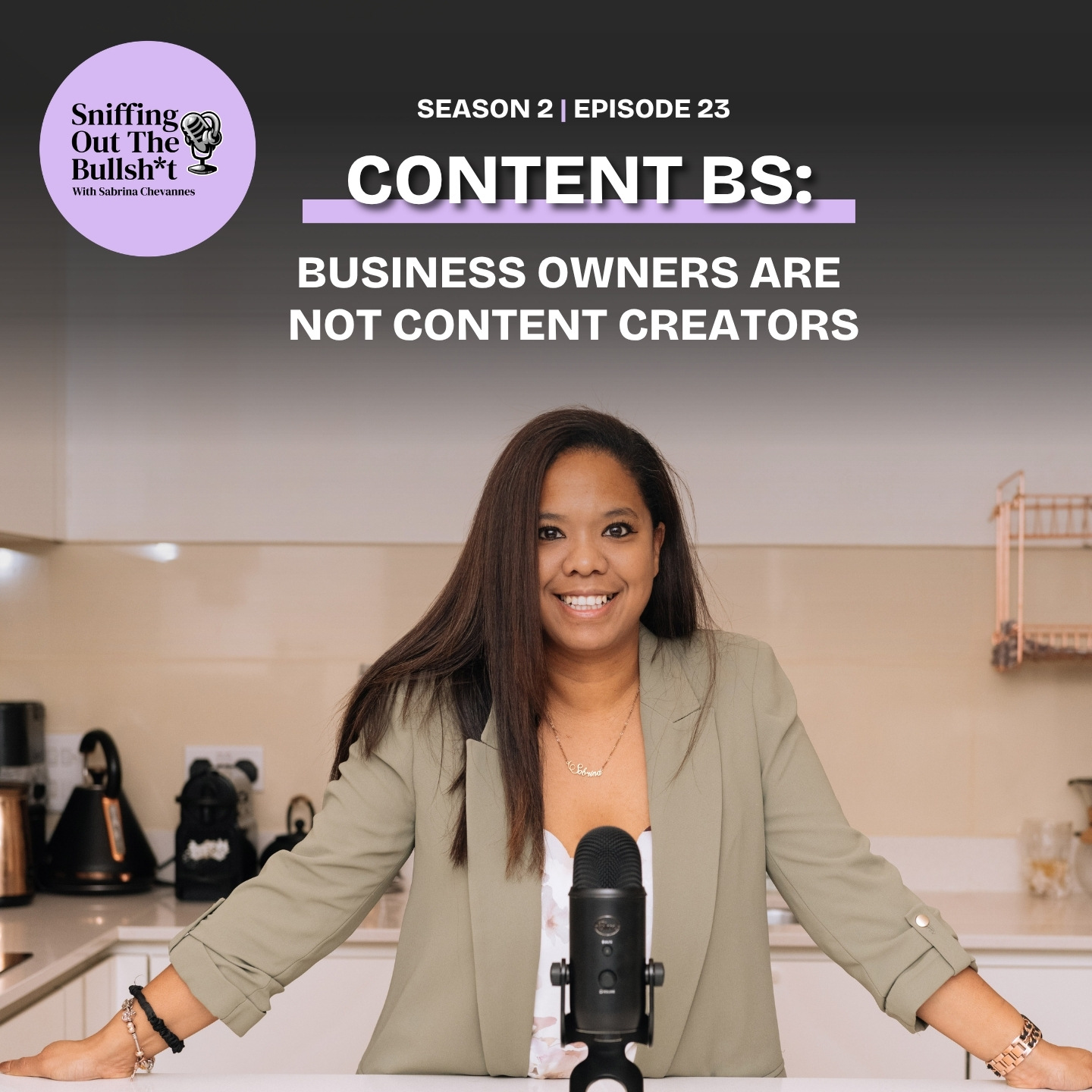
“Every business owner must become a full-time content creator to stay relevant.”
Sniffing Out the Bullsh*t · Season 2 · Episode 23
Business Owners Are NOT Content Creators
This episode examines “Business Owners Are NOT Content Creators”, showing why business owners and content creators have different commercial jobs and success metrics.
Myth vs reality.
Business owners and content creators have different commercial jobs and success metrics.
Business owners and content creators have different commercial jobs and success metrics. Content is valuable when it serves acquisition, trust, retention or revenue—not simply because it generates views.
Episode summary
Treat content as a business tool, not the business itself
Are you a business owner who’s been told to act like a content creator?
This week, Sabrina tackles the uncomfortable truth that the content industry has been selling business owners a playbook that was never designed for them. Posting consistently, chasing the algorithm, obsessing over follower counts — those are a content creator’s metrics, not yours. In this episode, Sabrina breaks down: * Why business owners and content creators have fundamentally different jobs, business models, and definitions of success * The real cost of content creation (spoiler: it could be eating nearly £29,000 a year in opportunity cost) * Why 47% of B2B marketers don’t measure the ROI of their content — and why that’s a serious problem * The channel that drives 82% of new business for small businesses and converts at 3–5x the rate of social media * How content can masquerade as…
Key takeaway
Treat content as a business tool, not the business itself: choose channels based on commercial outcomes and measure whether the time you invest actually moves the needle.
Short clips.
One useful idea.
Watch the argument in context and continue on the original platform.
Listen, skim or read every word.
This is the maintainable version: the summary, chapters and transcript all originate from the same approved transcript.
Why Business Owners Are Not Content Creators +
What do you think about the content that you consume on a daily basis?
Is it genuinely helping your business or do you consume it mindlessly and never actually apply it to your business?
So I’ve been thinking so much about content lately, not only from a consumption perspective, but also from a content creator perspective.
In fact, I hate the fact that I’ve just accidentally called myself a content creator because I’m not.
I’m a business owner and that’s kind of what this whole episode is about because I am sick of seeing content consistently advising business owners to jump on this damn content hamster wheel, right?
To post consistently.
Yes, that damn buzzword, consistently, because business owners are not content creators.
We have a business to run, so our objectives should be completely different.
But unfortunately, according to many bits of content, content creators and business owners are essentially one and the same.
And it infuriates the hell out of me, which is why I’m making this episode.
It’s why I’m going to be creating a lot more content around this.
Ironically, of course, because I’m not a content creator, I’m a business owner.
Got to keep reminding myself of that.
But I also want people to realise that creating content is part of running a business, but it should only be a small part of running a business.
And you need to consistently assess your ROI for creating that content.
Otherwise, you’re just distracting yourself from what you should actually be doing as a business owner.
So stay tuned as I delve into why business owners are not content creators.
Hello and welcome to Sniffing Out the Bullshit, a podcast for ambitious entrepreneurs who want help wading their way through the bullshit jungle of entrepreneurship and learn the tools, skills, and mindsets that are actually required for success.
I’m your host, Sabrina Chevannes-Denman, the No Bullshit Entrepreneur.
The Fundamental Difference Between Content Creators and Business Owners +
So first of all, I want to shout out to my avid and loyal listeners who may have picked up on the fact that I’ve already done an episode similar to this, and I called it Post Every Day Bullshit, where I basically talk about how posting every day is not a strategy.
So it’s got some similarity to this episode and it talks about the consistency bullshit.
And, you know, for those of you who have stuck around, listened to many of my episodes, and realise that this is a topic that I’ve spoken about a lot, I want to say thank you.
Thank you to those who have been listening, for sticking around and being loyal, but also thank you for realising that this is actually a topic that needs to be spoken about over and over again.
So the episode that I’m talking about, if you want to go back and listen to it, if you haven’t, or you want to remind yourself about it, was Season 2, Episode 7.
And it really spoke about how if you are posting consistently because everyone’s saying that you’re supposed to post consistently, right, then you might just be doing it without any strategy at all.
Because some people just say, “Oh, I need to show up every day.”
They don’t really think about why.
So the focus of that episode was about the importance of strategy when it comes to content.
It’s like being intentional with your goals.
So not just having a schedule, putting it in a content calendar and, you know, calling that a strategy, but actually thinking about why you’re posting, what you want to achieve from every single post, and how that aligns with your business goals.
But this episode is a little bit different.
This is more, I’m digging down deeper into this one.
It’s more about what is your true identity.
And it’s more about, are you a business owner or are you a content creator?
Because so many business owners want to just run the business, doing the things that they are best at, but at the same time, they feel so much pressure to create content because that’s what everyone says you should be doing.
Content is king.
That’s how you get business.
All that sort of stuff.
We hear it all the time.
Now, of course, creating content is totally a factor of building a business.
I think it should be.
I mean, who am I talking? I’m creating a lot of content.
But it shouldn’t be the primary thing that you do when you’re building a business.
And if it is, that’s when you’ve started to blur the lines and when you should start to re-evaluate things.
And I’ve been speaking about this quite a lot on different channels lately.
For example, on my other podcast, No Bullsh*t Talks, the one where I have a guest come in every week and it’s a video podcast.
You’ll find it on YouTube and Spotify.
I had Joe Gannon on that.
Now, he’s a guy that’s responsible for the personal brands of the likes of Ali Abdaal, Jordan Peterson, and Chris Williamson.
Like all these big-ass names, right?
He is legitimately a big deal in personal branding.
And we were discussing the difference between a content creator and a business owner, and I brought it up there to him because he had a slightly different way of talking about it.
And I’m not going to ruin it.
I’m going to get you to watch the episode because that episode was probably one of the closest things I’ve ever seen to a blueprint for success.
He dropped so many gems.
I mean, I keep going back to watch that for my own personal gain because it was a brilliant episode.
Now, he thinks about it a little bit differently, but I brought up the difference between a content creator and a business owner because I also think that a lot of the people that he’s working with are very much content creators.
Look at those names I just mentioned.
Ali Abdaal, he runs a YouTube channel.
That was his whole business.
Yes, he’s maybe now created other elements and revenue streams on it, but he’s very much a content creator.
And then Chris Williamson, he’s a podcaster.
That’s what he does.
These guys are media personalities, so their whole job is to create lots of content.
It’s very different from, for example, myself running a creative agency, or someone who is a business coach, or someone else who perhaps is even a plumber and they’ve just been told that they need to do content.
Because your job is running your business and doing the skills that service your clients and doing the things that you are strongest at.
Because something you learn quite early on in business is that the earlier you can delegate everything, the better it is.
Like people say, delegate everything you can.
What Happened When I Took a Four-Month Content Fast +
I mean, you should be left with, in an ideal world, obviously, doing only the things that you are fantastic at.
Now I’m sitting here recording this podcast and still doing a lot of content.
And ideally, I wouldn’t be.
You know, lots of people might look at me and think, “Oh, she’s great at creating content.”
And I thank you if you do think that, because it’s very nice to have that thought.
But I think that where I’m best is connecting people, putting amazing people in the same room, and making magic happen.
I like introducing people to the right parts of the community and growing their businesses.
And I’m very much a people person in person.
Creating content for me is a necessary evil.
And again, you see, this is why I need this episode too, as much as anyone else, because I felt like I have also jumped on this content hamster wheel.
And I love making some content.
I love making this podcast.
For me, this is one of my favourite things I do.
I also love my No Bullsh*t Talks podcast because I get to speak to incredible people every single time.
Essentially, it’s like free coaching from every single person that I get on.
And I get to inspire hundreds and hundreds of other people who listen to it, and they also get inspired by it.
So it’s a really nice thing.
However, I don’t want to be posting on social media.
I don’t really want to be churning out YouTube videos day in and day out.
I really enjoy having real conversations and helping to educate people.
So I wouldn’t be spending most of my hours doing this.
I believe that content creation should just be one of the very many things that you do as part of a marketing strategy.
But if it’s how you spend most of your hours, then something has gone wrong a little bit.
And I also wrote about this on my Substack recently.
I recently decided essentially not to consume any content for like four months.
I didn’t post on there.
I didn’t post on social media as regularly.
I stopped reading other people’s blogs and newsletters.
I stopped watching YouTube videos, stopped listening to podcasts, and I didn’t produce much of my own content for a while either.
You can even see that this is the first podcast episode of this podcast that I’ve released in a while.
I took a complete break from it because I wanted to focus on my business, and that is N0BS, the Entrepreneur Members Club, the one that talks about the importance of in-person relationships.
And that’s what I wanted to do.
I wanted to show up for my clients, and so I didn’t really do much content.
And the question is, what happened to my business?
Well, it was absolutely fine.
In fact, it was more than fine.
I was making great progress because I spent time working inside the business on the strategy, developing the business model and the processes.
I signed clients for our agency and signed members for the members club, as opposed to just churning out content.
And so the discussion around this post kind of shocked me too.
So many people reached out to me because they felt the same thing.
And they were all kind of sick of being on this content wheel too.
But they felt the pressure that they needed to show up all the time and produce content because that’s what the world is telling us to do.
And people were telling me that they were relieved knowing that there is another way.
And that’s kind of why I realised I need to do a full episode dedicated to this topic.
Why Content Creation Can Be a Form of Business Avoidance +
So I just want to simplify or clarify my argument on this case first so you totally understand where I’m coming from with this.
So you are a business owner who can use content as a tool.
You are not a content creator.
Those are two completely different jobs with completely different success metrics, different business models, and different definitions of winning.
And the moment you start measuring your business success using a content creator’s metrics — that’s follower count, reach, engagement rate, and views — then you’ve started playing the wrong game entirely.
A content creator’s job is views.
And that’s not me being reductive, but that’s literally their business model.
Views translate into ad revenue and brand deals, right?
That’s how they make their money.
And volume and reach are all part of how they make their money.
So for them, posting consistently, feeding the algorithm, optimising for reach, all that stuff, it makes complete commercial sense because it is their job.
However, your business model is completely different.
You make money when someone trusts you enough to pay you for your services or your product.
That requires leads, conversations, and conversions, not just views.
And yet, the content industry has been remarkably successful at convincing business owners to adopt this creator’s playbook.
You post every day.
You build your audience.
You show up consistently.
And you feed the damn algorithm.
And business owners just do it because it sounds reasonable, right?
Because everyone else seems to be doing it.
And because the alternative — sitting with the honest question of where your next client is actually going to come from — is so much more uncomfortable and difficult.
And it’s much easier to just stay busy by posting things.
But let me be really direct about what I’m saying here when I’m saying staying busy posting things, because essentially this is just avoidance.
It’s like the business equivalent of tidying your desk instead of actually making that really difficult phone call, even though you know that phone call is going to help you make business.
It feels like work.
It has the shape of work.
It smells like work.
But it’s not really the same thing as work that actually moves your business forward.
The Staggering Opportunity Cost of Excessive Content Creation +
And I’ve got some numbers to back this up too.
Of course, you know that the point of me calling out bullshit is that I have to prove what I’m saying is not bullshit.
So I always include research in my content.
So I’ve done a fair bit of research for this episode because I wanted to collect a few bits of data for you and just show you that what I’m saying is very much true.
And you’re not going to be the only one who feels this way.
So first up, I want to tell you about a survey that VerticalResponse did.
They found that 43% of small business owners spend six or more hours a week on social media marketing.
Six or more hours a week.
And, you know, for those who are managing multiple platforms and making video content from scratch, that number easily climbs to 10 or 12 hours, which is what Glow Social found in their 2026 analysis of hundreds of small business customers.
So I want to convert this into cold hard cash for you so you can see where I’m coming from.
And I’m going to take the lowest figure so it shows you I’m not exaggerating anything.
So we’re taking the six hours a week and we’re going to evaluate your time at, say, £100 an hour.
And for most of you running service businesses, your time is probably worth considerably more than that if you’re running a business and you’re an expert at what you do.
But for the sake of easy maths here and doing things simply, we’re going to use £100 an hour.
And so six hours a week is £600 a week.
That’s how much you should be making, right?
For six hours a week, £600 is your opportunity cost.
So that’s roughly £2,400 a month, which is nearly £29,000 a year in opportunity costs alone before you’ve spent a single penny on tools like Canva, CapCut, scheduling platforms, or anything else.
Even if you’re spending money on AI now to try and generate that quicker for you, you still have to do a lot of checking and there are still costs involved.
So the question is, what is the return on that £29,000 a year?
Now bear in mind, this is a study that said business owners spend six hours a week on content.
In my circles, it’s definitely considerably more than that because the content advice that I see on LinkedIn is that you should be spending six hours a day just on LinkedIn alone.
Like genuinely.
And how many of the people who say this are LinkedIn gurus?
They are doing LinkedIn personal brand services.
So obviously they spend six hours a day on LinkedIn because that’s their job.
That’s what makes them money.
They have a direct ROI on those six hours.
Or maybe they don’t.
But, you know, that is where they have to spend their time.
That is not your job.
So you are mixing up the wrong signals with these people saying that.
And oh my God, six hours a day.
These people all bang on about how comments are king on LinkedIn.
And so if you’re not commenting at least 30 times a day on people’s LinkedIn posts, then you’re not making progress with your business.
And so again, let me do some basic maths.
If you are commenting that magic number of 30 times a day, and bear in mind these have to be meaningful comments, not these silly AI-generated comments because everyone hates those and everyone knows when they’re AI-generated.
You actually need to sit down and think about what you’re writing.
So let’s say each comment takes about five minutes, and I’m being generous here, right?
Because you need to read the post.
You have to actually think about your reply.
Then you have to craft your reply in a way that reflects you best.
And then you have to type your reply.
So five minutes may be about reasonable.
So I’m going to say an average of five minutes per comment.
So 30 comments a day, that’s 150 minutes a day, which is two and a half hours a day.
And that’s just commenting on LinkedIn.
That’s not coming up with content ideas, writing content, creating graphics for content, creating videos for content, actually scheduling the content, and engaging with your own comments that you’re going to get.
If you’ve actually made the effort on all of the above things, that’s what you want, right?
You want your own comments.
Then those 30 comments are not even for your own profile.
They’re especially for other people’s profiles.
So that’s two and a half hours a day, plus obviously the time you spend creating your own content based on some of the LinkedIn gurus’ advice.
So think about how many hours that actually takes every single day.
And so I think that those who said they spend only six hours a week on content are not actually time tracking what they’re spending their time on.
And this is why I always advise people to time track what you do on a day-to-day basis because you’ll be so surprised by what eats up your time.
Now, I think people are spending a lot more than six hours a week on content, but, you know, whatever.
Remember that content doesn’t just relate to social media.
And that particular research was talking only about social media.
There’s also email marketing, blog posts, podcasts, and whatever.
There are so many different forms of content out there.
So it’s not just social media.
Why Referrals Consistently Outperform Content Marketing for ROI +
But at the end of the day, people are not even paying attention to how long they’re spending.
And so they could be racking up so many hours and have no idea that actually content is bleeding them money.
And according to the Content Marketing Institute’s most recent B2B research, 47% of B2B marketers don’t even measure the ROI of their content marketing.
That’s nearly half of the marketers.
So they are spending all this time, spending all this money, and they’re not even checking whether it’s working.
Now, obviously, these marketers are employees and not just business owners.
And so, you know, a lot of them don’t care because it’s not their money, but this is their job.
It is awful.
And OK, it’s not all their fault because the industry has trained them to care about different metrics.
They care about reach, impressions, follower growth, the things that actually feel like progress but maybe have no relationship to revenue at all.
And I’ve seen this in so many different places.
When researching SEO Profy, they cited the same CMI data, and they found that 56% of B2B marketers said it’s genuinely hard to connect their content efforts to ROI.
So more than half of them cannot tell you whether their content is actually driving business.
So you should really be saying, what’s the point of doing it?
Because they essentially just keep doing it because stopping it would feel like admitting defeat, which is kind of ridiculous.
So now compare that to the channel that consistently outperforms everything else for small businesses, which is referrals.
Anyone I ask, when I ask how they get most of their business, they say referrals.
According to research cited by Constant Contact, 82% of small businesses say referrals are their primary source of new customers.
It’s not just my circles here.
It’s not LinkedIn.
It’s not Instagram.
It’s not a random post that happened to go viral one time.
It’s from a conversation, a recommendation.
It’s someone saying to someone else, “Oh, you should speak to this person.”
“They are great at what they do.”
That is more powerful than any form of content marketing.
And referrals usually convert at three to five times the rate of leads from other marketing channels.
And in other research, I think it was Influitive’s research, they went even further.
Eighty-four percent of B2B decision-makers actually start their buying process with a referral, not a piece of content.
So word of mouth drives an average of five times more sales than even paid media impressions, according to Demand Gen.
Loads of companies have done this research.
McKinsey has done research on it.
So many people have done it.
And so you have this channel that 82% of small businesses say is their primary source of customers, that converts at three to five times the rate of other marketing channels, and it drives five times more sales than paid advertising.
But yet we’re still spending 10 hours a week on Instagram.
Please make it make sense.
Because I hope that when I frame it like this, it sounds utterly ridiculous because it really is.
How the Content Industry Profits from Business Owners' Misconceptions +
We are sucked into this content trap and we are losing time and money buying into this bullshit.
But I want to talk about how we got here because I do think it matters.
Because the content industry genuinely profits when business owners believe they are content creators.
And that’s why platforms profit when you post more.
Because more posts mean more data, more time on the platform, which means more advertising revenue.
And scheduling tool companies profit too.
The personal branding coaches profit.
And obviously this is the one that I find the most bullshitty.
Because the people who are most loudly telling you that consistent content is how you build a business are often the people whose business model is selling you the course or the programme about how to do exactly that.
It is ridiculous.
Like, it’s nuts.
So let me just say that again.
When you post more, their audience grows, not necessarily yours.
And when you then buy their course on content strategy, they make money.
So the advice they give you is self-referential at best and deliberately self-serving at worst.
It’s horrendous.
And then, do you know what?
Then there’s the whole psychology of posting, which I think is probably the most insidious part.
Because posting feels like work.
You write something.
You hit publish.
You watch the likes come in.
And your brain gives you this small hit of dopamine.
It’s genuinely satisfying.
And because it feels productive, we count it as productive.
We’re like, “At the end of the day, I posted, I showed up, I did the thing.”
But the question is, did you actually move the business forward?
Or did you do the thing that feels like it moves the business forward so you didn’t actually have to do the harder thing?
Which, you know, is probably making a difficult call, going to the event, or having the real conversation with a real human who might actually hire you.
The things that actually move the business forward.
Because content can feel like you’re hustling, but really it’s just another form of avoidance.
And I’ve done it myself, so I’m not throwing stones in a glass house here.
I’ve absolutely posted things in the past because I felt guilty about not posting, not because I thought it was the best thing for the business.
But I can tell you from experience that many of those posts did absolutely nothing for my business.
They just made me feel like I was doing something.
The Difference Between Strategic Content and Reactive Daily Posting +
Now look, I want to be fair because obviously there’s a genuine counterargument and it deserves a proper answer.
I mean, the argument is that content builds trust at scale.
Like, you can’t have a one-on-one conversation with 10,000 people, but you can create something that lets people feel like they know you before they’ve ever met you.
And that’s true.
And I believe it.
And I live it.
Look, I have two podcasts, a YouTube channel, a Substack, etcetera.
I am obviously not sitting here telling you to never make content.
But there’s a version of content that serves your business and a version that serves the platforms.
And they are not the same thing.
Long-form content that actually says something.
A podcast.
A properly researched post.
A LinkedIn article.
Excuse me.
A newsletter maybe that makes people think.
Those things can absolutely work.
It can warm people up who will eventually refer you, commission you, or join whatever you’re building.
And that’s different from just posting every day because you’re scared of the algorithm.
You see, one is intentional.
The other is reactive.
And the evidence does not support the idea that reactive daily posting is where business actually comes from for most founders.
So I want to talk about one more piece of research because HubSpot always does some great pieces.
And their State of Marketing data for 2025 found that the top ROI-generating channel for B2B brands is actually their website, blog, and SEO, not social media posts, which is old school.
I keep talking about old-school marketing, but that is still the best-performing channel.
And for our agency, totally, as we don’t get anything from social media.
It’s all our website and blogs.
And the Content Marketing Institute again found that in-person events were the most effective distribution channel for B2B content, beating every digital format.
Which is why I am only doing in-person events and I’m starting to do that for our clients too.
So the data consistently points somewhere different from where founders are actually spending most of their time.
Why Our Obsession with Social Media is a Vanity Project +
So the question is, why are we so obsessed with social media?
And I guess the thing is, social media is the most visible.
People can see your success.
Essentially, it’s just showing off because the private emails that you’re getting asking for your business can’t be seen by all your followers, even though they make you more money.
And I know no one wants to admit it, but being obsessed with content, and I mean customer-facing content, social media, that sort of thing, it really is just a vanity project.
All the statistics will show you that you only reach a tiny, tiny percentage of your audience on social media, yet it’s the most time-consuming form of marketing.
Your ROI on social media will be the lowest of any form of marketing because, as we’ve seen from the research, most marketers don’t even know what the ROI is.
It’s nuts.
And they probably don’t even know how to calculate the ROI, right?
And lots of companies hire social media teams because that’s what other companies are doing, but they’re not even exploring how other channels can increase their revenue.
And because social media is customer-facing, yes, for some brands it makes sense because brand awareness is incredibly valuable.
And I know brand awareness is valuable for everyone, but not to the same extent, right?
You have to work out your cost per acquisition because your strategy is going to vary very much depending on what that is.
Because for most businesses that I work with, email marketing is so much more powerful.
Always remember the stat that I keep quoting.
Email marketing has a 42:1 ROI.
Social media is like 2:1.
Honestly, it’s ridiculous.
So again, why are we spending all this time on social media?
It’s really for our own ego.
Most people won’t want to admit this, but the moment we do, and the moment we realise it, we can take ourselves off that content hamster wheel and actually start working on the things that genuinely make the biggest impact for our business.
How to Audit Your Content and Focus on What Drives Business +
So here’s what I want you to do with this episode because I always think that a measure of a good episode is whether it changes something you do, not just whether it was interesting to listen to, although I really hope it was.
So the first thing I want you to do is make a simple audit.
Go back through your last month of content, not to judge the quality, but to ask one question about each piece.
What was this actually for?
And did it do that job?
Did it generate a lead?
Did it start a conversation?
Did it result in a referral or a click to a sales page, or even a DM that turned into something real?
And if the honest answer is that you don’t know, then that’s the problem.
Not the content itself, but the fact that you’ve been producing it without a clear enough purpose to know whether it’s even working.
And the second thing I want you to do is think about where your last five clients actually came from.
See, most business owners, when they do this exercise properly, find that the answer is referrals, relationships, and real conversations, not content.
And if that’s true for you, then you need to ask yourself whether the time you’re spending on content is proportionate to the return it’s generating compared to the channel that’s actually driving the business.
Remember, you are a business owner who can use content strategically.
You are not a content creator.
So stop measuring yourself by a content creator’s metrics.
Stop letting the algorithm make you feel guilty and start investing your time where the evidence says your business actually comes from.
So I hope you found today’s episode useful.
It may have sounded harsh in parts, but it’s also the same message that I need to tell myself regularly.
So until next week, keep sniffing out the bullshit.