No Bullsh*t Talks · Season 1 · Episode 26
Personal Branding on Linkedln, Authenticity and DEI
With Shoaib Ahmed.
 Watch on YouTube
 Listen on Spotify
 Apple Podcasts
The source Episode has no valid video still. ▶
About this conversation
On Allyship, Branding and LinkedIn
Shoaib Ahmed is a personal branding expert and has already built up a huge community on LinkedIn at just 23 years old. He now runs his own personal branding agency, advising CEOs and founders. However, Shoaib struggles with the lack of diversity in the creative sector and feels there needs to be more representation to inspire the younger generation.
We discuss DEI issues, how authenticity is being diluted on LinkedIn and what can be done about it. Join us for this honest conversation about how you can create a personal brand on LinkedIn… and what NOT to do.
Watch
See the full video conversation.
Listen
Take the conversation with you.
 Audible
Watch the moments
that travelled.
Watch, share and continue on the original platform.
Read the full conversation.
The transcript is organised by timestamp so it can be generated from the master transcript, edited once, and published here without designing a new section every week.
Intro & Meet Shoaib Ahmed+
Sabrina Chevannes-Denman: Hi everyone, and welcome to this week’s episode of No Bullsh*t Talks. I’m so pleased to be joined here today by Shoaib Ahmed, who is an absolute expert when it comes to personal branding. So thank you, and welcome for coming today.
Shoaib Ahmed: Thank you so much for having me. I’m so excited. When I heard the title of this podcast, I was like, yes. Yes. I mean let’s do it.
Sabrina Chevannes-Denman: I love that because I think lots of people like the idea of the title, and then when I start to have conversations with them then I’m not answering that and I’m like did you want to know No Bullsh*t Talks podcast anything, goes.
But yes, I’m so glad to have you here. I want to talk about this whole personal branding thing because it’s huge at the moment.
Building a Personal Brand Before Graduation+
Sabrina Chevannes-Denman: And you’ve already very obviously practiced what you preach. You’ve already built up your own great personal brand, but you’re actually still at uni and you haven’t even graduated yet.
How on earth have you done this and how did you get into this? It’s not like you go to university and study personal branding. You’re doing geography or something, right?
Shoaib Ahmed: Yeah, it’s insane. So I did finish uni in July last year, I just haven’t had my graduation yet.
Yes, I’ve only been in this game for less than 12 months really, but I got into it actually when I was on a placement year working for a marketing and media agency between second and third year of uni. And obviously that was during the pandemic hit, right?
So I was furloughed while I was working there and I just had all this free time. I thought, okay, what can I do? And you know the job market was going to be shit afterwards after the pandemic. And it’s always so competitive, and the graduate job market is already a mess in itself. That’s another conversation for another day.
But I thought, okay, what can I do? What can I be doing? I want to be proactive. And also I love keeping busy. So when I’m bored or have nothing to do, I started on LinkedIn and just started posting content. At the time, you know, I wasn’t expecting anything anyway at all. I was just sharing my advice or tips or talking about my life and my experiences and that kind of thing, and just showing up and kind of taking up space.
And yes, that started that. Then I started to gain a little bit of traction. Nothing major, nothing compared to what we’re seeing now on LinkedIn. Back at the time, it was three years ago now, and it was quite new for creators to be on that platform.
I ended up creating a guide to personal branding or a guide to LinkedIn or something like that, I can’t remember. But it was essentially a book where I gave advice to people on how they can start on LinkedIn. Because I know so many students see LinkedIn as this really scary platform that’s just for a certain demographic of people. They think it’s for legal people, lawyers, financial analysts, that kind of thing. And they don’t realize actually it’s a platform for everybody, no matter what industry you work in.
So I created this guide, and on the back of it I asked another creator person to feature in the guide. And another guy who was kind of creating content at the time, skip Months.
And I was like, you need my final piece. And he reached out again and remembered the guys that I created offered to be kind of a job. And he was like I’ve just had my personal branding agency, he said, “I know you’ve created content on LinkedIn because obviously we worked together eight months ago and just just kind of gave me a job and part-time at uni I was helping him create content for clients.
Now we’re talking about CEOs and directors, established people in their field, and we were helping build personal brands on LinkedIn.
That then translated into a full-time job offer after uni. So from August to December last year, I was there as a first full-time employee kind of very start-up vibes you know, all this kind of working home in our bedrooms kind of building brands for these kind of huge entrepreneurs.
From Freelancer to Agency Founder+
Shoaib Ahmed: And then I left that job in December because I’m so ambitious that I just wanted to kind of get my hands on something bigger. Also, I have a slightly different approach to personal branding, which I wanted to kind of explore a little bit.
So then yeah I set up as a freelancer in January of this year. Literally January 1st was my first official day as a freelancer.
And then, yeah, in April I started my own agency just because it made financial sense to go limited.
And now I’ve got 22 clients and I’m growing the team. We’ve got like four part-time people on the team at the moment, and here we are.
So it’s a bit mad. The journey’s been quite quick.
The Truth Behind “Overnight Success”+
Sabrina Chevannes-Denman: Really quick. You just said you’ve gone from nothing to four or five people in your team and 22 clients in six months. That is an insane success story.
But because I keep hearing all those things about overnight successes, by definition that is an overnight success. But in reality, if you think back to what you’ve just said, you were posting every day a little bit for three years. And that’s the thing—you did that for so long, and that must have had some effect on this.
Obviously, you can’t just start up an agency in January and become a success by the summer like that. I mean, that’s how you would tell it for PR purposes, obviously. But in reality, what work do you think contributed to you being able to do this in such a short space of time? Because it isn’t an overnight success, obviously.
Shoaib Ahmed: It’s not. Yeah, and I’m really conscious of that when I share it on LinkedIn and share the journey.
It’s a struggle because I want people to see what I’m doing and not think that this is achievable or unattainable. Because you know I’ve had a lot of comments on whether this is amazing, saying
“I don’t know how you do it,” that kind of thing. And actually, I struggle a lot as well. It’s fucking hard. It’s not easy to do.
But yeah, I think there’s a lot of things that have helped and contributed. One is the people that I’ve had around me. Since building my personal brand on LinkedIn, obviously I’ve networked with other freelancers and small business owners. And the support that they’ve given in terms of education and knowledge—how to write contracts, how to retain clients, how to network with business owners—all that stuff, I never had the privilege of being aware of growing up.
I didn’t know anyone in my family who was a business owner or anything like that. So it’s grown in my network. But I’ve been kind of using it, and a lot of those people have turned into clients over time. So it kind of has a knock-on effect.
When you build your personal brand, you attract a lot of influential business people into your circle, and then you learn from them and grow with them.
How Personal Branding Attracts Inbound Clients+
Shoaib Ahmed: And then, you know, working in the marketing and lead agency for a placement year at university was transformative, I think, in terms of my mindset.
Obviously I was just a student at uni studying geography, nothing related to business whatsoever. But then just working in the heart of a fast-paced startup and kind of understanding how to work with clients and how to work in a team and all that kind of stuff, I almost had a whistle-stop tour of marketing that allowed me to gain so many skills that now I’m realizing are so applicable to what I’m doing. But at the time, you don’t realize that.
And finally, the thing that really helped was building my personal brand. So I started taking it very seriously last year around September time, and that’s when the wave of creators came onto the platform, which I’m sure we’ll get into.
And I started consistently posting five times a week. Looking back now, I see some of the stuff I posted and think, “Oh my God, what was I thinking?” I did a picture of me in my pajamas in my bed and I did it all sorts I was just like you know this is what it looks like to be a young kind of working professional, this is it it’s not kind of corporate offices to entice you know in kind of big historic buildings anymore. This is the new working world.
So I think I was quite disruptive with my approach to how I showed up on LinkedIn. And just continually doing that every day, five times a week consistently, now I’m growing the founder brands and able to have a waiting list of clients.
And I haven’t even to this day liked more than anyone or cold called or done outreach for work. Everything’s inbound. So that is the power of building a personal brand, right?
Sabrina Chevannes-Denman: Absolutely. That is the ultimate goal. You just said it’s purely inbound leads. To not even have to have a marketing team or make the effort on marketing, that is exactly what everyone dreams of obviously.
But you know, it’s not easy to do. And you said consistently five days a week—that’s a commitment. That is such a commitment.
And I guess the problem for most people is either they say they don’t have the time, which I don’t ever agree with that term because I feel like everyone I know that everyone’s gonna hate you know the whole everyone has the same 24 hours in a day because that quote has now been butchered.
But you know people do have the same amount of time, right? It’s how you choose to use it.
Obviously not everyone has the same resources, but people prioritize their time in certain areas. It’s the same as saying, “I don’t have time to go to the gym,” but you have time to watch loads of shows on Netflix. It’s just that you’re choosing to do that instead of going to the gym.
Why not stick your iPad on the treadmill and do both at the same time? Like you know that’s what I said so it’s like
how have you managed to dedicate that much time? Because every day is a lot. And also, for most people I think it’s not even time, it’s “What on earth do you write?” Like how on earth like because it’s like I think I saw a post like you know the day was like oh “I don’t know what to write today, so I’m just gonna do this” Or something like what do you write? How did you come up with content?
Creating Content From Real-Life Experiences+
Shoaib Ahmed: Yeah, big question. Honestly that’s one of the most popular questions I get asked and
I always come back to: you’re talking about yourself, right? It’s not the company brand, it’s called personal branding for a reason. And my approach is kind of 80% of it is personal. It’s just personal raw and real content. It’s not the filtered-down stuff you might see on a company social media page. It’s not the you know kind of salesy, promotional marketing kind of stuff. It’s talking about the realities of your life.
So for me as a business owner, I talk about building a business. I’m very kind of passionate about building a business in public because I’ve had such a leg up with all the people in my network who supported me.
And I think if I can also show people insight into the business and what it looks like in a rapidly growing startup, then that can help somebody else who might be thinking of doing it. Because I can actually show them my failures and give them bits of advice or things I’d do differently.
So a lot of it is just based on my day-to-day experiences obviously not everyone’s business owner and doesn’t want to be and so it’s about sharing things you know that you’re passionate about.
So if you work in marketing or social media, you might want to talk about trends in marketing, talk about what’s happening in the world of social—anything to position you as a thought leader in your field. And that can be any industry.
Diversity, Inclusion & Workplace Culture+
Shoaib Ahmed: Well, it’s just about showing up and also then not just talking about the work and the industry, but also you as a person. So your identity, what makes you unique.
So for me like one of my content pillars is diversity and inclusion. So I’ll talk as much as I possibly can about my identity and how that affects work because I know there’ll be so much more other people who could either relate to that or it might can trigger something in somebody’s mind about something they haven’t thought about.
So for example, I ended up posting about how typically in kind of offices you have beers on a Friday or you go to the pub for lunch kind of thing. And I just talked about that. Why have we got a work culture centered around alcohol? Like as soon as you win a client, go to the pub. You have a really good day, go to the pub, have drinks. Christmas socials, birthdays—it’s always alcohol-driven.
So I just did the post like, “Are you also providing non-alcoholic beverages?” And by that I mean not just water from the tap. I mean like a selection of other drinks to make other people feel included.
And you know funnily enough a founder did a post the other day tagging in the person it was a picture of his like beer fridge, and it was stocked full of non-alcoholic drinks. And he was like, “This post made me realize for the first time, yeah, there’s nothing there for anyone who doesn’t drink alcohol. We’ve spent our entire culture around it.”
So for me, that was such a win because it could be somebody who for religious purposes doesn’t drink alcohol. It could be the pregnant, it could be illness, it could be addiction.
So for me like, I create a lot of content around my identity and how that fits into the world of work. So I work in culture and everybody can relate to that, right? Like culture, leadership—whether you’re a CEO or an intern, you’ve had a touchpoint with bad leadership, good leadership, good culture, bad culture.
So it’s just about kind of inserting your story into these universal themes that are so popular throughout the world of work—what it means to be professional, culture, leadership, entrepreneurship, all these kinds of things. So yeah, it’s just kind of universal themes and me telling my unique angle and my take on that topic.
The Problem With Fake Authenticity on LinkedIn+
Sabrina Chevannes-Denman: I actually love that you’ve basically just changed another company’s culture for the better with a single LinkedIn post. That’s what it is.
And think about it, there are probably so many people in that company who don’t want to say, “Oh, I don’t drink,” or don’t want to talk about it because they feel awkward. Because most people do. It’s British culture. British people—like I said—it’s like, we want to celebrate, drink. We want to drown our sorrows, drink. That’s just what we do. It’s Tuesday, drink. That’s British culture.
But obviously not everyone has that same thing. And the great thing about England is that there are so many cultures here, but not every single one of them wants to drink.
And by you posting that—absolute kudos to that person who implemented it in their company—because not a lot of people would read that and think about it. A lot of people would have read that and been like, “Oh, party pooper,” or whatever. And it’s great that you’ve positively influenced someone’s company. I think that’s amazing.
And you know what I love about what you just said? It is personal. And I think my issue with personal branding is that there’s so much of it now. It’s become such a buzz thing. Everyone talks about personal brand, and there are so many personal brand coaches out there and agencies who do this, etcetera, etcetera.
I’m starting to feel that now it could become a little bit inauthentic. I’m so big on authenticity. It’s my whole thing. We talked about what’s personal to you. Mine is also diversity and inclusion. It’s something that’s very, very big as a topic for me as well, which we’ll definitely come into. But authenticity is huge.
I mean, this is No Bullsh*t Talks. We’re a no-bullshit agency. It’s all about authenticity. And so obviously your personal brand, like you said, should be things that are completely authentic to you.
The problem is that there are obviously certain things that work in terms of social media and algorithms. So do you not think there’s a danger now that with so many personal brand coaches out there, they’re all teaching the same thing? They’re all basically teaching all the CEOs and people out there to basically become cookie-cutter versions of each other, all kind of having that same voice.
They’re all talking about entrepreneurship and the struggles and all that sort of stuff, and it seems like it’s just the same thing. Whilst this personal stuff is great and refreshing to see on LinkedIn, it’s becoming quite samey now that it’s become trendy to do it. Everyone’s kind of doing the same sort of posts with the same sort of tone.
Where do you draw the line on this side of personal brand? Do you think that there’s a possibility that—not yourself—but other people who try to become brand specialists are basically just carving some sort of LinkedIn entrepreneur content-creator being out of everyone? Do you not see that happening?
Shoaib Ahmed: Yeah, I understand. I think this is the single biggest threat to the industry.
Initially, like you said, it’s exploding right now. In the last six months, half the stuff in my newsfeed is from a brand coach, personal branding person, whatever. So as soon as one person builds their own brand, they want it for themselves and other people.
And I think there’s a big danger in that if I’m completely honest. Because I think it’s a little bit different managing your own thoughts and belief systems, but then authentically sharing another person’s and almost getting inside their head and understanding who they are.
I think a lot of times you’ve got those fights happening. You know, if people know how to do that, great, good for them. But for me personally, I love seeing really kind of broad, real, hard-hitting, good quality content. I don’t think you can always get that if you just ghostwrite content for somebody.
So my approach is every bit of content that I write with clients is total collaboration with them. So one question function at the start of the week, I’ve got all my clients to send voice notes because that’s one way I can hear their voice specifically—even down to word choice, language, the tone, where the emphasis is on certain words. I can also hear a lot of emotion in them.
And clients get quite deep. Some of my clients have spoken about really deep, raw things like relationships and being an entrepreneur and how that’s damaged their relationships and mental health, suicide attempts—really hard-hitting stuff. So it’s important to get that right. You can’t just use a template for stuff like that.
So yeah, one thing I do is making sure we speak all the time. All my clients, I speak to pretty much every day because I consider them like friends now. I know them like the back of my hand. But even then, every bit of content is done collaboratively. They see everything that goes out.
And I encourage that with very open-ended questions to try not to pivot them down one particular path. So I’ll give a very open-ended question and kind of let them navigate the discussion so I can see what they’re trying to say but struggling to articulate. And that’s where I come in. I come in to help them tell that story.
So yeah, that’s my approach. But one hundred percent, it is an industry that is booming right now. So I think you’ve got to be quite careful, especially when you’re using the same structures in posts. I’ve seen certain book formulas which work with the algorithm, right? Nothing’s going to beat engagement, profile views, potential business leads. So I completely understand why it’s happening.
And even I was guilty at the beginning. I started seeing what worked for others and thought, “This is how I’m getting work.” But there are clients that are super happy. Since then, I’ve actually got rid of the training that I used to deliver because I realized actually giving the same training to 20 different CEOs means they’re just getting the same thing.
So what I focus on now is, “How would you tell your story in your way?” Encouraging founders to open up a little bit. So many people struggle with that. I don’t think we realize because I’m in a little bubble with my generation. I think we’re so open about talking about this stuff.
You go to a founder who’s been in a legal firm for like 30 years and ask them to talk about misogyny in that law firm or talk about mental health, and they’re immediately just like, “Fuck off.”
So for me now, it’s almost like encouraging them to share their story and guiding them through the process. It takes a lot of time. Sometimes I have clients who don’t want to share for four months. But slowly, slowly, it’s so important as well. I like to share those stories because once one person says it, it normalizes that discussion in the workplace.
So yeah, that’s my approach. I think there are definitely risks with the industry as a whole, but I think if we can try and keep it real and keep it raw and never dilute what you’re saying, that’s so important. If you have a strong opinion, say it.
Handling Hate, Criticism & Online Abuse+
Sabrina Chevannes-Denman: That’s exactly how I’ve always felt. And it’s a struggle because I’ve written a lot of posts on LinkedIn that haven’t had very good reactions to them. And, you know, I’ve got a bit nervous with it because sometimes I’ll write something that’s a bit controversial. I mean, most of my posts are kind of controversial, but they’ll get some bad reactions back. And I’ll get some people sending really horrible messages. Like even, I woke up one morning and someone just messaged me going, “Just go top yourself bitch.” Like It’s not exactly nice to wake up to, and it’s just so aggressive. And I’m like, okay, so part of me thinks I’m just going to not say anything on LinkedIn. I should just keep quiet. But that’s the problem. That’s how they win. And I think everyone needs to keep saying strong. And I think that all of us who have the confidence to speak up have a duty to speak up, otherwise things get hidden again. And like you say, those people are just scared of saying stuff.
It’s not right, but I love the voice note thing because that’s real. You’re capturing who they are. Because for me, ghostwriting seems like the most inauthentic thing ever. It’s your personal brand, but it’s not personal at all because someone else is writing your thoughts for you. And it’s like, you may think those things, but it’s not you saying it. It’s not your emotion, your tone. So how can we avoid that? Other than obviously the voice notes thing, which is good, but if this is working, the problem is everyone’s manipulating the algorithm. Look at when everyone started doing polls because it was different. That was driving us mad. It sounds like people will jump on whatever’s doing well with the algorithm. And then isn’t this just going to cause like trends and waves of trends? Like every few months we just see one type of content and then a few months later another type. How do we keep it real? How do we keep it creative on LinkedIn?
Shoaib Ahmed: Yeah, I think one thing is that over time people spot when you’re just following trends. One thing you can’t copy is trust. And if you build trust in who you are as a person before the business, that’s not something anyone can take away.
So for me personally, there are a number of things you can do. One of the most important is writing content like it’s a conversation I would actually have. When I say things out loud, I always think, “Would I actually say this in real life?”
I always whenever like listen to a voice notes I’ll have a conversation I usually record our conversations all the time so we’ll sit for like an hour sometimes on a call with clients and it won’t even be like a direct business call it’ll just be a chat and they’ll be inventing or talking about something else but oh like that’s interesting what about this and then you know pivot the discussions it’s just a very normal real conversation that then turns into content. But I always kind of ask, “Can I imagine them saying this?” Because if you can’t, you’ve already diluted the message for a LinkedIn audience. I think see that so many times like people are using words that they’ve never used in real life or phrases something in a very kind of just a non-them way and it’s so obvious to spot because I know this person’s real life and they’re showing completely different brands.
For me, that online and offline cohesion is super important. The best way to do it if like just putting it into very simple terms is just showing up unapologetically and saying the first thing that comes to your mind, because that’s often the most truthful. That avoids diluting messaging. I also encourage people to go deeper with what they’re saying. If they think something is “too much,” that usually means it’s been filtered for the audience. So I say no, go with the first draft of that because that’s what the most real that’s what you felt like deep down in your gut so that’s what we’re going to share because that’s what you actually think not just this for example sometimes they’ll come back to me with like three or four different budgets and be like I’m thinking I hadn’t thought maybe this is too much maybe we should take this away unless you do this.
And I’m like, nope, the first one is what you actually thought and it’s heartening and it’s wrong people are going to disagree with it that’s the world like nobody has like universal kind of ideas on the same topic, right?
So I had one client
who did a post that got over 100,000 likes and went insane. He only had like 5,000 followers. So it just like went proper viral and there was a post about him talking about a time when he fired an employee
after four days being in the business. So the story he wanted to tell and we did kept it in its raw form.
It was about like his business he wanted to create a culture of kindness, he was personally coming to the business and riley had been really severely rude and quite malicious to a younger junior intern in the team and he spoke to them and they couldn’t see kind of their faults and therefore he had to let them go and I you know would thing I respect that 100%.
Maintaining that culture of kindness, protecting kind of young intern in the business from a more senior arrogant staff member he had like 5,000 comments in his purse he was getting in web inquiries to his website with like really nasty messages he was getting people about over 2,000 people shared the post like this is what bad entrepreneur looks like and it’s just like you can say anything you say you’re the most positive thing in the world and somebody is going to take spin on it or you know you only write so much in the LinkedIn post you can’t provide the full context, right? So people always have something to say kind of keyboard warriors I say fuck them. Like if you’ve got opinion just say it because every person who disagrees is going to be 20 to 30 who agree. So you’ve got to just show up in your authentic self and you’ll build a community that way.
Sabrina Chevannes-Denman: I agree. And I think you mentioned that in a post recently and you were calling people out on it. You were saying you learn slowly, not quickly. And you can’t please everyone, right? In business or in life in general, there’s no point trying. I saw your post saying don’t be scared of posting your opinion and real thoughts, because people will always say something negative. And you called it out and said it’s mostly men that do it. I was shocked, but I was so pleased to be honest just to see you say because I called it out on a couple of posts, right? Then the amount of abuse I got back was mostly from men saying, “Oh imagine if I wrote the same thing.” and I was like of I’ve noticed it’s all women who do that all black people who do that and I was like, okay, but if it’s factual, you can do that. It doesn’t mean you’re being sexist or racist about it that show actually a hundred percent of men were the ones who did this, another one of them I weren’t just saying and they’re like “Oh you’re abandoning all the men as bad” I said no I didn’t I’m saying from those stats that was the case and you know from all the messages I’ve ever received on LinkedIn which are abusive, sexist, racist like one’s caught giving me death threats all that stuff a hundred percent have been from men.
I was looking at the stats on LinkedIn I think it’s 57 percent of men are in LinkedIn and 43 percent women, I think that’s the split so it’s not far off not enough to skewed the stats that much and I was so because again every time I bring this up I’d get accused of you know this whole girl power thing and using your feminine power to save him because we can’t say the same things back and I’m like no I’m not actually being like you know I’m the first kind of defend men when they’re badly treated or it’s not fair like I do think that it’s quite difficult for men in the workplace these days because they can’t say anything nice to a woman without being accused of sexual harassment or something it’s very tricky and I don’t thing that’s fair.
I don’t thing that amber heard thing was fair I was definitely not on her side like I’m I would happily call things out where they are but it is men on LinkedIn what is with that and you called it and I was like yes a guy is doing it let’s see what reaction he gets but first of all you know you’ve obviously noticed that. First of all, why do you think of men are reacting that way and secondly did you get any shit for your comment on that?
Shoaib Ahmed: I got no shit on my commander and that exactly proves the point we’re making right I had so many men agree in the comments like so many people agree with what I was saying and
I think I’ve definitely seen this obviously I work with a range of founders probably I’d say it’s more like a 17 male and 30 female split just the way it’s been so far and I definitely see every female that I’ve worked with I read the comment section and every single post will have a negative or an inappropriate comment from a male, and it’s always a male.
There’s times also there are obviously females who do it as well I’m not going to mention that because I saw a post recently and it was from a female taking about other females kind of because she posted a picture of her a selfie and immediate people like oh you’re only getting all these likes because you’re putting your face you’re flaunting too much showing your shoulder and it’s like it’s so ridiculous but it was also coming from women but like we said let’s not deflect it’s majority men it’s massively majority of men and I think as even dms I see some disgusting dms sent to my clients and I got to the point where I would make sure to log in daily on my clients account just to go delete some of the comments because I was like I’m just trying to put myself in there choosing that this would really affect my mental health the comments that I was getting so I was like trying to go in before they’d log into their accounts just to delete some, block some of the accounts and it’s like wait a minute why are we doing why am I doing this? Why do I have to do this? like and obviously women who don’t have somebody who to be able to do that for their accounts I’ve seen that being confronted by it and it’s like a violation it’s like entering your space because LinkedIn essentially your audience your little space it’s someone just like coming in like nobody would walk into your house and say that but they’ll happily go into your dm’s and do the same thing and I think there’s a number of things that need to be done I think LinkedIn obviously has a responsibility as the platform to implement something, I don’t know what would it look like but there’s definitely discussion worth having about what we can do better and I think also you know I’ve seen some people like as soon as someone leaves a comment they’ll just tag their employer and I quite like that I think that’s but again we shouldn’t have like nobody should have to do that and also I think the final think is I think more men need to speak up about it and say that this is not okay and I think this broadens the discussion to every kind of topic, I see so much Anti-LGBTQ+ stuff on my newsfeed like so when I work with my virtual assistant but did a very like lovely post, heartwarming post and had to log off in LinkedIn for a few days because of the hate that he was getting, death threats to his websites, his business, and loads of very disgusting things and it’s like it’s great you kind of disagreeing with it or liking a post to support the LGBTQ+ person but how are you showing up and actively being an ally? I think that’s the difference, I think a lot of us would see something oh, that’s wrong but what are you actually doing about are you like block reporting people if you see negative comment on LinkedIn please report them because the more people do that the more we get rid of the account and like you know just show up and like be there for people who I have massive privilege on LinkedIn, I’m very aware of that like I can write person if I wrote the same personality, my client would be from completely
Race, Identity & Workplace Bias+
Shoaib Ahmed: Completely different perception. So you’ve got to be very aware of that. But also, there have been times where I’ve posted about my name, for example, and how so many times I go to interviews and people aren’t even asking like oh how do you pronounce your name or anything not just shorten it themselves, create a nickname for me and this happened multiple times in the first interview.
One person said to me, “I’m not sure how to pronounce your name. I think she’s like oh it’s a bit of a funny name, sorry if I’ve called you Sho just for sure.” This is the first time I’ve ever met this person and I was like, hold up, what?
So I did a post and then I had some comments come my way saying, “It’s just a name. Why are you making such a big deal? Why are you using race? Why does race have to be part of every discussion?” And it has to be part of the discussion because it’s very real for people who feel it. It’s the same for any community and any minority.
And I think that’s exactly why it’s important to talk about it. I think the more discussion we have, I’m not kind of like allowing that kind of fear of backlash to kind of silence you because the more we talk about it, the more it encourages others to do the same. And then suddenly we build this really defined community saying this is not okay, so we need to do better.
Sabrina Chevannes-Denman: You’re speaking to someone who’s been trying to get this message across for ages, and that’s exactly how I feel. Like everything you just said there was so much which is so crazy . It’s basically explained my life the last couple of months.
And you know, it’s funny because I also asked you before this how do I pronounce your name, making sure I get it right. But I know that this thing is just a name. It’s not. It’s your identity. It’s respect. This is what you’re called. So I want to say it correctly.
I’ve had my name mispronounced my whole life and no one’s tried to ask. I feel like, you know, it’s your name, you want to say it correctly. So that’s respect at the end of the day.
Shoaib Ahmed: It takes two seconds to ask them about how to pronounce someone’s name.
Sabrina Chevannes-Denman: It’s respect. And for me, the thing about the mental health of these comments, now this is exactly how I felt. I have had over the last six months or something, I’ve been posting quite a lot on LinkedIn and getting lots of negative feedback because of the things I’ve been posting about and my opinions on some sort of controversial topics, whether they’re about sexism, racism, war, whatever it is. But I will voice my opinion.
I don’t think I’m ever disrespectful, but I am highly opinionated. There’s a difference. And I’ve actually now hired an executive assistant purely to kind of go through and filter my social media channels. And you just saying that you’ve done that for your clients, I can’t believe that I’m hiring someone to do that as a job.
Because I think that I need to spend more time on LinkedIn, like I said, for personal brand, to build the business, to build reputation. But I actually cannot handle reading some of the stuff that I get back.
But again, based on authenticity, I don’t want someone else replying on my behalf. I would like to reply to people. So I can’t sit there and not see the bad stuff. But now I’ve had to hire someone to go through and delete the bad stuff. This is what’s going to happen so that they can reply to the ones who actually want to have an interesting debate.
And it’s not that I’m deleting everyone who doesn’t agree with me, but it’s the ones who are disrespectful. I like people who disagree with me and actually can have an interesting conversation about it. Not everyone’s going to be able to do that, but the disrespect I find very, very, very tough.
I had to switch off, take a break from social media. I have had to do that because even though the problems lie with them, you can’t help but judge yourself or think, you know, there’s something wrong with you. And you mentioned race and all that kind of stuff.
And that’s one of the things that I’m so passionate about, trying to normalize the discussion when it comes to race and ethnicity. And you saying that people say, “Why are you bringing race into it?” They always say that to me. “It’s nothing to do with race. People just hate you because you’re you.” But a lot of the time it is, and people don’t want to mention it because you get told you have a chip on your shoulder or whatever.
And the problem is that you might have been turned down for loads of jobs because of your name. I’ve had this with many employers, right? You put your CV in with your name on there. It’s obviously an ethnic name. People immediately put that in the reject pile and they don’t even look at your CV. They look at your name and just do that.
And there are lots of employers who do that. And I’ve been in pubs with people and they joke about it. “Oh yeah, Muhammad, reject.” And it’s like, what on earth? So then you get people obviously changing their names to like John Smith, the most English name possible, just to even get a foot in the door so they can prove that they are good at what they do. And I guess that’s the beauty of LinkedIn.
Representation & Being a Young Person of Colour in Business+
Sabrina Chevannes-Denman:
You are able to show up and be like, “This is who I am. I’m proud of who I am, proud of where I come from, but look how damn good I am at my job,” regardless of how young I am or regardless of my ethnicity.
Yeah, but that must be so difficult for you. And, you know, I want to understand what it is like to be a young person of color in the creative world where there are so few.
And I don’t understand it fully, but, you know, how have you found that? And what have you seen in terms of negativity towards you and your race and everything like that? How have you handled it?
Shoaib Ahmed:
Yeah. No, that’s 100%. There’s a lot to unpack there, but there’s a massive lack of representation. I did a post like this a while back.
You know, there’s probably a network of about 13,500 or 14,000 people, and on one hand I could count the number of people who look like me. And I think that’s insane that you know so much people.
I don’t know if it’s because people don’t feel out the spaces for them, or the space is not being advertised as inclusive, or if it’s actually because when people do show up as their authentic selves, they’re not with this backlash.
So I met up with someone incredible — who once a social media person in my network — and she was also from Pakistani heritage, like a second- or third-generation migrant, and we met up in person for the first time.
And it was really interesting because every other person that I’d met up with in person from LinkedIn like I’m blessed to have like friends from being that genuinely close to friends now but that was the first person I met and we’d have conversation completely different to any other conversation I had and it was just about, “Isn’t it weird how there’s no one like us?” Like, it’s just us, and we felt like we were representing an entire community.
Sabrina Chevannes-Denman: You are. You are very competitive that is
exactly why people like yourselves need to go out there be as amazing as possible to be like
everyone else who looks like me — you little kids coming up — “You can do it.” You have that duty to encourage all other people of your heritage to come through and be like actually I’m not gonna get get rejected well maybe I will get some racism but I can battle it through and become like him and it’s like that’s be amazing.
Shoaib Ahmed:
It’s so important because when I first started, I never had that I never had anyone who was doing kind of what I was doing typically, in like Asian families, the trajectory you’re pushed into right like it’s medicine or law like kind of thing you know like no one I didn’t knew nobody like I grew up in a very kind of ethnic area like a very
predominantly Pakistani community, and there was no one who was doing like creative marketing, branding, all this stuff.
I almost had to carve my own path in that. There’s so many young people now every day there’s more and more young people coming onto the platform which I think is amazing it’s like okay everyday I need to show up I need to be the person that I needed five years ago that’s my goal now it’s like to be the person so wherever I was when I was like not trying to build a business not sure what I wanted to with my career not sure how to apply for a job.
I’m constantly like oversharing my experiences, my failures, my tips, my advice so somebody else will see it and think, “Okay, this is how I do it,” or, “Maybe I should try that.”
But yeah, there’s a massive lack of representation on the platform, and I think, I don’t even know the answer is to be honest I know like what I’m trying to do is
consistently show up, take up space, be unapologetic about the things I say, and talk about my identity and I think if many people who are like new on the platform are able to do
that, hopefully that can inspire the next generation of people which will be a much larger volume as well.
Sabrina Chevannes-Denman:
Yeah, I hope so. I mean, that’s exactly what I’m trying to do as well.
I created a mini brand newsletter and blog called “The Black Female Boss” for that reason and to be like look why are there are so few black women who run their own company especially in the creative industry there are like almost none.
And I wanted to inspire other people because I’ve done a lot of mentoring before the past and there’s a young Black women would say, “I don’t want to do this because there’s no one that looks like me in this career, and I’m obviously going to fail.”
And they get told that stuff from a young age as well.
I got told so much as a kid, “Oh, don’t bother. You’re not going to get in anyway.”
I remember applying to medical school. I went to medical school first. Typical Asian trajectory — I’m half Jamaican and half Chinese so the Asian Chinese side of me, went to medical school but even when I was applying for that they all this my school told me “There’s no point. You’re going to get rejected.”
They told me I was going to get rejected, and I was like great thanks and I went home I remember if I didn’t have such great parents, I wouldn’t have gone I went home devastated I was like there’s no point and they were like oh
“Why don’t you pursue sport? You’re good at sport.” But then I was like injury prone so I was like I’m never gonna do that and it’s true I just had knee surgery so I would never have been able to do that.
I went home and told my dad what they said and he was like “how dare they” he got annoyed, really annoyed he’s like how dare they say that to you, he was like let me read your covering letter and whatever you’re sending in and he was like “I think this is excellent” he goes send it in he’s like just send it you’re good at what you do. Believe in yourself.
And then I got offers and went medical school. But my dad did that for me.
That’s what the school supposed to do that to you if you believed in the school system or whatever I would have I don’t know what I would have done so it’s not right and I think that you need people like yourself like fighting for other people who are mini used and want to become successful and they are scared to know what to do so I’d say just keep on doing whatever you’re doing and keep inspiring them.
Okay, I need to ask one more question — how old are you now? You’re still very young.
Shoaib Ahmed:
I’m 23.
Sabrina Chevannes-Denman:
23, that’s very young. I feel old saying that.
23, so fresh you’re managing accounts for big executives and CEOs loads years of experience.
Do you not get people say to you, “What on earth does a 23-year-old know about running a business, being the CEO, managing all these things?” like you said you’ve only just started you’ve got six months of experience, running actually you know managing staff.
How can you be the personal brand voice behind all these big-shot guys like this? What the hell do you you know? You must get that all the time.
Shoaib Ahmed:
Yeah. I had that in the call once, it was an onboarding call with a client who was just about to sign off.
He was really excited about the results and stuff that he was seeing and he just casually said “How old are you, by the way?”
And I was like oh I’m 23.
Immediately, the tone shifted. Like immediately the tone shifted and it was like “Okay, so how much experience do you have? that was the next question and then the question was okay so “When did you finish studying?” “What did you study?”
It was like a series of questions like trying to almost understand that am I worthy to be working on his account and in the end, after I felt so deflated from it that was actually I don’t want to work with this person, I don’t want to work with somebody who doesn’t value my time. Anyone who comes on that I’m like luckily I’ve got my personal brand enough that people know the value that I can bring to them, I just look at my results like I’m so confident in my results.
You can look at an agencies that have been established for 10 years and personal branding — I guarantee my results will be better. Just look at my results.
Sabrina Chevannes-Denman:
That is so strong. And oh my God, the confidence it takes to get there.
But that’s why I say walking the walk is so important. If you’re sitting there on LinkedIn with no presence, your posts aren’t reaching anyone, no one actually cares who you are then that’s a little bit different but you have literally proven that look I can do what I can do and you know regardless of how old I am or whatever I’ve proven that I can do this.
I’ve got case studies of other clients I can do this for and what you just said again you know for me you are way mature than in business sense than so many people I’ve heard because the fact that you even just said I’m walking away from this potential client because they’re not right for me because they don’t show me the respect that I deserved.
I didn’t learn that for like six years in business or something, I’d still be like oh well you know I need the money coming in so I’m gonna take them on I’ll get treated like shit for the whole time and they’ll like you know overwork me and underpay me and I’ll still do it.
Only in the last few years I’ve suddenly been like right okay I don’t deserve to be treated like that, I know what I’m worth I know I can provide value.
So you know regardless of your age, that shows you’ve already got more business maturity than a lot of people I’ve ever spoken to so that’s pretty impressive.
Shoaib Ahmed: Thank you.
Sabrina Chevannes-Denman: But it’s gonna be a question than lets people ask they because I feel like you know you’ve got that tone of voice you’re so young. How do you bring that but that’s obviously the point of your job, right? Is that your job is to understand the client and to get into them and regardless of whether they’re 90 years old, 10 years old or whatever, whoever it is these days bringing up you is to understand their brand and do that voice but I also love to know what are the biggest LinkedIn mistakes that you see? Because you know obviously because it’s a big popular platform now everyone’s going on there what are the biggest mistakes you’re seeing at the moment?
Shoaib Ahmed:
The biggest mistake I would say one obviously is we talked about the beginning of the lack of authenticity like people can see through that instantly you’re not writing your speaking voice on your like filtering down your messages for LinkedIn algorithm, that’s noticeable and people it might work for a few posts you might have some big numbers and then people will start to in terms of brand affinity and loyalty and how people you know your reputation how people view you as an individual that can actually be quite damaging to your brand and so you know, don’t chase numbers, chase the kind of longevity in terms of your brand and reputation and trust they’re the things that I like to focus on and other mistakes actually people are not posting consistently enough because some people coming on post like every day for like a month and then build a speed for three months and all that momentum just kind of gets lost to find a number that works for you even if it’s like three posts a week or two posts a week if you’re doing it consistently for a year just imagine the growth that you might be able to see so that’s be another one and also I’d say some people don’t know deep enough.
I love seeing really great content it’s my favorite type of content like I want to hear about the messy stuff, the emotional stuff, the real stuff.
For me the more I see all that on the platform the more I think we can kind of move towards that authenticity and so I would say you know a lot of people say something but it’s been said a thousand times already so how are you making it unique to you how are you inserting your personal story into that how are you giving an example of you know it’s very raw and real and relatable to your life into your community that they’re the things that I’m focused on.
Sabrina Chevannes-Denman:
I love that last point because it’s obviously what the whole point of No Bullsh*t Talks is about.
I’m so sick of seeing interviews with people, I’d love to this is obviously the dream is to interview people who I’ve been doing interviews a million times and obviously pr people say the same things to them.
I want to ask them the questions that no one ever asks them.
And when I’ve done that the few times, people said, “No one’s gone that deep before with the questions.”
And I’m like that’s the people actually want to hear. That’s the stuff that people learn from and you know everyone can know what pr response is no one cares about the sort of stuff people want to know the real person behind the brand and stuff like that which I think is exactly what direction we’re going into which would be great.
But I guess my last question is: what can people do because not everyone can afford a personal brand consultant?
Because obviously, if they could you sound like a good one to have because you know actually give a shit that’s the difference, you actually care about their messaging portraying them in the way that they should be done and it’s real and it’s actually like them doing it like you said with the voice those I think that’s genius I think it’s great you’re able to basically bring out their voice, bring out their emotion in their posts but obviously they’re not they might not be great writers they may not think they have anything to say but actually they have loads to say and you’re able to take it out of them it’s fantastic.
What if people can’t afford you what would they do what tips would they would you have like you know for the who want to just start out build up their brand a little bit before you know coming to you and managing later?
Shoaib Ahmed:
Firstly, I’d say a number of things one I have a guide on my website which is a free guide that I work with other LinkedIn creators on so it’s just completely free.
It’s a 35-page document all about personal branding strategy — how to optimize your profile, grow your network, and create content. Some really cool and exciting other creators in there as well who have contributed so let check that out obviously that’s a free resource.
I’d also say: consume content. Look at what other creators doing in your industry, your niche, be inspired because I think first before you start posting, you’ve got to get inspired and excited about what you’re doing and then obviously if you want to kind of rotate it seriously you can either you know find a personal branding, freelancers or an agency to work with you can do a workshop so I deliver a workshop just like a one-off, one-off fee it’s a two-hour virtual workshop where I kind of give all my knowledge and insights to the person so they can then take that and run with it and build their own branch it’s not like a monthly retainer, it’s just like a training they’re equipped with all the knowledge they need whether it’s up to them to kind of deliver that that’s usually people tend to go for it they can’t afford like the monthly, the full package, so there’s options.
Sabrina Chevannes-Denman:
Perfect. That sounds great.
I’ll put the link to the PDF and your workshop in the show notes so people can refer to that and they could pick that up and get in touch if they need anything.
But I want to know what’s coming up next with you because you’ve got so much and it’s so exciting. Your growth has been incredible. So, what’s next?
Shoaib Ahmed:
Okay, so currently in the process of designing the company and building that out so I started the agency in April but I don’t even have a trading name right now, people just don’t know me as like Shoaib, I work with Shoaib even though now I have a team around me I obviously want my team to be part of something not just being part of like my brand.
So, yeah. That’s coming up in August, fingers crossed that will be out, new branding, new name, new website, new services, new social media profiles. Lots of stuff in that area and then also I am going to next year I have a very kind of exciting idea that I’m not going to show yet but I think it might change the whole personal branding game. Big statement.
Sabrina Chevannes-Denman: Oh yeah! I want a
Cliffhanger! Oh my gosh.
Now you’re gonna be so anticipated like what’s coming p now I’m excited and I did see you there with all your pantone cards trying to decide what colors to pick for your brands so hopefully you picked one already.
I’m so excited. I’m so excited to see you know like what’s coming up next, and I hope that maybe we can catch up again for Season 2 of *No Bullsh*t Talks* and talk about the new brand, we can talk about the “game-changer” of the personal brand industry, which I’m so excited to find out what it is and maybe we can catch up then for an update to see if you’ve grown even more in the next six months which I’m sure you have but it’s incredible.
Outro & What’s Next for Shoaib Ahmed+
Shoaib Ahmed:
I can’t wait. I would also love to come back down, and thanks so much for having me on the podcast.
Sabrina Chevannes-Denman:
Absolutely. And I’m sure there are going to be so many people listening to this who will have questions for you.
What’s the best way people can get in touch with you? Let me guess — Is it LinkedIn?
Shoaib Ahmed: 100% in LinkedIn. I have a website at the moment obviously I’m getting a new website so comes out a little bit delayed. So, yeah. Just messages me on LinkedIn I’ll get back to you as soon as I can.
Sabrina Chevannes-Denman: Perfect! We’ll drop that in the show notes as well. But thank you so much for coming in today and chatting with me. It’s been incredible.
Shoaib Ahmed:
Yeah, I really enjoyed it. I think this might actually be my favorite podcast I’ve done so far to be honest.
Sabrina Chevannes-Denman: I love it
I’m gonna like slip that clip out put it everywhere now. Amazing.
Thanks to everyone who’s been listening, and I’ll see you next week for another episode of No Bullsh*t Talks.
Meet the guest
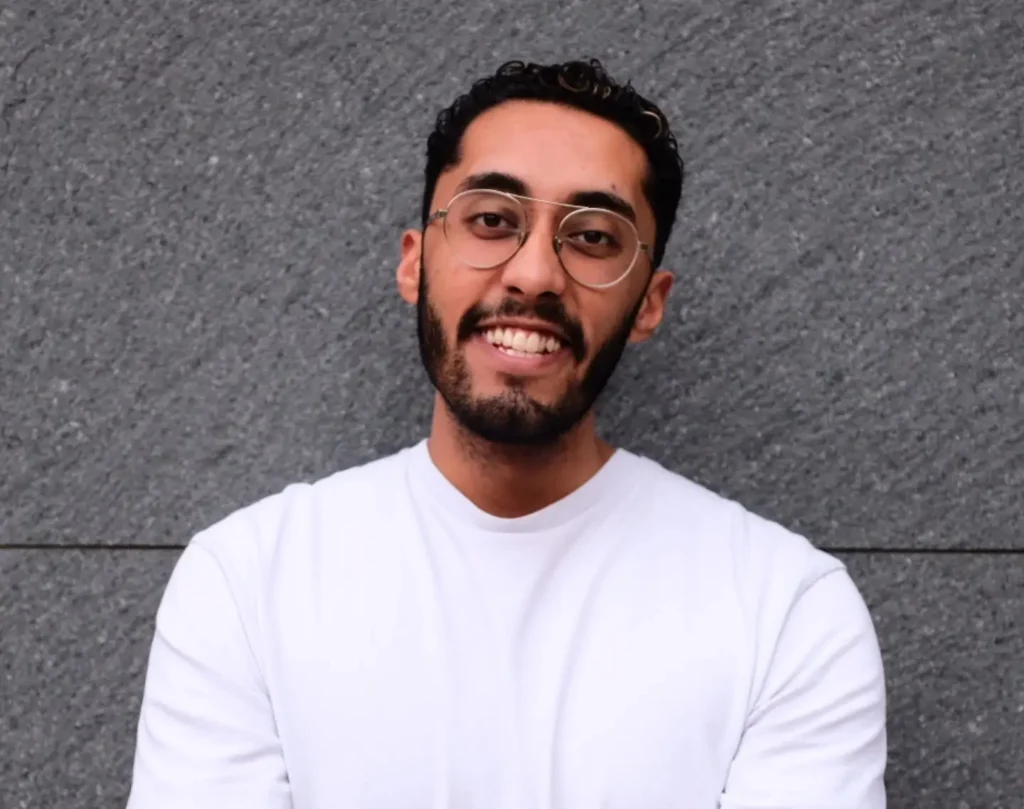
Shoaib Ahmed
Shoaib Ahmed is the founder of a personal branding agency called Yellow Hippo. At just 23 years old, he’s only recently graduated from university and decided to start his own business instead of getting a graduate job. He’s already built up a huge following on LinkedIn and has run the personal brand for several influential people and has a ton of case studies to show how to grow personal brands with the use of powerful storytelling and authenticity.