Listen on Spotify
 Apple Podcasts
 Audible
“A new year, rebrand or reset will fix unresolved business problems.”
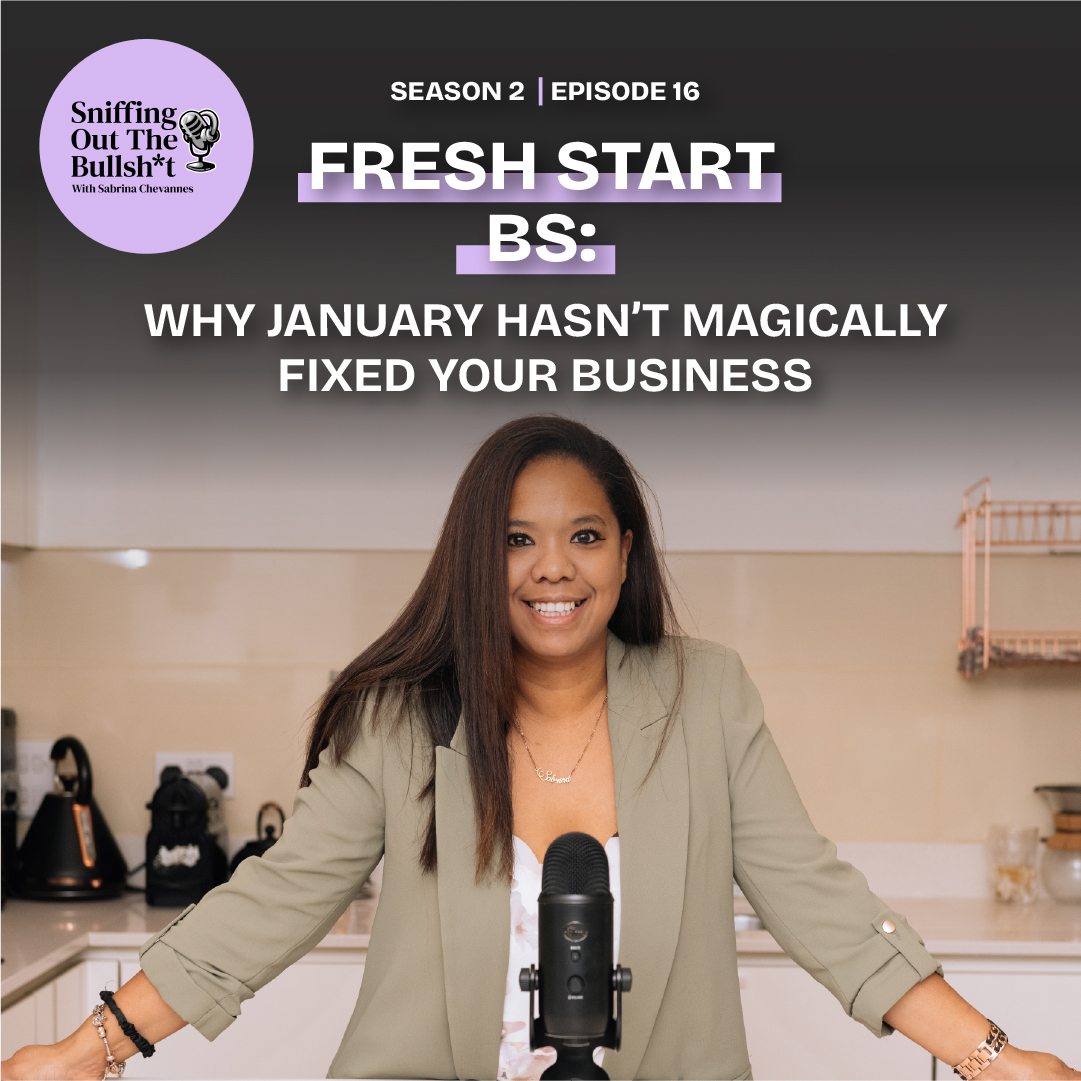
Sniffing Out the Bullsh*t · Season 2 · Episode 16
Why January Hasn’t Magically Fixed Your Business
This episode examines “Why January Hasn’t Magically Fixed Your Business”, showing why a fresh start changes the date, not the underlying business.
Myth vs reality.
A fresh start changes the date, not the underlying business.
A fresh start changes the date, not the underlying business. Unresolved positioning, operational and commercial problems survive a reset.
Episode summary
Diagnose what is actually broken, stabilise the fundamentals and change
January is supposed to be a fresh start. So why are so many founders exhausted, disappointed, or quietly burning out by February? In this episode, I break down why January launches are riskier than we admit – from burnout and seasonal depression to market saturation, creator income data, and why “fresh starts” don’t override biology or economics.
If January hasn’t magically fixed your business, this episode will explain why – and what to do instead.
Key takeaway
Diagnose what is actually broken, stabilise the fundamentals and change the system instead of relying on the emotional reset of a new year or rebrand.
Listen, skim or read every word.
This is the maintainable version: the summary, chapters and transcript all originate from the same approved transcript.
Why January's 'Fresh Start' Often Leads to Exhaustion and Burnout +
So it’s the start of February 2026, which means that January is now over.
So all those big goals, those major plans, the huge launches, they should be done and dusted right now, right?
Because after all, January is all about those launches, the momentum, the fresh start, etcetera, etcetera.
And February is somehow wherever it all quiets down, because apparently you should have had everything figured out in January, so that from February onwards, everything just flows without you.
You don’t have to do anything because, you know, everyone is so optimistic in January.
They’re buzzed from the new year and they expect this new month and new year to magically somehow fix their business.
But let me ask you something.
How are you really feeling right now?
How did your launches go?
How are your goals looking?
Because most people I know are actually exhausted.
They’re already behind on something and they’re asking themselves why isn’t this working?
So don’t worry, it’s not just you.
This is so normal for January, but people just don’t realiZe it now.
This episode looks at all of the fresh start bullshit, the lie that January is somehow the best, the cleanest, the most powerful moment to reset, to launch and demand peak performance from yourself and your business.
Because when you look actually look at the science, the market, and what happens to founders in real life, January is often the worst time to do that.
Hello and welcome to Sniffing Out the Bullshit, a podcast for ambitious entrepreneurs who want help wading their way through the bullshit jungle of entrepreneurship and then the tools, skills, and mindset that actually required for success.
I’m your host, Sabrina Chevannes-Denman, the no bullshit entrepreneur.
So January has this weird pull about it, right?
It feels powerful, it feels symbolic.
It feels clean, like the slate has been wiped.
And psychologically, this makes sense because we humans, we love art and poor landmarks, the New Year’s, birthdays, Mondays, or whatever.
We mentally separate old me from new me, and we convince ourselves that things will be different because the date is different.
Now, I did an episode on the whole new year, new year new me, new year, new me bullshit a couple of weeks ago, right?
And so if you want to check that on out, you should check it out too.
And I spoke about this there, that this calendar change doesn’t just change your business model or your market overnight, and it definitely doesn’t change your biology.
But January does somehow create some kind of emotional momentum, but it also often totally misses the strategic clarity.
And I had to say, emotional momentum is a dangerous thing to build your business on because we all know that January is often seen as the most depressing time of the year.
It’s right after Christmas.
So there’s a come down from all of that high.
We’re all broke, the weather is crap, and we have to kind of go back to work after a pretty juicy amount of time off.
And in fact, we have Blue Monday right in January, which is deemed as the most depressing day of the year, that third Monday in January.
And people just feel really down, Like the NHS sees massive spikes in their mental health service in January and seasonal affective disorder is affecting more people each year.
So I don’t know, doing big launches, putting the most pressure on yourself during a time of the year when everyone appears to be struggling anyway doesn’t really seem like the best option.
But yet somehow this is what we’re all doing.
And let’s not forget, please, that January is peak illness season with flus, colds, respiratory infections.
They all spike between December and February, with January consistently one of the worst months now.
I am literally finishing a course of antibiotics right now for chest infection and you probably can hear if I’m the slightly creaky bit of my voice.
I’ve medicated and downloaded liquids.
I’m hoping it’s not too bad, but you probably can hear it a little bit raspy.
And I know so many other people who are suffering from 1/2.
It’s not a coincidence.
This is just standard January flu season.
And there’s plenty of evidence to show that your immune system is weak in winter, that your vitamin D levels are lower, that sleep quality is worse, and fatigue is generally just higher.
And what does this translate to?
Well, it means your brain is under a lot of strain thanks to the physical symptoms.
And yet somehow this is the month that we tell founders to launch, to create more content, to sell harder, to show up confidently, to make big decisions, and somehow then regulate all their emotions under this pressure.
So January is the month where people expect peak cognitive and emotional performance from bodies that already depleted.
It honestly makes no sense when we think about it.
So if you’re feeling foggy and slower, less sharp, more irritable, maybe even more tired right now, then that’s not a mindset or motivation issue you’ve got.
It’s really just your Physiology at play.
And you know, I want to talk about burnout, right?
Because burnout so often starts in Q1.
And we misunderstand a lot of things about burnout because burnout doesn’t usually happen at the point of pressure.
It shows up after the push that people push through December, they push through the holidays.
They’ll tell themselves they’ll just reset after January.
And then January arrives and instead of recovery, we pile on these huge goals, these public commitments, launches and identity level expectations.
And then when it starts wobbling, well, people don’t stop.
They don’t reassess.
Instead they just internalize it.
And I see all the time among my clients and my community because burnout and founders rarely looks like some sort of dramatic collapse.
It usually looks more like inconsistency and avoidance, procrastination and suffering from quiet shame and perhaps disappearing from things that you were excited about 3 weeks ago.
So January can cause a lot of burnout because it compresses ambition, pressure and visibility.
Or into that same moment, which is a lot.
Why Launching in January is a Risky, Overcrowded Business Strategy +
So I want to talk about the business strategy around this.
Like right now, because January is sold as the time to launch now.
I’ve launched plenty of things myself and helped endless clients go big in January.
It’s almost inevitable, and that’s most of my Christmases I’ve actually spent working because I’ve had got clients who want to have this big start to the new year.
So I don’t really have time to invest over Christmas, which then kind of makes that whole, but I think even more severe.
So yeah, tap, tap me, I know.
But this is what we do as business owners all the time.
And for this reason, January becomes one of the noisiest months of the year in online business because everyone is launching a course, membership, newsletters, then they’re creating these challenges, they’re doing rebrands and they’ve got always got an offer that’s like, this is the year.
And so all this really means is that attention is fragmented from all these different offers and buyers are then overwhelmed.
And this means that decision fatigue is really high.
And more often than not, price sensitivity is higher than people realize because bear in mind, mostly we’re broke in January.
So the reality of it all shows in January does not actually favour newness, it really favours existing trust and existing demand momentum, right?
So if you already have a warm audience and clear positioning, then January could be a great month for you.
But if you don’t, then if you launch, you will never know whether your offer is actually bad.
It may just be that you launched into a crowded and distracted and overstimulated market while demanding peak performance on yourself.
And I want you to think about the consequence of doing this, the consequences of a failed launch.
And I’m doing air quotes on myself when I say failed here because I believe it’s such a harsh word.
Like we put so much pressure on ourselves for this huge success and everything less is somehow deemed a failure.
So then this plays on our confidence and it massively lowers motivation, press, all that time and effort that we put into the launch financial contribution.
It can just be so demoralizing, especially when most of these people didn’t even need to launch anything in the 1st place, right?
Because it’s usually a better, a more sustainable and viable business alternative.
But usually it doesn’t look as flashy and as January vibes as, as, you know, doing a launch.
Because after all, optimization doesn’t exactly look sexy on Instagram, does it?
So I’ve been looking into this a lot this year, right?
Because I’ve also consciously taken time out this Christmas and the year for personal reasons.
Like if you’ve listened to my other episodes, you’ll know why.
So if not, go back to those, especially the one at the end of the year.
So I’ve not really launched anything this year and instead I’ve been focusing on some key clients and helping them with their launches.
And instead, I’ve been consolidating all of my offers and reaching out to people individually and doing kind of one-on-one time, which has been so much more beneficial.
But Joe has been really sad is seeing some of my clients and the pressure that they put on themselves because they’re constantly comparing themselves to what other people are doing, right?
They’re like, and looking at other influencers or people who are technical competitors and they’re seeing that they’re doing launches and they’re doing all these new offers.
And do you know what’s funny?
Some of the people that they’re comparing themselves to, they were like literally obviously tell me the critters are so I can put it to them.
So these guys are actually sliding into my DMS complaining that their launches are not doing well and they actually need my help.
So it’s all a big fund.
And right now the biggest issue is that people are trying to do too much without even refining their positioning or their offer first.
But the problem is this is the boring part, right?
No one can brag about strategy.
So they need fancy launches to look like they’re doing something.
And of course, I mainly work with small business owners, but this doesn’t just affect them.
It’s a global problem.
And like I said, I’ve been looking so much into this because I’ve been questioning whether we’re basically all just doing marketing wrong at the moment.
And you might want to check out last week’s episode on this because I’ve basically delved into this and those.
But are we doing marketing wrong and flipping the funnel and everything?
So please do check out that if you’re interested in what I mean by that.
Unpacking Creator Success and Why Corporates Cut Costs in January +
But like, you know, let me give you a couple of examples of, you know how I think this is a bigger issue now.
I saw some content by a famous content creator, Ali Abdul.
Now, if you don’t know who he is, he’s a doctor turned YouTube and kind of ended up becoming known as like some sort of productivity guru.
He, I guess, got really big during COVID because he was doing all these kind of productivity things and people found it really useful.
And so at the time of recording this, he has a whopping 6.53 million subscribers on YouTube.
So it’s pretty safe to say that he’s pretty popular that I know.
Look at me getting sucked into vanity metrics here.
But you know, I believe that most of his followers are in fact, real.
And I’ve watched him grow gradually over the years.
He’s not this overnight success, although many people might believe so, but he has been doing this for over a decade.
And I’ve also met him in person a few times and he’s always a come across like really intelligent and humble.
So, you know, don’t get me wrong, these the love his creative guys are in the same kind of networks.
They help each other grow on social media.
But do you know what that stuff is immaterial here.
Like I’m not here to talk about his audience at the moment.
I want to talk about like his goal setting and his openness, because I think he’s always been quite open in his videos about processes, commitment, etcetera.
And naturally he does a lot of high quality content and it takes a lot of work to do so.
So you know what I’ve noticed in his a lot of his content, he’s talked about how they’ve been years, like particularly early in the year when like where like too many goals were set at once.
Like, so he had these big plans, lots of parallel priorities and like great intentions because you know, these goals are all set with great intentions, right?
We don’t intend to fail.
But when the execution didn’t then match the ambition, like the, the learning lesson around it wasn’t just try harder.
It was more along the lines of they overestimated capacity and they underestimated the drag and they confused motivation with sustainability, right?
And to me, I thought this was so significant because if someone whose entire brand is productivity can fall into that January over ambition, then this isn’t about being more disciplined at all.
It’s about falling victim to the calendar.
And no, I, I distantly remember when Ali wrote this newsletter called Lessons from a Bout of Burnout.
And so many people sent this to me because they totally resonated with them.
Like he felt completely demotivated to record and he just stopped finding joy in what he was doing, which is really sad to hear.
And I think this hit home with a lot of people because they’re like usually sitting there with a like a measly following and thinking, what’s the point?
Like every time they release a video and they get like 10 people looking at it, they’re thinking, well, is there any point me doing so much content like this and putting so much effort into it?
But then there’s this guy, he’s reaching millions of people every week and somehow he’s still not motivated.
So what, what can you do?
Like, is it just a lost cause?
And they start to feel a bit better than something wasn’t wrong with them?
Because I think it’s personal what motivates you, right?
And plus, when your numbers are that high, you’re then competing with other people to get your numbers even higher and you open up a whole host of issues.
So so you know, for me, Ali, Ali, you like showed me how the king of productivity has still fallen victim to the January mindset.
And if he also lacked the motivation and stuff of a burnout, if he, a doctor, just to add, has made these mistakes, then I think we can all be just a little less harsh on ourselves because, you know, the creator economy in general, I feel like is is.
So I don’t know what the word misunderstood, I guess misrepresented, blown up.
I don’t know.
I’m, I’m definitely going to do a separate episode on this.
But I, I wanted to introduce some of the research I’ve been doing over the last couple of weeks on this here.
Because I think the reason why people are obsessed with launching and doing new things in January is because it looks like everyone around us is doing the same thing and they’re doing really, really well from it, right?
But they want to tell you some numbers because a recent report showed me that there were 14.5 million creators in the UK in 2025, right?
So that’s pretty recent.
And this is predicted to go up to 21.8 million by 2032, which is huge.
But 14.5 is sort of a hell of a lot of people call themselves creators right now.
And bear in mind this won’t even include business owners who create content, but these people are considered creators as their main profession.
But however, when I look at YouTube channels, there are only around 80 K channels with more than 10K subscribers.
That’s a very, very, very tiny proportion of people who were supposedly smashing it, right?
And that’s 10K subscribers.
I don’t know how much money they’re making, but let’s talk money, right?
Because data shows that if you have two to three years of experience, then creators can earn around 33 KA year at two to three years of experience.
That’s crazy.
And like that’s average wage after two to three years of experience.
And Visa did some research themselves and they showed that almost half the UK creators earned around £1600 a month, which is not really sustainable to live on, especially if you’re in London.
So this whole creators are all rich narrative is bullshit.
Most of them are struggling and not earning anywhere near as much money as people think they are, but they’re obviously just very good at storytelling.
If you believe that, they’re all loaded, which probably means they probably should be paid more if than than if they’re that convincing.
But you know, sorry, there’s that chest infection you heard that was a very nasty cough.
Anyway, I wanted to say that also, most of the research shows that globally this is also not the case.
It’s not just the UK.
Only 4% of creators globally earn over 100 KA year.
And I mean, that’s USD by the way, and that’s globally.
So the US market is generally bigger and better paid.
So the reality is creators are nowhere near as wealthy and successful.
I’m using those inventor commas again, as you think they are.
And you know what?
It’s not just creators who are affected by this January blaze in the corporate world, for example, in the tracked tech layoff data, because everyone goes nuts when they hear that Amazon’s like, sacked.
Of the 14,000 people, January has had the highest number of layoffs among almonds in recent years.
For example, 34,137 layoffs in January compared to lower numbers in other months, according to the aggregate tracker data.
And in 24/20/25 alone, the global tech sector eliminated around 244,000 jobs, according to recent tracking.
So while it might feel like layoffs are random, that is a pattern to them and it ties directly into our bigger point about January not being this magical reset.
Because HR experts confirm that January and December are typically the months with the most job cuts because companies want to finish the year’s books and head into the new one with costs aligned strategy.
So let me ask you a question.
If big companies take this time to cut costs and to restructure, then why are founders feeling pressure to launch big offerings in January?
Why are we doing it in the same economic season when these big players are tightening their belts?
Like when we put all this data together, it makes absolutely no sense to be launching new programmes in January.
So I guess the question is, what should you be doing in January instead?
Ditch the 'Fresh Start': Focus on Stabilisation and Honest Systems +
Well, I think January should be more like a stabilization month now.
This is what I’ve been doing this year for myself and for my clients.
And I’m much more confident of the results that I’m going to see for the rest of the year for myself and for them.
Because I truly believe that a better use of January is doing things like tightening your systems, reviewing what already works, following up with past leads, improving your existing offers, strengthening the distribution of them and fixing those bottlenecks.
Not reinventing your business and not demanding transformation and definitely not tying yourself worth to a launch.
And because for me, some of the most under-utilized, yeah, affected forms of marketing are actually seen more in the the follow-ups, the referrals, like the tension of clients is way better than getting the new ones, Your clarity of message and your consistency over novelty.
But the problem is none of these feel like a fresh start, which is supposed to do in January.
And they definitely don’t look sexy on social media either, but all of them do compound and they genuinely bring results.
So hopefully you’re you’re listening to this still when it’s fairly early in the year.
And so I’d love for you to do a couple of things for me.
This key one, I want you to go back and genuinely check your own data.
Tell me, what activities have you been doing that have been getting good results?
Where do most of your leads come from?
How happy are your current clients?
Is there more you can do for them?
And what about your previous referrals or your previous clients?
When was the last time you spoke to them?
So I want you to look through this list of people and answer these questions and reach out to some of the people who are key.
I bet you you will get more results from talking to them than doing any launch or cloud cold outreach.
So if January hasn’t magically fixed your business, then good, because it was never supposed to.
Your business does not need a fresh start, it needs fewer dramatic resets and actually just some more honest systems.
And you know what?
You can build those on any random Tuesday, not just the 1st of January.
We’ve all fallen into the fresh start bullshit trap.
I know I have.
But hopefully this episode has made you realize that actually January is a bit of a crappy month to do new things.
And hopefully you’re now getting over your January Blues and you’re getting enough rest to get rid of any cold or flu if you’ve had them.
And hopefully now you’ve got all your systems in place to help you reach your goals for this year.
And if you haven’t, please give me a shout.
I’m more than happy to help in any way I can.
But please stop looking at those shiny objects and concentrate on what you’ve already got.
I believe it’s probably pretty amazing already.
So that’s it for me.
Until next week, please keep sniffing at the bullshit.