No Bullsh*t Talks · Season 2 · Episode 23
Building a Portfolio Career Without Labels
With Charlie Rogers.
 Watch on YouTube
 Listen on Spotify
 Apple Podcasts
About this conversation
On Branding and Freelance
In this episode of ‘No Bullsh*t Talks,’ host Sabrina interviews Charlie Rogers, the founder of the Undefinable Community and a semi-pro sponsored athlete who has represented Team GB. Charlie shares his philosophy of seeing beyond conventional labels to connect with others as human beings, revealing how this approach has shaped his business and athletic pursuits. They discuss the conceptual framework of the Undefinable Community, its core values, and the process of building a meaningful, multifaceted portfolio career.
Charlie also shares his personal journey from being one of the worst in his running club at age 14 to reaching the top 100 in the Ironman world championships, emphasising the importance of curiosity, goal setting, and embracing the process over the outcome.
Watch
See the full video conversation.
Listen
Take the conversation with you.
 Audible
Watch the moments
that travelled.
Watch, share and continue on the original platform.
Read the full conversation.
The transcript is organised by timestamp so it can be generated from the master transcript, edited once, and published here without designing a new section every week.
Introduction to No Bullsh*t Talks+
So I think the way we see it is we see beyond the labels rather than see them as barriers to connection.
Yeah.
And for us that means we all just show up as human beings, and we can have those conversations around how the labels are meaningful to us.
One of the exercises we actually did at one of the most recent retreats that I led was all about taking stickers out and writing the labels that we ascribe to ourselves. So we don’t ignore them—they are there—but we see beyond them.
And that’s the key, that they are things that we can see as part of ourselves. But I think when you see them as your whole identity, that becomes quite challenging because you’re then limiting your world perspective to that single identity as well.
No Bullsh*t Talks is a podcast for entrepreneurs, by entrepreneurs.
There’s too much bullshit out there, especially when it comes to business. This podcast aims to highlight what’s true and what’s not in the world of entrepreneurship, bringing you honest and raw conversations about the rollercoaster that is entrepreneurship.
Each week, my guest will be a high-performing entrepreneur sharing the ups and downs of their journey and helping you prepare for the road ahead, while providing you with actionable insights and absolute gems of knowledge.
Stay tuned as I introduce this week’s guest.
Meet Charlie Rogers: Founder of the Undefinable Community+
Charlie Rogers is the founder of the Undefinable Community, which provides intimate spaces for those who intentionally live beyond conventional labels.
He spent years dedicated to helping other entrepreneurs build a meaningful portfolio career. Outside of this, he is also a sponsored athlete who has had a top 100 place in Ironman and has represented Team GB.
I present to you this week’s guest, Charlie Rogers.
Well, so welcome Charlie to No Bullsh*t Talks today. I’m so pleased to have you.
Thank you for having me. I really appreciate it.
It’s going to be a good conversation, I feel like, because you work with founders all the time and have so much insight into what everyone’s talking about. So I’d love for you to start first by introducing who you are, what you do, and yeah, why you’re here.
Thank you.
So hi, I’m Charlie, and when people ask me what I do, I say a few things, which often gets a puzzled response.
“What does that mean?”
Beneath that, I work four days a week at a startup called The Portfolio Collective as a Founders Associate. Even that role, I do a few things. It’s finance, it’s legal, it’s project management—a bit of everything. Kind of a generalist within the role.
Outside of that, I’m building a community called the Undefinable Community, about 40 members strong. We do retreats, gatherings, and meetups all around living beyond conventional labels and embracing that bit between who we are, realizing that we’re not just one thing and actually many things in life. It’s really quite beautiful seeing those people come together.
I’m also working on writing a book called *Undefinable Careers*, about how individuals can navigate the careers they’re facing.
Then I also do some consulting on the side, and I’m also now, I guess, a semi-pro sponsored athlete too. Along the way in my own portfolio career, I’ve actually managed to get sponsored by a really cool company as well. So that’s been another income stream for me, which has been pretty wonderful to have too.
I mean, you just casually dropped that in at the end, didn’t you? That’s so cool, which I will 100% come back to. I don’t want to skip past that because that’s arguably the coolest thing you’ve said.
The Concept of Living Beyond Labels+
I definitely want to talk about the community and especially the fact that it’s called *Undefinable*, which I so love for so many reasons.
But it’s also because right now, in this day and age where we’re at, everyone has a label. Everyone loves a label. It’s just like they have to fit into a certain category, otherwise you don’t belong.
And you’re literally doing the other way around.
Yeah.
And I also love it because you’re like, “Oh, I do lots of things. And you know what? I’m creating a community of lots of people who do lots of things, and we’re embracing that lots of things.”
Because I am so sick of people just telling me I do too many things and you’ve got to niche down, is what everyone says.
So *Undefinable* sounds like a place where you’re breaking all the rules, where you are kind of going against all the social media trends and the norms, and you’re doing something different and you’re just kind of building a place where everyone can just be themselves.
And it’s kind of nice, right?
Yeah, yeah, it really is.
And I mean, one of the problems we’ve had recently is, how do we define the undefinable? How do we know who’s in the community and who’s not? Who does it relate to?
I think when we really sort of delved into it, we explored that there’s that aspect of living beyond conventional labels.
And what we mean by that is that instead of just taking on, “Oh, I want to be a consultant. I want to be a founder. I want to be X, Y, Z label,” it’s, “Oh, actually, why do I want to show up in life? What mission is important to me? And what do I want to do on a day-to-day basis?”
It’s thinking beneath them rather than thinking, “How will it look to other people?” It’s, “How does it feel to myself?”
And that kind of maturity is really what invites people into the community, and it leads to some of the most amazing conversations I think I’ve ever had.
Wow.
So what made you come up with this? Where did it come from?
Building a Community and Navigating Careers+
So I guess I’ve always been community building without realizing it.
I’ve had a previous business called House Hack, which was a talent accelerator and consultancy, which I did in my final year of university while we had COVID going on.
I ran that for about 18 months and took that from an idea which was just a hackathon, bringing together some students and some businesses who were challenged by the COVID environment and having them solve problems together.
That then evolved into, like I say, that talent assessment center vibe, where we had this on where people could also get out of it maybe a job at the end too.
And it became a really cool way of building a community around problem solving, around people who were willing to spend their weekends doing extracurricular things.
So there was that kind of ambitious early-careers individual. I was like, okay cool, there’s about 37 or 40 of them who turn up on a regular basis, who are then empowered to lead the sessions and scale the business.
And that became a great base of people that I connected with on that journey.
Then when I moved to London in 2022, I basically brought them all together in different ways.
I would do Sunday Scribblers. We’d go out and write in different cafés on Sundays.
I’d get people together for a little meetup where I’d co-host and we’d each bring three guests and they’d all get on together.
Dinner Doubles, we called it, was really cool, particularly intergenerational. We’d co-partner with someone who was considerably older and then we’d have quite meaningful conversations around very different topics, which was really awesome.
But beneath it all really was this theme of, I just like when people get to know one another and I can be the catalyst for that change.
So I was writing a newsletter at the time called *Mastery Your 20s*, or it was then, and I just realized there’s an audience here who already resonated around this idea of doing many things.
So I hosted our first event back in March last year, so 2023, and got together 35 people around this idea of doing many things.
We had this little venue in East London and just had a really awesome evening together. I put a little bit of thought into it, had a speaker on there, had some cards at the entrance to facilitate the conversations.
But again, it was the right people in the room, and that led to some awesome conversations.
Then I separated it from the newsletter and decided it was a separate thing, rebranded it into the Undefinable Community, and had our first retreat in early July.
That really solidified the ten of us that went there into becoming a really strong foundation for a community.
We intentionally then grew slowly and said to ourselves, rather than growing it too quickly, let’s actually build it slower and get the right people in.
I said to everyone from day one, it’s not going to be an income stream for me. It’s going to be a way for us to reinvest into one another.
So I’ve always thought about it as the social impact project first, and that has, I think, enabled the acceleration in terms of other people getting involved too, which is awesome.
Ah, I love it. I love it so much because it resonates so much with what I’m trying to do.
I’m trying not to use the word community, just because I feel like everyone’s using the word community like it is a buzzword.
And I think that lots of people, when they say community, they’re also thinking numbers.
So I hear so many questions going, “Oh, how many people are in your community?”
And like you proudly saying we’ve got 40, and that’s a very good number, but that’s also small if you look at all these silly online Slacks or WhatsApps and they’ve got thousands, but no one actually knows each other.
Whereas your 40 are all in it together. They’re all helping grow it together.
It’s a lovely, lovely vibe.
And so I really like that, and it’s so nice.
And I think that it came out really naturally as well, that you’re trying to curate this really special environment of people to have really good conversations.
So I think that’s really a totally different aspect of what people are trying to do, which I love.
And you talked about it being undefinable for several reasons, but also largely because, like you said, people do different things.
In your job at the moment, you’re working with people who have these portfolio careers, like you mentioned there.
And to most people, I guess a portfolio career means people who kind of do several different things, right?
And I think another term now is “multi-hyphenate” is what people like to call it, which I would think I fit into that category, someone who does lots of different things.
Yeah.
Like I said, some people see it as a negative because they think I’m doing too many things and I’m spreading myself too thin.
Personally, I love it. I love doing different things and I have different interests.
Tell me more about that because I feel like, again, the term portfolio career has kind of got itself a bit of a reputation from, I guess, people doing NED roles and kind of bouncing about different companies.
But you also said portfolio work, which I guess I want to ask you how to differentiate the two.
Who are the types of people that are kind of doing that, and what is the difference between portfolio work and—
Yeah, good question.
The Portfolio Career and Its Variations+
So, in my main role right now 12,000-plus portfolio professionals, people who earn from more than one source of income. That’s the kind of definition there.
And we see different sort of styles beneath that. Multi-hyphenates are one of the styles that we call out, where people work very different streams that aren’t related. Then there are side hustlers, people who have a main job and then work outside of that as well.
And then we have the focused expert, the one that tends to earn significantly more. We ran a survey at the end of last year. More than 200 people answered it, and we found that those who were focused experts earned a lot more than those who weren’t.
That’s because they either had a specific skill, so they were either a great lawyer who could then have their own law practice, obviously, but then be a speaker and then write about it and earn through different income streams related to their skill.
Or the one that I think is the most fascinating is when they have an industry that they know better than anyone else. So you might be the guy for fintech, and you might then again do the public speaking around it, write a book around it, build a business around it, but you have that purpose that’s higher than yourself. And that then enables you to play in what I call a category of one.
So you differentiate yourself in the market because no one else can be you. We are all unique individuals, and that is part of the belief of being undefinable.
My whole theory of what I’m writing *Undefinable Careers* about is how do you blend those different interests together? How do you go semi-pro in a few interests and then find the golden thread that unites them and then express that back to the world in a way that only you can compete in?
So how do you find your category of one? How do you then earn through the different income streams relating to it?
So it’s quite easy for me to say you’re the guy for fintech. There’s a lot of people in fintech, so you go narrower than that. You go, “Ah, you’re the guy in fintech who knows about how people come together around problems.” Okay, that seems a bit more interesting. Maybe we can word that. Maybe we can call that the fintech catalyst, something like that.
We can give it a brand, and when we give it a brand, it makes it quite exciting because then you can think about how you can spread that message beyond yourself, and it becomes really powerful for leveraging your uniqueness.
And that is the kind of essence of the advice that I want to give to people.
And we see this from different perspectives. There are those who are in their 50s and 60s who have that kind of NED portfolio career, and that’s definitely very true. They’ve often lived the experience and they’ve walked the walk before. Now they get to talk the talk afterwards.
But then there are those in their 20s who are kind of forgoing the nine-to-five as the sort of way of getting experience and instead building their careers very differently.
And there are often people in between too. Those who are first-time mothers who are like, “Oh, I can’t even work full-time anymore. How do I then do 20 hours a week around it?” Companies don’t want to accept that.
So there’s a lot of rare talent involved as well in unlocking their potential, I think, through portfolio careers. Portfolio work is really quite exciting.
They all come to it from different perspectives, different lenses, different needs, different experience levels, but I do believe the principles are quite similar.
How do I build leverage?
How do I build credibility?
How can people trust me to be the expert in my domain that I’m in?
And how can I then communicate to other people?
How can I do some with the business side?
How can I sell things?
How can I then work and collaborate with other people?
If I sell a project bigger than myself, how do I bring people in?
How do I automate some of the work that I do?
How do I now use AI? That’s a really interesting question. I’ve been working with a few people on that too.
And all of that kind of comes together into this whole solopreneur business slash freelancer, slash any sort of term you want to insert there, of working for yourself in a leveraged way.
And I think that’s the really interesting part of those that kind of make portfolio careers work for themselves.
And that’s totally fine. People can just earn via a few different income streams that pay by the hour, and that’s totally fine if that’s what they want to do.
But those that I think really sort of see the exponential rewards from it are those that detach their time from their work. They either sell project fees or they then go and sell assets, like digital assets, that are beyond themselves.
So a lot of my thinking is, how do you build the domain knowledge so you can systemize it into a project and then into a digital asset that is beyond you?
Do you know what you’ve just said? You’ve just summarized basically what all these cowboys online try to sell.
Whether it’s personal branding, digitalizing your products, earning passive income, it sounds like all these people who are trying to do this kind of teaching. They’re selling a course and all this, conveniently, because that’s what they do.
And it sounds like you’re doing all of that, but actually legitimately. You’re actually doing it in the right way with the right intentions.
I just heard you describe all that and I was like, you’re actually talking properly. You’re actually making logical sense. You’re actually doing it from a place that makes sense. You’re actually talking about earning income, like actually building the right thing, the credibility, not just boost your personal brand and go viral.
And it’s like, oh my God, I’m listening to you and I’m like, this is what should actually be being done, not the stuff that’s online.
So there are probably so many people I can think of right now who need what you guys are offering, but they don’t even know you exist because you’re not doing the whole cliché things on social media. Instead, you’re actually trying to curate proper content and do this in the right way.
So, like for example, I have loads of people, myself included, right, who technically would fall under this portfolio career, portfolio work, as you know.
So what should people like myself or other people be doing, and how do you guys help in that sense?
Say if someone like myself came to you and was like, okay, I do all these different things. I’m kind of… because the common thing that I see with people that I’m working with at the moment is that they’re doing a lot.
Yeah, they’re doing too much.
Whether it’s not that they… it’s that, like for example, people tell me I do too much. I don’t think I’m necessarily doing too much, but I’m doing too much of the wrong things. I’m not organizing my time in the right way.
And like you said, some people might have opportunities that they’re missing.
So it’s like, say if you had a typical person that I speak to. It’s an entrepreneur who’s out there every day trying to find the right connections, going to networking events, just desperately trying to meet the right people, trying to land speaking gigs, trying to land coaching here and there. They’re just trying to get all these revenue streams, but they don’t know how to actually do this in a systematic way.
Yeah.
What advice would you give to them, and where do they start, especially if they’ve got so many different aspects of what they do? How do they kind of organize that?
Yeah, I mean, it’s a great question.
I think at the heart of this, you know, the Pareto’s Law 80/20 here, it’s how do you find what are the 20% that make the difference.
One of the books I read recently talks about thinking about the vital few over the trivial many.
How do you really double down on those areas?
And I’d say, because we’re talking about people who want to earn via more than one source of income, it’s no longer an easy answer.
The easy answer is find the one niche and make the title and do the thing. That’s the obvious answer.
But if you still want to sell by multiple income streams, find the consistent string and the thread that links them all together.
So for me, it’s “undefinable.”
Yeah, like that’s the brand term.
Then I can think about that through a community offering, so that’s something that I do anyway.
Then there’s an undefinable coaching offering.
Okay, cool. I can help people who are then wanting to navigate their careers as undefinable.
Okay, quite clear too, still with me.
And then undefinable consulting.
Okay, that’s a bit different. How does that work?
Take it a few ways here.
We can say I help people who are more experienced in their undefinable careers, who have gotten quite far, and they then want to leverage their time more effectively. They want to be able to use AI, work with other people.
Okay, cool. I can help them to do that.
And then we can think about, in the long game, this is what I’d love to do, like sort of five, ten years, have more experience, is to do undefinable workplaces.
Help organizations to engage that talent who want to think differently about their careers.
We’ve sort of lived that model.
My main role right now, I work four days a week. The other people work three, three and a half. We have very variable hours, and it works.
We’re a team of ten full-time equivalent, and then there’s like thirty others that come in for projects.
But that at scale, and that with big corporates, that would be super interesting.
Can I help them see beyond the nine-to-five, beyond the forty hours a week, and not just think, “Oh, let’s do forty hours a week down to thirty-two, four-day work week. We’ve won it.”
No, that’s not quite how it works.
So think about that talent engagement piece.
That’s my long game.
But to get there is through understanding the undefinable and being able to create content and meaningful frameworks for them to navigate what they’re doing.
So even though I’m offering many things here, I have created a brand identity around “undefinable,” and that then becomes the thing that people know me for.
Are you the undefinable guy, rather than you’re the sales guy or you’re the marketing guy?
It’s an easier description for yourself.
And that, I think, is the thing to aim for when you have these very disparate interests and these very disparate income streams.
What’s the thing that brings them together?
Ah, well, I feel like you’ve just validated my whole rebrand, which is really nice, so thank you.
Because I feel like I was doing so many different things and none of them really connected.
Then I brought them all together under NOBS, which sounds ridiculous, obviously.
I talk about no bullshit all the time. Like, that is the underlying thing.
It’s like the podcast, No Bullshit.
The agency is a no-bullshit agency.
Everything, I’m like, they’re like, “This girl’s no bullshit.”
So we became NOBS, right?
And like you said, it automatically filters out people because some people don’t want to be part of that.
And now it’s like, “Oh, she’s the one that runs NOBS.”
Queen of the NOBS.
I’ve got all these…
So it is a brand now.
Whereas I think before I was just someone who ranted on about entrepreneurship online.
I didn’t really have that kind of a definition, so to speak.
And I feel like you’ve just validated that, which is quite interesting.
But I definitely then want to come back to what you just said about, you know, you were saying earlier, how do we define undefinable, which is almost like tattoos.
But what about people who really attach themselves to an identity?
Because you know that is the sort of thing at the moment that people are doing.
Whether they are people who have ADHD and they’re really, really proudly neurodiverse, or those who are non-binary and trying to bring power to those who identify the same, or even when it comes to race and, you know, “I’m a proud black woman and that’s who I am.”
Whatever you identify with, whatever that is, would they feel, being part of the Undefinable, that you’re stripping away a bit of their identity? How do you deal with that sort of thing?
So I think the way we see it is we see beyond the labels rather than see them as barriers to connection.
For us, that means we all just show up as human beings, and we can have those conversations around how the labels are meaningful to us.
One of the exercises we actually did at one of the most recent retreats that I led was all about taking stickers out and writing the labels that we ascribe ourselves to.
So we don’t ignore them. They are there, but we see beyond them.
And that’s the key, is that they are things that we can see as part of ourselves.
But I think when you see them as your whole identity, that becomes quite challenging because you’re then limiting your world perspective to that single identity as well.
One of the key questions we ask those who want to join our community is, when’s the time that you had to give up a previous mission that you had?
That often relates to the identity piece.
Like, “Oh, I thought I was a founder, and then I realized actually I am much better as the second person and I just love helping people.”
That’s one story we’ve heard many times.
I think it’s really interesting when people have let go of a previous self.
I mean, myself, I’ve closed two businesses already.
When you let go of things, you can kind of outgrow them and become bigger than you were before while keeping the themes of what made you successful in the first place.
I often think that is a huge sign of maturity, being able to do that, because you can see it’s not just my perspective right now that matters.
There are other ones that also exist, and they’re also correct too.
We can both say things that are true but have very different perspectives, and that can lead to a much greater conversation.
I think that in the world today, what we need a lot more of is not just tribalism.
“I’m this, you’re that, let’s just clash.”
Instead, no, we’re both human beings.
Let’s find our common ground and let’s talk about things in a way that we can actually understand each other.
Yeah, I totally agree with that.
Because I feel like the labels now are hindering people and actually causing more harm than good in some ways.
I totally agree we need awareness.
I totally agree that we need proud advocates for certain labels, one hundred percent, and people to talk about it.
I definitely agree with that.
But I do also think that if you define yourself too narrowly, it holds you back and restricts you.
Even take, for example, people talk about me as a black woman.
Can I talk about some of the racial issues that I’ve faced and things like that?
Yes.
But I rarely try to position myself as that.
I actually created a newsletter once called *The Black Female Boss*.
I created this because someone told me to.
Someone advised me and said, “This is what you need to do. This is the brand you need to go for.”
And I didn’t like it.
It just didn’t feel like me.
As I started doing this, I started to feel more—I don’t know how to describe it—but I think I became more paranoid about racial issues.
I started thinking, “Oh, that person is judging me because I’m black.”
Actually, it wasn’t even there.
Paranoia was setting in.
I was thinking, “Oh my God, they’re being misogynistic.”
No, it was nothing to do with that.
But because I took on this identity as the Black Female Boss, being that color and being that gender almost hindered me and held me back.
It made me feel like these were negative things.
I was trying to embrace it for other black women, whereas I think you can just be you.
Like you said, don’t ignore the labels, but see past the label.
So yes, I am still a black female boss, but that’s not all of who I am.
I think that’s the same with a lot of other people who are identifying with either a certain condition or a certain demographic, and they’re seeing that as holding them back.
Even the girl-boss era.
People think, “Well, actually I’m not able to get this because I’m a woman.”
That’s not actually true.
But they’re always seeing themselves as slightly inferior because they’re identifying with that.
I think what you’re saying is great.
I would love to know what other tips you can give for people who are going through that phase at the moment.
Because it’s great, and on the other hand, finally being able to fit in somewhere is important as well.
If I was in a place and it was only white men—the opposite of me—I wouldn’t feel comfortable.
Actually being in a room full of black women, suddenly there’s something safe about that and I feel like people understand me.
So I totally get there’s a need for it.
But then it’s like, how far is too far in terms of identifying with that?
You don’t want it to box you in.
You don’t want to become definable in that sense.
So what advice would you give for people who are struggling at the moment with identities and that sort of stuff?
I’d say, look to other aspects of who you are.
Look to your values.
That’s something we’re really strong on with the community.
We have five core values, and they are what we speak through.
All of our events revolve around our values.
How can we engage with them in a meaningful way?
I think the same is true for our lives.
We often resort to identities because we lack the words, the description, or the self-reflection for the other parts of who we are.
So we almost say, “I’ll fit in that box because someone else has defined that box quite nicely, and I kind of resonate with that.”
But if you can create your own boxes by blending your values, your mission, some of your life stories, some of what makes you unique, and some of your unfair advantages—put that all together and think of other ways of describing yourself that aren’t in a title or a label—you’ll find that there’s a whole melting pot of you in there.
Actually, when you put it together in a certain way, you can find that no one else is you.
And that is my hypothesis as a way of you earning in a way that only you can, but also as a way of you living in a way that no one else can too.
It’s just about being true and authentic to yourself.
The Importance of Stillness and Self-Reflection+
And to get there, I think what I often see every day now is the need for a lack of white noise in your life. You need to be able to just sit with stillness and be quiet and just be able to connect to yourself. Go out for a walk, go out for a run, don’t put headphones in, don’t distract yourself from life, but just truly connect to yourself and truly connect to others, and you’ll find that that actually will bring up who you are.
A lot of people are too afraid to do that, and I think that then results in, “Oh, I haven’t had the time.” Well, you make the time for that, and I honestly believe that if you just sit with yourself, you will find some of those answers.
Yeah, I mean that’s so true. I don’t know many people who go out without headphones. They’ve always got headphones in, especially in London.
Exactly.
But actually, we said we don’t have the time, but think about how much time a day you actually have to have those moments. A lot of people are working from home at the moment, but even commuting, for example, people go into London at some point. Even though I live in London, I live in Zone 2, so my commute is not going to be as long, but I still have at least half an hour on the train every day. That’s half an hour there and half an hour back, so that’s an hour.
Then I walk my dog, so there’s another couple of hours and stuff like that. Imagine that’s three hours a day that I’ve got alone with my thoughts. Then there’s obviously going to be other moments, like if you’re having a coffee and you sit down, you just have a moment. Most people switch on the TV or watch a YouTube video or do something. They fill up those gaps.
But actually, if they took those moments—and you don’t have to be meditating or doing that sort of stuff—and I think there’s too much pressure on wellness and mindfulness that becomes a barrier to people because they’re like, “Oh, I’m not into that,” or, “I’m not like that.” People find it even more difficult.
But actually, just sitting there completely in silence with your thoughts and a cup of coffee, even for five minutes, I think is really interesting.
A lot of the time I have my big AirPods Maxes on. I put them on noise-canceling and I don’t have anything going through them most of the time. That’s what I’m doing, and it’s really changed how I feel inside and how I understand my own thoughts and what I’m going through.
Before, I’d always have a podcast on or something and I’m consistently just downloading information into my brain. That’s an overload, and my brain doesn’t actually get to rest. So when you’re on a train, or like I said, three hours of the day, I’m doing that essentially. Sometimes I fill it up with podcasts—but, you know, oh my God, how dare I.
But that’s a lot of time in a day that I’ve got to actually just be alone with my thoughts, and it’s really shocking what goes through your head. Then you start to realize, “Wow, I didn’t realize I actually cared enough about that thing. It’s playing through my mind quite a lot.” You start to realize where your attention lies or the ideas that keep bubbling up in your head.
Again, I don’t think you can be creative unless you give yourself that time to be creative. People say, “I don’t have time to do all this sort of stuff,” but like you said, you’ve got to create time, and I think it’s really different.
Yeah, I think it really is, and you do get a lot out of that stillness. I totally relate to wearing headphones purely for the noise-canceling. When you walk through London sometimes, it’s overwhelming. You go into the countryside for a day and think, “Why don’t I live here again?”
I know. I do it every time.
The thing is, I love London as well. I love the fact that you’ve got the world at your fingertips. Anything you want, any type of food you want, any cuisine—it’s just mad experiences in London.
But I think I need both. That’s why I have to leave London frequently enough that it doesn’t become overwhelming. I think noise-canceling headphones are essential for London.
The other way I do it as well is through my running and through my sport. People always look at me weirdly when I say I don’t wear earphones when I train.
They’re like, “What? Don’t we all?”
And I’m like, “No, I don’t take my phone out. It’s just me and the watch.”
I mean, I have a watch that tracks my sports, so it’s okay. But going out, even just this morning, was like an hour and ten minutes of easy running, just with your thoughts.
If you asked me what I thought about on the run, I have no idea, but it was time alone, and it’s nice.
Sometimes I also go out for three- or four-hour bike rides, and again, no earphones in, just present with it. I did one on Sunday—a 33k run—and halfway through I was like, “Oh, we’re getting there. A little bit further to go. Another six and a half to go.”
But I actually found that you get that peace as well. It was just like, “One foot in front of the other. Keep going towards the end.”
For me, that was like, “Okay, I feel a lot more refreshed.”
I mean, I have a lot on in life right now across the different aspects of my portfolio work and portfolio career…
Charlie's Journey to Becoming a Sponsored Athlete+
But even within that I think that the sport becomes a grounding mechanism for me and it’s my way of coming back to me, even though everything else wants my attention outside of it.
You just casually said, “Oh yeah, I’m a sponsored athlete, Team GB.” It’s not often you get to speak to Team GB, so tell me about this because, like I said, you’re doing all that.
Yeah, I mean, you’re literally the definition of a portfolio career. This is also random because I feel like other people who are doing portfolio careers, it’s all kind of business, but just different areas. Like you said, authoring, speaking, and work—that’s a normal consulting sort of way. Team GB, though? Yeah.
Like you said, still pro technically now, so you’re semi-pro. We’ll take semi-pro, we’ll take pro, we’re verging on that.
Okay, well, I feel like the definition of pro is to be paid for it.
Totally.
Well, okay, time. Talk me through this. Talk me through how this happened, what’s your history, how you got to where you are now, because it’s also fascinating.
Yeah, it’s a good story. I started when I was about 14 doing running. I joined as one of the worst ones there in my running club, and it turned out it’s actually the oldest running club in the world. Didn’t know that at the time, but part of my school.
Through school, we had a Royal Shrewsbury School Hunt, and that actually got commemorated as the oldest running club in the world because they used to go out with horses to chase hounds and game. Then they didn’t have horses one day, so instead decided to run after the game they were chasing, which was the start of the running club, the start of the cross-country club.
“Oh, very cool. I was definitely part of one of the oldest running clubs. I was part of Birchfield Harriers.”
Ah, yes. That’s very cool. I love that. I don’t think they went quite as far as chasing hounds though.
But you were 14, which already is a late start. How did you start so late? What made you decide at 14 suddenly one day, “I’m just going to start running?”
Good question. I think for me, I was into different forms of sport. When I went to secondary school, I tried rowing in that sort of 13 age bracket, and then football and a bit of all sports, but I was never amazing at one.
I knew I was a good enough runner. I’d done some when I was younger. I wouldn’t say I really tried or thought of it as a sport, more just PE. But then at 14, I had an amazing running coach. I think this is often how these stories start. He said to me, “You should come along and get involved in our club.”
I was like, “Yeah, let’s do it.”
I just turned up and kept turning up. It’s the kind of sport where the more you do it, the more rewards you get. He taught me and gave me a lot of direction toward getting involved in races.
I did my first race when I was like 14 or 15, and throughout that time from school till I was 18, I just kept getting better and better. I kept improving and getting faster. I was around people and thought, “Oh, this is getting quite exciting.” The exponential rewards to competency were coming together.
By the time I left at 18, I was vice captain of the club, which was pretty awesome.
Then I chose Loughborough as my university.
That’s one of the toughest sports schools, I feel like. I remember them beating us every time in netball, but they were really good.
At Loughborough, I actually went more for the experience. I took it as my only choice and said to myself that I wanted to learn everything about starting a business. So I did International Business and said to myself that actually the degree was the least important part. Sorry if you’re academic, but that’s what I thought.
I was like, “I’ll get a good grade anyway.” Got a first in the end, so did okay.
But for me, it was the bits around the edges—the sports, the clubs, the experiences—that were going to teach me about the world and how to do something meaningful.
One aspect of that was the sport. So being there again, I went from being pretty good at my home club to being one of the worst ones again, because you’re back in this huge pool of talent. You’re around people who think 100-mile weeks are normal, and you’re like, “Okay, time to upgrade. Time to go bigger.”
I had to integrate myself into that group of people who were thinking differently about their running.
I saw quite a lot of them get injured, quite a lot overtrain. That’s quite common because you’re in this highly competitive environment and people want to push themselves all the time.
You go out for an easy run or a tempo run—which is sufficiently vague that anyone can decide how far and how fast they want to go—and by the end of it they’ve already injured themselves ahead of the race on the weekend.
The really key is not getting too caught up, but using it as inspiration and using the people around you as, “Keep telling me how you think differently about it.”
While I was at uni, I really think my 5K time might be most telling. I went in with about an 18:55 and by the time I left I did 14:49.
“I mean, I don’t know what the world records are or anything like that, but shaving off that much sounds mega.”
Yeah, that was pretty good.
“And just for context, what is like a GB record around that time on the track?”
Like on the track this stuff was on the road, but on track you’re looking at around 12 minutes.
“So you’re not far off.”
Not far off, but that last bit is hard. That last bit is hard.
Being around those people and having an amazing coach really helped me focus during uni.
Then in my first year at university, I collapsed during a running race. I was running about a 12K race and with about 500 meters from the end, I just collapsed.
I was like, “Whoa, what’s going on?”
“Five hundred meters from the end?”
Yeah. I was literally dying on the ground. They put me in the back of an ambulance. My heart rate was at like 180 the entire evening.
I made my way to the ER and they did scans over a two-week period. Everything came back clear, and they said, “Nothing that we can tell is wrong with you, but you might not be able to do sport at a high level.”
I was like, “Okay, I think I want to do sport at a high level.”
So afterwards I started cutting things from my diet. One of the things I cut was caffeine, and I found that really helped—probably unsurprisingly in retrospect.
Cutting caffeine enabled me to compete at a high level without getting pain in my neck, which was where I’d have it.
I always had this question of, “Am I overtraining? Am I not?”
I went to see a cardiologist in 2021 after uni and they said to me, “It’s purely in your head.” whatever that is left, In the sense that, again, the scans were clear, but pretty much psychological. I was putting too much pressure on myself.
That became an interesting narrative of, “Okay, how can I not put too much pressure on myself, but still be competitive? mindset”
After COVID, I did a bit of traveling around different locations in the UK, about four weeks at a time. During that period, I reflected on my goals.
On my ten-year goal list was doing an Ironman, and I thought, “Why not do it in one year? Why am I waiting ten years?”
So I signed up for an Ironman the following year.
I was meant to do it in June 2022. You can tell by the phrase “meant to” that it didn’t quite go to plan.
I moved to London and trained hard. Running was my strongest discipline. Swimming I used to do when I was younger, so I was relatively good—not amazing, but relatively good. Cycling fitness transfers quite well from running, especially on hills.
I’d unknowingly signed up for one of the hilliest Ironmans in the world—over 3,000 meters of elevation on the bike and more than 400 meters on the run.
Everyone kept asking, “Why did you sign up for that one as your first one?”
I said, “It’s the UK one. Why wouldn’t I?”
They said, “Well, it’s the huge one with loads of elevation.”
As race day got closer, I’d done nine months of training. By May, I was feeling fit and healthy. I’d been training on this £300 bike. Bear in mind, in triathlon people have £10,000 bikes. The top end is really expensive.
But this really heavy bike—the one I got at uni—was good enough.
I went out to New York with my triathlon club in May. I had about a month or two until race day and I was feeling fit and healthy.
The first few days were great. They gave me this carbon-frame bike and I was like, “This is so light.” I was flying up the hills and coming down at speed feeling good.
Then we went out for this big day. It was about 140 kilometers on the bike. Feeling good. It was going to be great.
Cycling Adventure in Mallorca+
Loads of scenery.
We were in New York. It was going to be beautiful, and we go up some of the mountain climbs, get some of the fast times on the climbs from our club, and I was feeling good by myself. I was maybe a bit overconfident.
Then we made our way through the mountainside and came out the other end, and then there were these series of switchbacks that are very sharp.
There’s one that does about a 270-degree turn, and after that it goes over a bridge.
A Near-Death Experience+
And I’d taken that at 63 km an hour, so I’m coming flying down towards this bridge and I try to hit the brakes.
The brakes on the European bikes are the other way around, so your front is your back and your back is your front, which is kind of significant in that split second there.
So I’m hitting them and my bike’s shaking, and I sort of slow down and kind of have a choice: either lean into the ground and scrape my entire body, or I go and hit the crash barrier and go over.
Not that there’s much of a choice at that point, but the latter happens. I hit the crash barrier, the bike stays on the road, I go over, and there’s like a 10-foot drop with a river below and I sort of hit the rocks.
So I basically only break my little finger, which is incredible to be honest, and very heavily bruise my back.
But I pretty much pull myself up from the side as this adrenaline’s kicking in. I get to the side of the road and I’m like, “Oh my God, okay, everything now hurts.”
Then I lie down and I can just see all these club mates coming around and throwing these jumpers and jackets onto me, and me looking up in the sky and seeing these birds flying around.
I’m like, “Oh, okay.”
But I still remain positive. I’m like, “Well, you know, that was quite an experience, wasn’t it?” That’s what I remember saying to myself.
41:22 Recovery and Decision Making+
And they call the ambulance and we get out to this top of the mountain in the middle of nowhere. They put me on morphine and take me into a hospital, and the guy says to me, he says, “If you can prove you can walk, then you can go home tonight.”
I was like, “It’s going to hurt, but I’m drugged up. Let’s do it.”
So I prove I can walk, and then they take me home that evening to where I was staying with the club. You know, just to great celebration because everyone’s very curious about what’s happened.
I then have to make a choice about whether I come back and try and do the Ironman that year. Bear in mind, I’ve got my whole arm in a cast. I’m like, “Um, maybe not.”
Or do I defer by a year and take it more seriously and do it the year afterwards?
As I’m contemplating that after coming back to the UK, I sort of realize that actually coming back the year afterwards is the harder choice.
I could cross a line and do it this year in 2022, but actually I wouldn’t do myself justice.
Ironman Journey Begins+
So I decide instead to commit for another year and defer it, and instead do a half Ironman at the end of summer, so in September, and be fit enough to do that race.
The end of summer goes well. I qualify for World Champs. I’m at 70.3 World Champs the following year, my first ever Ironman race.
Then I’m like, “Okay, I’m all in now.”
So I get a pro coach, take it seriously, and train like 15 to 20 hours a week. I do that for basically 12 months up until the following season.
Competing at the Highest Level+
In that season, I also put in an extra race where I managed to qualify for the European Championships in 2024, which is the one where I wear my GB vest.
But in that season, I go and compete and come to Ironman UK, where I’m 33rd overall out of about a thousand. About 45% didn’t finish because of how hard it is, so even finishing it is incredible.
But to be up there, and me on my road bike and these people on their £10,000 TT bikes, I’m just taking a road bike that I’ve got. I mean, it’s a nice road bike, let’s be real here, but just putting the clip-on tri bars on there.
Yeah, I mean, there’s definitely some aero gains to be missed from that, but I was there enjoying it.
I got over the line my body. You can feel the salts in my legs come over. There’s an amazing video my mum took of me coming around the corner. You ring your bell when it’s your first time, and there’s this kid looking at me like, “Ring the bell,” and I just go and absolutely smash it.
I’m just running towards the line with my arms out, and I can just remember my legs starting to cramp. I was like, “Just get me over the line. Don’t break down before the line.”
And we get there.
That Ironman is what? A 3.8k swim, a 180k bike, and then a marathon at the end, so a pretty incredible day out. It was nuts. Pretty awesome.
Then I did the 70.3 World Championships out in Finland at the end of August as well, where I got a 28-minute PB and came top 100 in the world for my age group, which is pretty awesome.
There were like 4,000 people in the race, which was incredible. I’ve never seen that many people racing at one time.
Then basically the following year the year that has been…
London Marathon and Beyond+
Basically, I decided, “Okay, I want to do running this year.”
So I did the London Marathon in April, and that became my focus for the winter months. At that race, I did a 2 hour 40, which was quite good. I was aiming for sub-2 hours 30, I won’t lie, and we’ve got unfinished business, so we’ll see if we can do it again this year.
But throughout that process, I always had in mind that I had the summer opportunity to wear the GB vest. So from the end of June, I took it seriously again and started training, and then basically I competed in Vichy, France, and it was quite a mad race, to be fair.
We had a river swim. River swims are always interesting because you get the current coming at you and then behind you. On the bike, it was the wettest day I’ve ever seen in my life.
I came out thinking, “Okay, I’m feeling good.” The bike’s my strong point. My swim’s okay, my bike’s pretty good, and my running’s really good, so I kind of get better throughout the race. Some people go the other way around — they start out really fast and then get slower.
So I pull out on the bike and get about 3K in. At the first roundabout, which was really slippery, the bike slips from underneath me and I basically have a total wipeout.
So I have to pick myself up from the side of the road. The left handlebar is pretty bent in and the chain’s come off, so I’m there lifting it up and doing mechanical work on the side of the road. After a few minutes, I put myself back on.
I’ve got this pain down my left side, but I was like, “Adrenaline’s in, we’re fine.”
So I take my corners on that bike ride pretty easy. Let’s not take it too badly. Then I come back in and get onto the run. My run’s strong, so I finished that out in a good time and came 15th in the European Championships.
The Mindset of an Endurance Athlete+
So yeah, that was quite a day out and I made the most out of difficult situations, but I think that’s probably been the theme of the last few years really. I always felt that in those moments you sort of got to realize what’s possible and try your best because my pressure on myself was just to enjoy that race.
And I think I did. Hopefully, retrospectively, as much. I probably didn’t enjoy it at the time, but I think I also got out of it what I needed, which was to cap out three years of triathlon while I now go and think about how can I be an endurance athlete.
So even when I’m thinking about undefinable parts, I’m thinking at first I was a runner, then I was a triathlete, and now I’m an endurance athlete. So you almost think bigger. It’s like what category can I play in that’s bigger than before?
And so now I’m eyeing up maybe a 100K ultra race next year.
I’ve got so many questions to ask. That was one hell of a story. I was so gripped. I feel like I was watching a movie or something listening to it.
I hear you say that, and I was like, “Oh my God, are you going to survive?” I’m like, “No, you’re here, you’re alive, so nothing bad happens. You didn’t become paraplegic or anything.”
But that could have been way worse than it was.
And I guess that’s the peril of sport.
Yes.
And also that’s the peril of going to Loughborough. That is the sporting university in the UK, and it’s like, how many people go and then injure themselves and that’s their career over? So it’s scary.
But I want to go back. I guess chronological order makes sense.
You started at 14.
Yeah.
In the grand scheme of things, that’s late. People say that’s early, like you’re only a kid or whatever, but no, that’s really late. And to get to where you are now when you started then is quite some achievement already.
From Worst to Best: A Personal Journey+
Because, like you said, you started as one of the worst in your club, right? So already, as a teenage boy, I feel like you already have a lot of things you’re dealing with as it is. And it’s like coming in and being like, “Oh, actually, I suck. What else?” It can’t be great.
And then going back to uni and thinking, “Okay, I suck again.” It’s hard.
And I think what you said is so real because so many people think they’re amazing at something like they always do. Until they get into a room of other people, they don’t understand who’s in the room. There’s always someone better than you out there. That’s the thing you just need to find them.
And I think that is quite eye-opening when you surround yourself with incredible people. People react differently, right? Some people just go, “Oh God, I can’t do this. What’s the point trying?” But you went from the worst to the best at what you do.
Can you please talk me through how that works? Because the amount of training that goes into it, the actual decisions that you made—I didn’t go to a sports university, but I know Loughborough University well, and it’s intense.
I did a lot of sport growing up as well. I ran for Birchfield, I played netball to a decent level, and I played tennis to a decent level. Decent nowhere near your level, but enough that I played against those universities and got hammered every time. So I know how good they were.
The fraction of work to get people to get there and to get further than that is just off-the-scale levels of work. It takes a lot.
Like you said, you also wanted to learn how to do business. Talk me through what it takes from a mentality perspective as well, because obviously you’re doing something physical, so we’re going to talk about that separately.
But first, to even get to the point where you want to physically train, I think you need a hell of a lot of mental strength.
Talk me through what it’s like being a 14-year-old boy who’s arguably the worst runner in his club, to like what it takes to become a vice captain at the end of school year, and then going to the strongest sporting university in the country and being arguably one of the worst there again, before becoming one of the best. That’s a roller coaster. How did you get through that?
Balancing Sport and Life+
So I’d say in the beginning it’s about having fun, like reframing it.
I take myself back to my 14-year-old self. It’s turning up and just enjoying it and saying, “Oh, I’m just here to have a good time. I’m just here to spend time with some friends, go out on some runs, and actually enjoy the skill that I’m doing.”
That then starts the process. You start doing it for the love of it and you’re like, “Oh, okay, actually along that way, maybe I can get good at this.”
Then something clicks. You go, “Oh, I can actually improve if I do more of it.”
I think a big part for me, like I mentioned before, was having a running coach who believed in me and sort of transferred that belief.
“Oh, he thinks I can race.”
“Oh wow, maybe I can race.”
So then I did that first race. Relative to the grand scheme of things, it probably went okay. I can’t even remember where I finished, but that gave me the confidence of, “Oh, I can race. I’m now a racer.”
You sort of identify with the thing you’re doing, and you start keep turning up.
You start doing, okay, maybe I’m doing two or three runs a week. I’ll do four or five.
Okay, what does four or five get me?
Okay, four or five gets me a few more results.
Okay, I can then see myself getting faster than other people.
There’s that competitive mindset too. It’s a very relative sport. Yes, it’s individual, and yes, you have your own speed, I have my own speed, and we’ll all improve differently.
But also, I can measure my time against yours, let’s be real.
So there’s that mindset too of, “Oh, I can get there faster.”
We had a sort of first eight and second eight, which were the top teams in that club.
That became the goal to begin with.
How can I get into that second eight? Because they’ll go and do the most important races.
Then it became, how can I get into the first eight?
Then, eventually, becoming vice captain.
That motivating factor of wanting to get to the next level was always there in my mindset.
But even along the way, I remember having some of the worst races.
I think when I was vice captain in my final year, at one of the most important races where I made the team, I was one of the two that didn’t actually qualify in terms of where we positioned at the end for the team points.
Yet we won overall.
We won overall by one point.
It was my coach’s last year, and it was his most incredible story. It was amazing.
But I was one of the two that didn’t actually count toward that result.
So when the whole school was celebrating, they got us all up on stage and had us be thankful for that moment and appreciate it.
I was standing there thinking, “I feel like a fake.”
“I feel like a fraud.”
And I think for me that became another motivating factor because I was like, “No. Okay. I need to prove to myself that I can do this.”
And that I am more than that race.
It was such a weird scenario. I was happy for him, happy for what we’d all done, but individually I was thinking, “I could have done so much better.”
So when I went to university afterwards, it was very much, “Okay, into the deep end again.”
And like I said, that first year, having the heart issue became an interesting factor as well.
“Oh, you can’t do it.”
“Yeah, I can. I can do it.”
That mindset that it can be taken away from you at any time, and that you’re always living near to not being able to do something, is what motivated me throughout university was that I don’t get this.
No one get this life. It’s a blessing that we have it. So being able to go and make the most of it, and live like it’s your last day, because genuinely sometimes it might actually be, helped me figure out what goals I’m aspiring towards.
I mean I wasn’t really drinking much in first year. I wasn’t doing many of the normal things people do at university. I was all in on sport, entrepreneurship, and the things that mattered to me because I’d had that near-death experience, but also because I wanted to become more.
I think what took me from being good at club level to being good at regional level and then national level was that I stayed in the game. I stayed the course.
A lot of people who were around my level at the end of school went to university and dropped off. They decided they had other things that were more important. Fair enough, maybe they did.
But now I see some of them coming back to the sport, and I think, “Those five or six years you missed, that’s where you could have been great.”
For me, doing it consistently throughout that time, while still having fun and still pursuing the other interests I had, meant I’d simply been doing it longer. That consistency led to a lot of the results.
So throughout university, the switch was being able to show up consistently and follow my own coach’s program.
Rather than training fully with Loughborough, I actually had my own coach and trained a lot by myself. I raced with them and did some sessions, but I was always thinking, “What’s my plan versus what’s the team’s plan?”
That was valuable.
Then throughout COVID, in my final year at university in 2020, I ran my 14:49. I did that by myself during lockdown.
My training was going so well. I was looking forward to being able to put it on the stage and get out there, and then it got taken away from me again.
I couldn’t race for almost a year because all the races filled up so quickly due to the limited spots because of COVID.
Then that experience with the Ironman—being able to train for it and then getting thrown off a cliff through my own mistake—again reminded me not to take it for granted.
You only get this one life.
For me, that’s about setting these big, scary things that terrify me.
“Can I do an Ironman? I don’t think I can.”
“Okay, maybe it’s possible.”
“Okay, yeah, I can.”
Now, when I think about that I’m like what scares me but the thing is the bar keeps getting higher and so right now when I say 100K ultra race, I’m like, “Can I do that? I don’t know.”
Okay, then it’s worth doing.
Anything that scares me is worth doing.
The more I run towards those things, the more I find that I reach levels of ambition and progress that I don’t think I would have stumbled across otherwise.
But how do you get to that level of embracing fear?
Because I feel like all the things you’ve just said—your near-death experience, the heart scare, the crashes—most people would say, “Well, I’m just going to stay away from that.”
And if you look at the narrative on social media now, it’s that health comes first. Everyone is very focused on protecting their health.
Whereas back in the day, people seemed to do all sorts of crazy things and didn’t really care as much.
Now everyone’s saying health comes first.
And everyone’s really big on that, but people might say to you, and I’m sure have said to you, “Charlie, it’s just running.”
You know, what are you going to do with that? It’s just a sport. It’s just running. Why are you risking your health and your life to do this thing?
Like you said, you’re multi-passionate, or whatever. You’re an undefinable. You’re doing so many different things.
Why does this matter to you so much that you are risking your health and everything for it?
And like you said, you’re going from something that was a smaller thing, and now you’re talking about 100K races. That’s huge.
What is it that’s making you drive to do these things despite all those odds against you?
For one, it’s curiosity, I think.
That’s genuinely it. What’s possible?
If I can start with not being very good and then do that, I think that I can do the next thing, next thing, next thing.
It’s that curiosity of, “Could I do it? Maybe I could. That’d be cool.”
But I think there’s also the ambition with yourself of, “I want to be better than I was before.”
How do you get better? By doing bigger things.
And then there’s the question of, what else would I do?
I’ve sort of become part of that mindset. It’s part of my DNA now, where it’s hard not to live like that.
I think there’s definitely truth in the idea that me taking things on at an intentionally amateur level would be a bit like, okay, that would be hard.
Maybe I’m just wired that way now. I don’t know.
But seeing the opportunity and wanting to do things properly versus wanting to just show up and get it done, I feel like I’m not doing myself justice.
I’d rather do all the inputs I can.
If the output doesn’t come out perfectly, great. That’s fine. That was a race condition, or that was something else that impacted you. That’s fine.
But if I do all the inputs, do all the training days…
I had a streak for like a year, a year and a half.
Again, it’s knowing when it’s too much, too. When you injure yourself by doing too hard, too much.
I think it’s the same thing with life.
My frame back to these people would be: what’s healthier?
Is it healthier not realizing your potential and sort of staying safe?
Or is it healthier going after it, but maybe along the way breaking a few bones and having a few long-term injuries?
I think it’s the latter.
I’d rather die as someone who’s used their body than someone who hasn’t.
But that’s a personal opinion.
I’m sure a lot of people won’t agree with that.
But it is quite remarkable.
Just thinking about all the things that you just said, I guess it’s like you are now, as a person, and you can’t take that away from you.
I guess it’s like you know your body as well, and your body is supposed to be pushed.
I think that’s the same with a lot of people now talking about stress.
They stop working because they feel like, “Oh, I’m going to get stressed. I don’t want to get overwhelmed.”
When stress is a good thing.
Stress, to a certain extent, obviously, is like the same as pressure on your body. It’s a good thing.
It pushes you to go further, and you know what your limits are.
When you were talking earlier about your injuries and they said that it’s all in your head and everything, that made me think.
Because I injured my knee. I had multiple knee surgeries.
I loved sport. Like I said, I played all that sport. It was a big part of my life.
I felt like I had this weird identity dissociation for several years because I couldn’t play.
I ended up on crutches non-stop, on and off, for like 10 years.
Then I had the surgery finally because I finally knew what was wrong.
I had all the reconstruction surgery. It went wrong, and I couldn’t walk for two years.
Wow.
And it was even worse.
I was like, “What is going on?”
Now I’m at this weird point. I finally had another one, and it’s kind of corrected it and everything is okay.
But again, it’s that same sort of thing.
Listening to you pushing yourself, I’m like, “I don’t want to push myself because I start to feel pain.”
I’m like, “Is that a bad thing? Is that because I’ve overworked myself?”
Like you said, it does mess with your head a lot.
I think it really is.
When you ask orthopods or physios and they’re like, “Oh, you’re going to listen to your body,” it’s really hard.
It’s like, am I pushing myself?
I want to push myself because that’s part of the endorphins, right?
You push yourself and, like you said, you’re doing this thing and you’re like, “Can I do this?”
It feels amazing.
But at the same time, you don’t want to overdo it, like some of the people you were talking about.
So it is a really fine line.
Listening to you is quite incredible.
Now I want to delve into the specifics.
I feel like you got from that to where you are now, which is nuts.
You’re still going. You haven’t even finished yet.
I want to break it down a little bit.
You said you had a streak for like a year and a half.
What does a training schedule like that look like?
Because you set yourself a goal, and it’s the same as in business.
People set themselves goals, and I think people set all these random goals and they don’t even know how to set them.
They just pick a goal because someone else has done it or something.
Then it’s like, how do you even get to that goal?
Goal Setting and Achievements+
Goal setting is a bit murky in business. I think people do the wrong things.
But I’d love to understand your training schedule because you can’t just rock up and do an Ironman without serious thought and planning. How did you pick a training schedule, including like diet and everything, and stick to it? Because, you know, the weather sucks in England. It’s not like you can go out on a nice sunny day every day and go for a run. So talk me through that.
Very true.
So I think there’s probably two layers to this. There’s a layer of, like, how do I plan the things which I take to sport, but I think I take to everything, which is I do an end-of-year kind of whole year review. Like, what’s gone well? What hasn’t? What can be improved? What are the major themes? Who have I met that’s changed the course of the year? How can I think about some of the finances, where I’m at with my entire life?
So I do that on a yearly basis. That’s probably quite common advice that anyone would see. But then on a quarterly basis—or I say quarterly, but it’s basically around key projects—so it might be quarterly, it might be monthly. It depends when I have the milestones, and the milestones are often sport-related because they’re quite easy to say that’s the endpoint, while other things are harder to give milestones to.
So I might have… I’m currently just finished my last phase, which was up to the end of September, and that was sort of doing the Team GB age group, going out there to Vichy, and that was kind of the milestone at the end of it.
And I basically then planned what were my intentions. So I say, “Oh, I intend to compete as well as I can at the race in Vichy.” Okay, great. What are the goals beneath it? How do my goals attribute to the intention?
Okay, so I will have a 12-week training program that’s relating to the triathlon specifically for that time, but I also do eight weeks afterwards on the marathon training, which I’m currently in now. I’ll blend them together, and I’ll do it my own way. I’ll go into details on specifically that in a moment.
But I can then attach these sub-goals to the intention, and then when it gets to race day, or the milestone, or whatever it is—if it’s moving the community further along, or if it’s my own main role or career, whatever—the intention is then, when I get to the next review, the next quarter, I can sit back and be like, “Okay, I’ve moved the needle.”
And maybe I’ve achieved that goal—easy, tick. Or the fun one: I haven’t achieved that goal, but I’ve actually got closer to the intention. That’s still pretty good progress.
So I think we often hold ourselves in a yes-or-no category with our goals. We go, yes, we’ve achieved it, or no, we haven’t. When actually, if through having the goal we’ve moved closer to the intention, it still worked.
And so that is my way of not being too hard on myself when my goal might be an outcome one. It’s often inputs, but if it’s an outcome one, like achieving a certain time in a race, which is a pretty clear one that I do, then if I get there and I haven’t achieved the time, but all the training has gone well beforehand and I’ve done it to the letter, and I’ve turned up, showed up on those bad days, and I’ve really done my best, I can’t do much more.
And so it’s reviewing the situation, understanding what the factors were. Maybe it was nutrition. Maybe it was not stretching—or me stretching is a different issue—but not doing certain things. Then I can review that and improve, but I can’t seriously say to myself I haven’t given my best because I’ve controlled the inputs to the nearest factor I can.
So I do that on a quarterly basis, and then on a weekly basis I also review each week too. And I have this journal. I just finished four years of doing it every week.
I think I saw that in LinkedIn. I was really impressed.
Yeah, I was really cool. So that was four years of doing it since 2020, and then I just started my new one as well.
And so they become a way of me monitoring the week-by-week basis of, like, what tweaks am I making? Am I on track with my long-term goals? Am I making a difference?
And then the quarterly becomes, like, what are the major projects? And then the yearly becomes, like, what are my big themes? What do I want to go after this year?
I think what I was hearing there is something that I really, really believe in, and it’s that being really process-oriented and not results-oriented.
Because I think, like you said, one of the biggest reasons why people fail at goals is because they are setting these big… what was it? The BHAG? What was that guy who created that? Big Hairy Audacious Goal thing that everyone did.
And it was just like, yes, it’s aspirational. Yes, it’s something that motivates you to achieve this really cool thing. But then if you don’t achieve it, then you see yourself as a failure. You’re like, “Oh my God, I suck. I’m not good. I’m a failure. I’m not going to do it again.”
But actually, like you said, if you’re making progress towards that goal and you’re still better than you were before, that should be something to be celebrated.
And like I said, I think if you’re doing everything right… and also, conversely, you could achieve that goal and you could have done everything wrong. You could have set yourself really bad habits and just got lucky along the way. And suddenly you think, “Okay, this is great.”
And I think this is how unscrupulous business practices happen as well, because they cheat just to get to their goals because they want to achieve these targets.
But they’ve done it in a dodgy way.
I’ll get you loads of engagement, but I’ll use bots to get you…
Exactly, exactly that.
And it’s like people just lie, cheat, and worse to hit sales targets or whatever, and get customers that are never, ever going to stay with them.
So I think this goal setting is really, really bad if you’re just purely results-oriented, whereas that’s why I think it’s all about the process.
So I love that that’s what you’re saying, you’re focusing on those bits.
How would this then relate to, say, what you are building with Undefinable, for example? Because I feel like they seem like they’re completely different. Like you said, it’s all about having that common thread, and they still do.
Because all those things we’ve talked about today they relate to entrepreneurship. All the mindset things, all the things that you have to do to overcome adversity and finding yourself in the worst possible position but actually being able to achieve things. There are a lot of parallels here.
So how are you relating even the goal-setting thing? I think it’s fascinating. How are you relating your career—from a 14-year-old boy who was at the bottom of his class to being Team GB now, like you said, a sponsored athlete—how are you relating that to Undefinable?
So I think for me, I was actually going to write a book in 2020. I wrote 30,000 words of it called *How to Start*.
And my theory with that was: for me to create something meaningful in the world, I first must master myself.
And I think that’s still very true with anything that I create in terms of entrepreneurship-wise. I can show up as a more effective version of myself when I am doing the bits for myself outside of it.
So when I’ve done this morning a seven-mile run and I feel good, I can be better and more present with this.
And I think that’s very true about all the different parts of my professional life too. I can show up as a more true, valuable, authentic person when I have my own personal life sorted, and I feel in control of it, and I feel like I am making progress in that too.
And so the two things are not separate. They are interdependent. They overlap.
And for me, by living as an Undefinable, by having the super interests, I always stand for that as a person.
And the amount of conversation I actually had a conversation last week. He was also Team GB as well. The conversation came from a LinkedIn post, and that then led to us speaking about, “Oh, can we partner on something related to Undefinable too? Can we partner because we both have many interests as well?”
And you often find that people who are wanting to do sport to a semi-pro level are often really interested in other aspects as well.
Like, how can I get really good at something else?
And so that mindset of getting good at something can be applicable to other aspects of life too.
The Undefinable Community+
I just want to ask, who should be an Undefinable?
Who should be Undefinable?
I feel like quite a lot of us can relate to it, and quite a lot of us are, in some ways, undefinable. In some ways, perhaps more definable, and that’s okay too.
I think who should… I mean, I always hate the word “should” because no one—
Terrible word, to be honest.
Actually, yeah.
But I guess in this, who is an Undefinable, and who perhaps wants to be Undefinable?
Anyone that lives by the five values. Let me hopefully get these right. Collective responsibility—it’s a CARS model, that’s how I remember it in my head.
Collective responsibility, purposeful action, respectful curiosity, seriously silly, and emotional bravery.
They are the key values that we have, and they are what unites the Undefinables.
So you might do a completely different thing from me, but we are all emotionally brave, so we’re going to have meaningful conversations.
We’re all taking purposeful action. I think we even just had an accountability club set up recently, so there’s even that tangibly being done, which is really cool.
We’re all respectfully curious. They’re going to ask some great questions and listen to the answers.
And then we’re also all collectively responsible, so we’re all leaving people, places, and projects in a better place than we found them.
And then we’re all seriously silly, so we have a laugh along the way. It’s kind of fun out here too. It’s not just about being super serious; it’s also about being able to joke about life too.
I think they are the values that we see as an Undefinable.
And I think we can all aspire to have them. Actually, I’ve seen quite a lot of the community members who come in with three or four values, and then they almost start to embed the fifth value in themselves, and they feel like they become a better person from it.
I think that’s a beautiful thing too, that we almost raise people to a higher level of themselves through the values that we embody.
And I think that’s true of who we are and who an Undefinable could be too. How do we become better versions of ourselves, and how do we also stay authentic to our true selves versus the labels other people give us?
Yeah, I think I like that.
I think people are using the word “authentic” too much these days, and it’s getting a bit silly.
But I think if you’re really, really… I think a lot of people also don’t know who they are. I think that’s a key thing.
And I think people, like you said, think they belong in a certain box, but actually they don’t really know who they are.
I think it’s okay to kind of go on that journey.
I found that a lot of people say, “I’m this” or “I’m that,” but actually if they just kind of let go of all that, who really are they?
And you said you do some exercise to do that. What was the exercise that you said you did when people join?
Yeah, so we have our joining process. It’s quite interesting, and it maybe reflects a private members’ club and the way they’ve approached it.
But we have a recommendation model. So current members must recommend someone, and then they get seconded by someone else.
So you’re going to meet someone else, and they tell you a bit about what the Undefinable community is, but also get to know you a bit more and ask you a few questions.
In those questions—we kind of… I don’t even know them by heart because other people do the seconding, not me—and they iterate these.
But there are some in there about:
“When’s the time you let go of a previous self?”
Or:
“When’s a goal that you used to have that you no longer aspire to have?”
I think that’s really interesting.
How can you become more than your previous self?
How can you let go of the identity that restrains you?
It’s almost like wearing your masks.
Sometimes it’s okay to have an identity and a label and to be in that room.
So sometimes me turning up as a triathlete—fine.
Me turning up as a runner—fine.
Me turning up as someone who is really interested in the future of work—cool.
Turning up as a future careers expert—great.
I can do a lot of different roles, a lot of different masks.
But actually, I’m more than any of them.
When we think about, particularly relating back to sport, people who have that gold medal syndrome—they get the success they’ve always wanted, and then they realize, “Oh, it’s not actually quite what I thought it was going to be.”
Then they get into that depression that follows because they think, “Oh, I’ve achieved everything I wanted to be, and it’s not actually as crazy as it sounds.”
You often find that the silver medalist and the bronze medalist are happier.
The bronze medalist is the happiest because the bronze medalist is just happy to be on the podium.
The silver medalist wants to be the gold medalist.
The gold medalist realizes that it’s no longer that important.
But the bronze medalist is just happy they’re on the podium.
So that is an interesting mindset to apply to the rest of this—just remembering that even when you achieve what you want, it might not even be what you want anymore.
Oh my God, that is so true actually.
And that is the same with lots of things in life.
I’ve had a few people on the podcast who have sold their company, and they’re like, “Oh, that was the worst thing.”
They’re just like, “I’m so depressed.”
It’s really bad.
Yeah, I think that’s exactly right. That’s crazy.
But one last question, because I feel like you said the future, and you said to me earlier, “I’ve got a 10-year goal. I’m going to do an Ironman.”
But then you’re like, “Actually, I want to do that in one.”
So I want to know now, what is your future?
Because you had a 10-year aspirational goal, which you did in one.
What are your future goals now?
What are you hoping to achieve in the next maybe one to ten years?
Future Aspirations+
So for me, really going and building this Undefinable brand is at the heart of this. I think there’s something there which, like you say, relates to yourself, but I think relates to a lot of people.
The community is one expression of that. Seeing it come together, seeing these people share that intimate space together, that’s really what the community is about — intimate space. So physical spaces, virtual spaces, holding space.
But how can we, or how can I, give that impact beyond just the community? So writing the book is one means of doing that. Undefinable Careers — I’ve seen a lot of people asking: how do I navigate this world? How do I think about how I show up? How do I professionalize what I do? How do I scale it? How do I earn a decent amount so I can actually make meaningful impact and not think about money? That’s the kind of big question, isn’t it?
And that is something that I truly believe I can help with as well. So building the brand around that is important, as is thinking about the top end. How do I help those in their 50s and 60s work with those in their 20s and 30s? There’s a huge opportunity there, and I’m not quite sure how it’s going to articulate itself, but there’s something in the expertise of those who have done it, lived it, and been through many different rounds of places, and the newness and freshness and closeness to technology, and particularly AI now, where they can help one another massively.
Together, they can be unbeatable. They basically play to each other’s blind spots. So I want to look into that at some point.
And I also say that the future of work — I want to help people live meaningful work because through that, they can do a lot more with the rest of their life. If they spend 40 hours a week minimum, let’s be real, doing work, then how can we make that actually meaningful? And meaningful doesn’t mean fun. It doesn’t mean necessarily enjoyable. It means it actually has a purpose and direction and it’s going somewhere.
And I think that is at the heart of this — giving people direction, clarity, and a feeling that what they’re doing is actually meaningful. Then the rest of life will follow.
My God, it’s been so good. I feel like today’s been a really refreshing episode because everyone’s talking about labels and high aspirational goals and stuff like that, and actually being like, you know what, just be free to be you and actually enjoy the process, enjoy everything, and the success will come.
So thank you so much today.
Nice. I really appreciate it.
Thank you.
[Music]
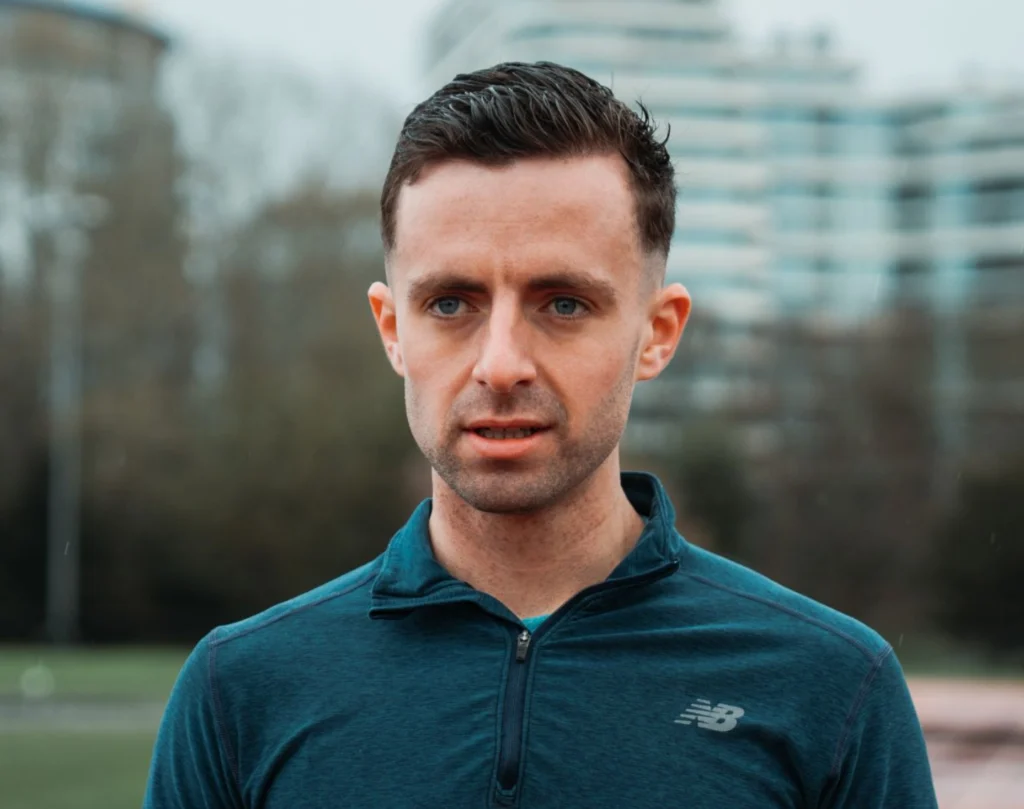
Meet the guest
Charlie Rogers
Charlie Rogers is the Founder of the Undefinable Community, which provides intimate spaces for those who intentionally live beyond conventional labels. He’s also the Founders’ Associate for the Portfolio Collective, helping other entrepreneurs build out a meaningful portfolio career. Outside of this, he is also a Team GB athlete and has competed in marathons and Iron Man competitions. Charlie’s Socials